Nadal Laura, Garcia Neus, Hurtado Erica, Simó Anna, Tomàs Marta, Lanuza Maria A, Santafé Manel, Tomàs Josep
Unitat d'Histologia i Neurobiologia (UHN): Facultat de Medicina i Ciències de la Salut, Universitat Rovira i Virgili, Carrer St Llorenç num 21, 43201, Reus, Spain.
Mol Brain. 2016 Jun 23;9(1):67. doi: 10.1186/s13041-016-0248-9.
The development of the nervous system involves an initially exuberant production of neurons that make an excessive number of synaptic contacts. The initial overproduction of synapses promotes connectivity. Hebbian competition between axons with different activities (the least active are punished) leads to the loss of roughly half of the overproduced elements and this refines connectivity and increases specificity. The neuromuscular junction is innervated by a single axon at the end of the synapse elimination process and, because of its relative simplicity, has long been used as a model for studying the general principles of synapse development. The involvement of the presynaptic muscarinic ACh autoreceptors may allow for the direct competitive interaction between nerve endings through differential activity-dependent acetylcholine release in the synaptic cleft. Then, the most active ending may directly punish the less active ones. Our previous results indicate the existence in the weakest axons on the polyinnervated neonatal NMJ of an ACh release inhibition mechanism based on mAChR coupled to protein kinase C and voltage-dependent calcium channels. We suggest that this mechanism plays a role in the elimination of redundant neonatal synapses.
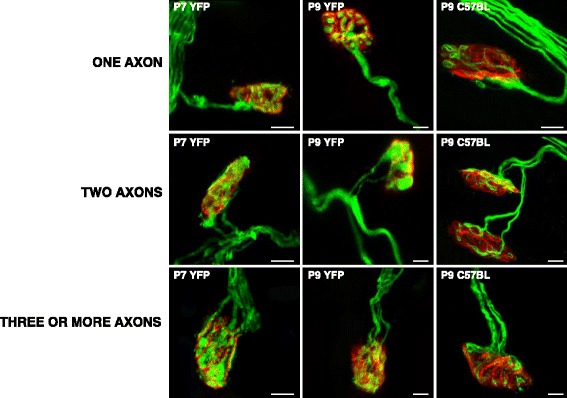
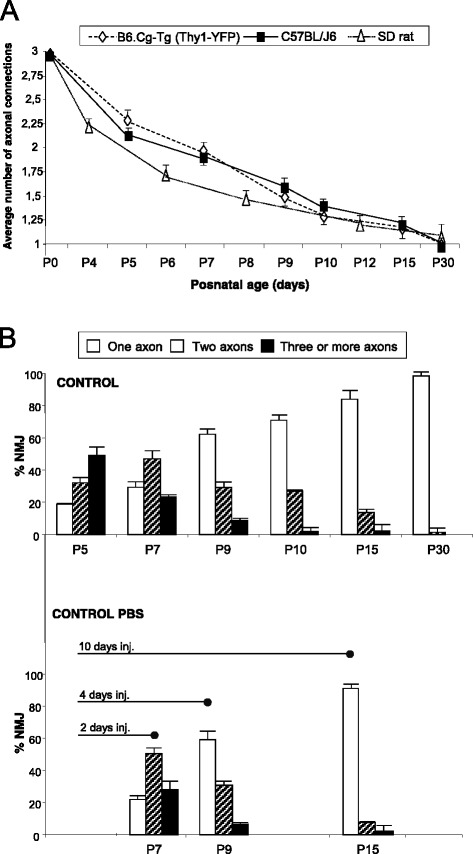
Here we used confocal microscopy and quantitative morphological analysis to count the number of brightly fluorescent axons per endplate in P7, P9 and P15 transgenic B6.Cg-Tg (Thy1-YFP)16 Jrs/J mice. We investigate the involvement of individual mAChR M1-, M2- and M4-subtypes in the control of axonal elimination after the Levator auris longus muscle had been exposed to agonist and antagonist in vivo. We also analysed the role of adenosine receptor subtypes (A1 and A2A) and the tropomyosin-related kinase B receptor. The data show that postnatal axonal elimination is a regulated multireceptor mechanism that guaranteed the monoinnervation of the neuromuscular synapses.
The three receptor sets considered (mAChR, AR and TrkB receptors) intervene in modulating the conditions of the competition between nerve endings, possibly helping to determine the winner or the lossers but, thereafter, the final elimination would occur with some autonomy and independently of postsynaptic maturation.
神经系统的发育涉及神经元最初的旺盛生成,这些神经元会形成过多的突触联系。突触最初的过度生成促进了神经连接。具有不同活动水平的轴突之间的赫布竞争(活动最少的轴突会受到惩罚)导致大约一半过度生成的突触元件丢失,这优化了神经连接并提高了特异性。在突触消除过程结束时,神经肌肉接头由单个轴突支配,并且由于其相对简单性,长期以来一直被用作研究突触发育一般原则的模型。突触前毒蕈碱型乙酰胆碱自身受体的参与可能允许神经末梢之间通过突触间隙中依赖活动差异的乙酰胆碱释放进行直接竞争相互作用。然后,最活跃的末梢可能直接惩罚不太活跃的末梢。我们之前的结果表明,在多神经支配的新生小鼠神经肌肉接头中最薄弱的轴突上存在一种基于与蛋白激酶C和电压依赖性钙通道偶联的毒蕈碱型乙酰胆碱受体的乙酰胆碱释放抑制机制。我们认为这种机制在消除多余的新生突触中起作用。
在这里,我们使用共聚焦显微镜和定量形态分析来计数P7、P9和P15转基因B6.Cg-Tg (Thy1-YFP)16 Jrs/J小鼠每个终板上明亮荧光轴突的数量。我们研究了在体内将镫骨长肌暴露于激动剂和拮抗剂后,单个毒蕈碱型乙酰胆碱受体M1、M2和M4亚型在轴突消除控制中的作用。我们还分析了腺苷受体亚型(A1和A2A)和原肌球蛋白相关激酶B受体的作用。数据表明,出生后轴突消除是一种受调控的多受体机制,可确保神经肌肉突触的单神经支配。
所考虑的三组受体(毒蕈碱型乙酰胆碱受体、腺苷受体和原肌球蛋白相关激酶B受体)参与调节神经末梢之间的竞争条件,可能有助于确定胜者或败者,但此后,最终的消除将在一定程度上自主发生,且独立于突触后成熟过程。