Piroth Marc D, Galldiks Norbert, Pinkawa Michael, Holy Richard, Stoffels Gabriele, Ermert Johannes, Mottaghy Felix M, Shah N Jon, Langen Karl-Josef, Eble Michael J
Department of Radiation Oncology, University Hospital RWTH Aachen, Aachen, Germany.
Jülich-Aachen Research Alliance (JARA) - Section JARA-Brain, Research Center Jülich, Jülich, Germany.
Radiat Oncol. 2016 Jun 24;11:87. doi: 10.1186/s13014-016-0665-z.
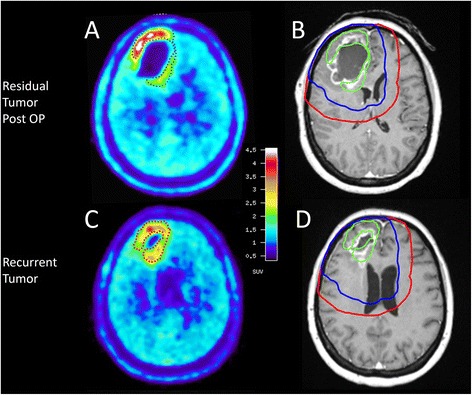
O-(2-18 F-fluoroethyl)-L-tyrosine-(FET)-PET may be helpful to improve the definition of radiation target volumes in glioblastomas compared with MRI. We analyzed the relapse patterns in FET-PET after a FET- and MRI-based integrated-boost intensity-modulated radiotherapy (IMRT) of glioblastomas to perform an optimized target volume definition.
A relapse pattern analysis was performed in 13 glioblastoma patients treated with radiochemotherapy within a prospective phase-II-study between 2008 and 2009. Radiotherapy was performed as an integrated-boost intensity-modulated radiotherapy (IB-IMRT). The prescribed dose was 72 Gy for the boost target volume, based on baseline FET-PET (FET-1) and 60 Gy for the MRI-based (MRI-1) standard target volume. The single doses were 2.4 and 2.0 Gy, respectively. Location and volume of recurrent tumors in FET-2 and MRI-2 were analyzed related to initial tumor, detected in baseline FET-1. Variable target volumes were created theoretically based on FET-1 to optimally cover recurrent tumor.
The tumor volume overlap in FET and MRI was poor both at baseline (median 12 %; range 0-32) and at time of recurrence (13 %; 0-100). Recurrent tumor volume in FET-2 was localized to 39 % (12-91) in the initial tumor volume (FET-1). Over the time a shrinking (mean 12 (5-26) ml) and shifting (mean 6 (1-10 mm) of the resection cavity was seen. A simulated target volume based on active tumor in FET-1 with an additional safety margin of 7 mm around the FET-1 volume covered recurrent FET tumor volume (FET-2) significantly better than a corresponding target volume based on contrast enhancement in MRI-1 with a same safety margin of 7 mm (100 % (54-100) versus 85 % (0-100); p < 0.01). A simulated planning target volume (PTV), based on FET-1 and additional 7 mm margin plus 5 mm margin for setup-uncertainties was significantly smaller than the conventional, MR-based PTV applied in this study (median 160 (112-297) ml versus 231 (117-386) ml, p < 0.001).
In this small study recurrent tumor volume in FET-PET (FET-2) overlapped only to one third with the boost target volume, based on FET-1. The shrinking and shifting of the resection cavity may have an influence considering the limited overlap of initial and relapse tumor volume. A simulated target volume, based on FET-1 with 7 mm margin covered 100 % of relapse volume in median and led to a significantly reduced PTV, compared to MRI-based PTVs. This approach may achieve similar therapeutic efficacy but lower side effects offering a broader window to intensify concomitant systemic treatment focusing distant failures.
与磁共振成像(MRI)相比,O-(2-¹⁸F-氟乙基)-L-酪氨酸(FET)-正电子发射断层扫描(PET)可能有助于提高胶质母细胞瘤放疗靶区的界定清晰度。我们分析了胶质母细胞瘤患者在基于FET和MRI的综合加量调强放疗(IMRT)后FET-PET的复发模式,以进行优化的靶区定义。
在2008年至2009年的一项前瞻性II期研究中,对13例接受放化疗的胶质母细胞瘤患者进行了复发模式分析。放疗采用综合加量调强放疗(IB-IMRT)。基于基线FET-PET(FET-1),加量靶区的处方剂量为72 Gy,基于MRI(MRI-1)的标准靶区剂量为60 Gy。单次剂量分别为2.4 Gy和2.0 Gy。分析了在FET-2和MRI-2中复发肿瘤的位置和体积与在基线FET-1中检测到的初始肿瘤的关系。基于FET-1理论上创建可变靶区,以最佳覆盖复发肿瘤。
FET和MRI在基线时(中位数12%;范围0-32)和复发时(13%;0-100)的肿瘤体积重叠均较差。FET-2中的复发肿瘤体积位于初始肿瘤体积(FET-1)的39%(12-91)。随着时间推移,可见切除腔缩小(平均12(5-26)ml)和移位(平均6(1-10)mm)。基于FET-1中活性肿瘤并在FET-1体积周围有7 mm额外安全边缘的模拟靶区比基于MRI-1中对比增强且有相同7 mm安全边缘的相应靶区能更好地覆盖复发FET肿瘤体积(FET-2)(100%(54-100)对85%(0-100);p<0.01)。基于FET-1以及额外7 mm边缘加5 mm摆位不确定性边缘的模拟计划靶区(PTV)明显小于本研究中应用的传统基于MR的PTV(中位数160(112-297)ml对231(117-386)ml,p<0.001)。
在这项小型研究中,基于FET-1,FET-PET(FET-2)中的复发肿瘤体积仅与加量靶区重叠三分之一。考虑到初始和复发肿瘤体积的有限重叠,切除腔的缩小和移位可能有影响。与基于MRI的PTV相比,基于FET-1且有7 mm边缘的模拟靶区在中位数上覆盖了100%的复发体积,并导致PTV显著减小。这种方法可能实现相似的治疗效果,但副作用更低,为强化针对远处失败的同步全身治疗提供了更广阔的空间。