Simon Luke, Zini Armand, Dyachenko Alina, Ciampi Antonio, Carrell Douglas T
Department of Surgery (Urology), University of Utah School of Medicine, Salt Lake City, UT, USA.
Division of Urology, Department of Surgery, St. Mary's Hospital Center, St. Mary's Hospital, 3830 Lacombe Avenue, Montreal, Quebec H3T 1M5, Canada.
Asian J Androl. 2017 Jan-Feb;19(1):80-90. doi: 10.4103/1008-682X.182822.
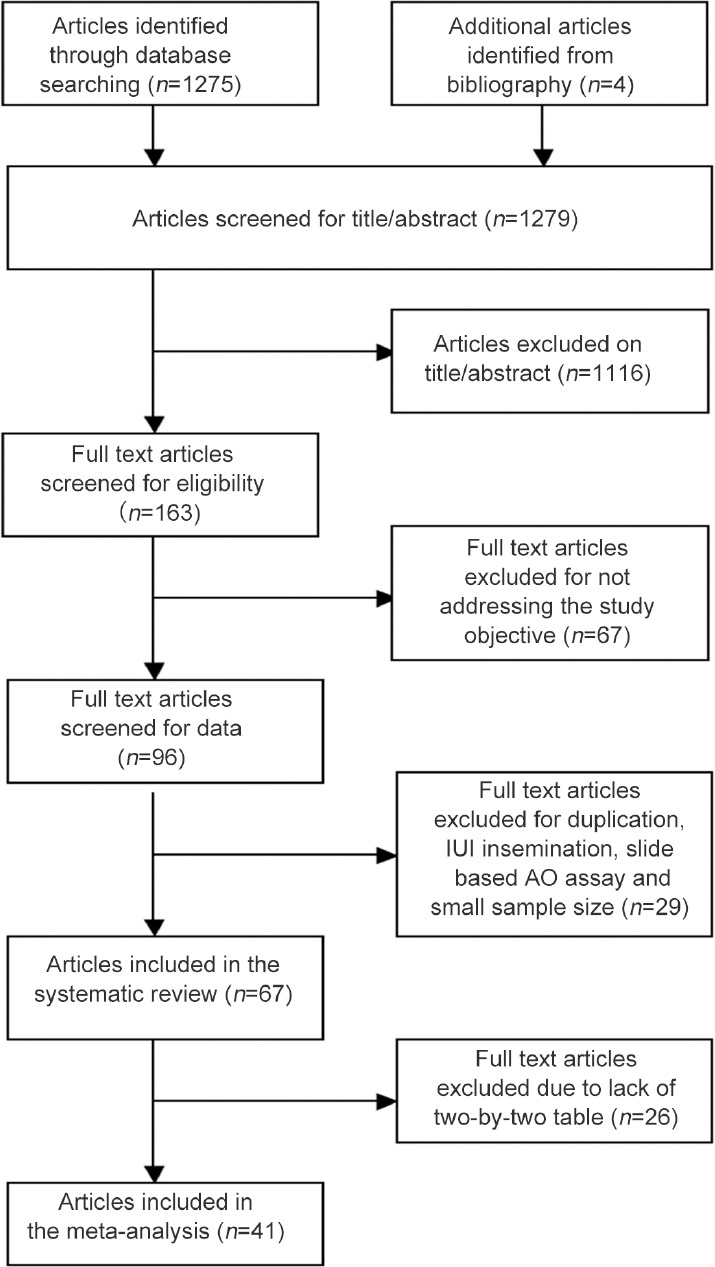
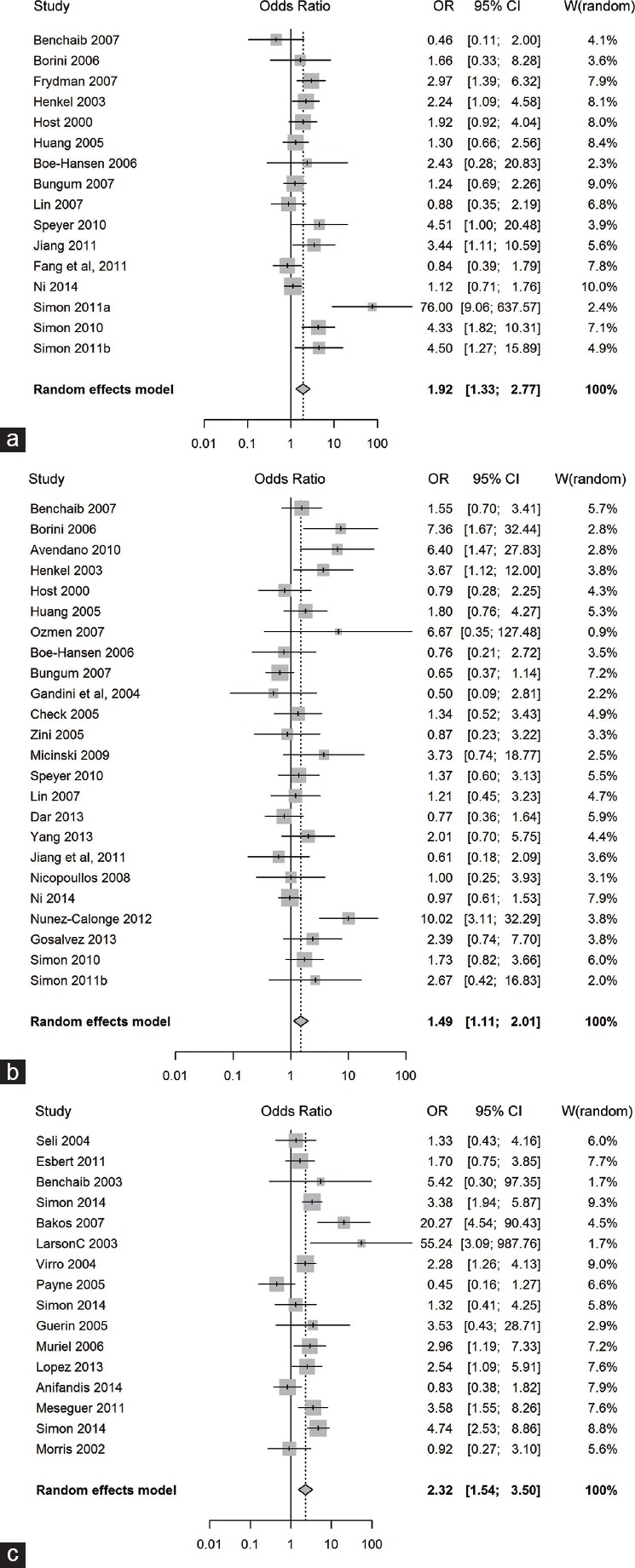
Sperm DNA damage is prevalent among infertile men and is known to influence natural reproduction. However, the impact of sperm DNA damage on assisted reproduction outcomes remains controversial. Here, we conducted a meta-analysis of studies on sperm DNA damage (assessed by SCSA, TUNEL, SCD, or Comet assay) and clinical pregnancy after IVF and/or ICSI treatment from MEDLINE, EMBASE, and PUBMED database searches for this analysis. We identified 41 articles (with a total of 56 studies) including 16 IVF studies, 24 ICSI studies, and 16 mixed (IVF + ICSI) studies. These studies measured DNA damage (by one of four assays: 23 SCSA, 18 TUNEL, 8 SCD, and 7 Comet) and included a total of 8068 treatment cycles (3734 IVF, 2282 ICSI, and 2052 mixed IVF + ICSI). The combined OR of 1.68 (95% CI: 1.49-1.89; P < 0.0001) indicates that sperm DNA damage affects clinical pregnancy following IVF and/or ICSI treatment. In addition, the combined OR estimates of IVF (16 estimates, OR = 1.65; 95% CI: 1.34-2.04; P < 0.0001), ICSI (24 estimates, OR = 1.31; 95% CI: 1.08-1.59; P = 0.0068), and mixed IVF + ICSI studies (16 estimates, OR = 2.37; 95% CI: 1.89-2.97; P < 0.0001) were also statistically significant. There is sufficient evidence in the existing literature suggesting that sperm DNA damage has a negative effect on clinical pregnancy following IVF and/or ICSI treatment.
精子DNA损伤在不育男性中普遍存在,并且已知会影响自然生殖。然而,精子DNA损伤对辅助生殖结局的影响仍存在争议。在此,我们通过检索MEDLINE、EMBASE和PUBMED数据库,对关于精子DNA损伤(通过精子染色质结构分析、末端脱氧核苷酸转移酶介导的缺口末端标记法、精子染色质扩散试验或彗星试验评估)与体外受精(IVF)和/或卵胞浆内单精子注射(ICSI)治疗后临床妊娠的研究进行了荟萃分析。我们确定了41篇文章(共56项研究),包括16项IVF研究、24项ICSI研究和16项混合(IVF + ICSI)研究。这些研究测量了DNA损伤(通过四种检测方法之一:23项精子染色质结构分析、18项末端脱氧核苷酸转移酶介导的缺口末端标记法、8项精子染色质扩散试验和7项彗星试验),总共包括8068个治疗周期(3734个IVF周期、2282个ICSI周期和2052个混合IVF + ICSI周期)。合并的比值比为1.68(95%置信区间:1.49 - 1.89;P < 0.0001),表明精子DNA损伤会影响IVF和/或ICSI治疗后的临床妊娠。此外,IVF(16项估计值,比值比 = 1.65;95%置信区间:1.34 - 2.04;P < 0.0001)、ICSI(24项估计值,比值比 = 1.31;95%置信区间:1.08 - 1.59;P = 0.0068)以及混合IVF + ICSI研究(16项估计值,比值比 = 2.37;95%置信区间:1.89 - 2.97;P < 0.0001)的合并比值比估计值也具有统计学意义。现有文献中有充分证据表明,精子DNA损伤对IVF和/或ICSI治疗后的临床妊娠有负面影响。