Fuentes Mariana M P B, Delean Steven, Grayson Jillian, Lavender Sally, Logan Murray, Marsh Helene
College of Marine and Environmental Sciences, James Cook University, Townsville, Queensland, Australia.
Department of Earth, Ocean and Atmospheric Science, Florida State University, Tallahassee, Florida, United States of America.
PLoS One. 2016 Jun 29;11(6):e0155675. doi: 10.1371/journal.pone.0155675. eCollection 2016.
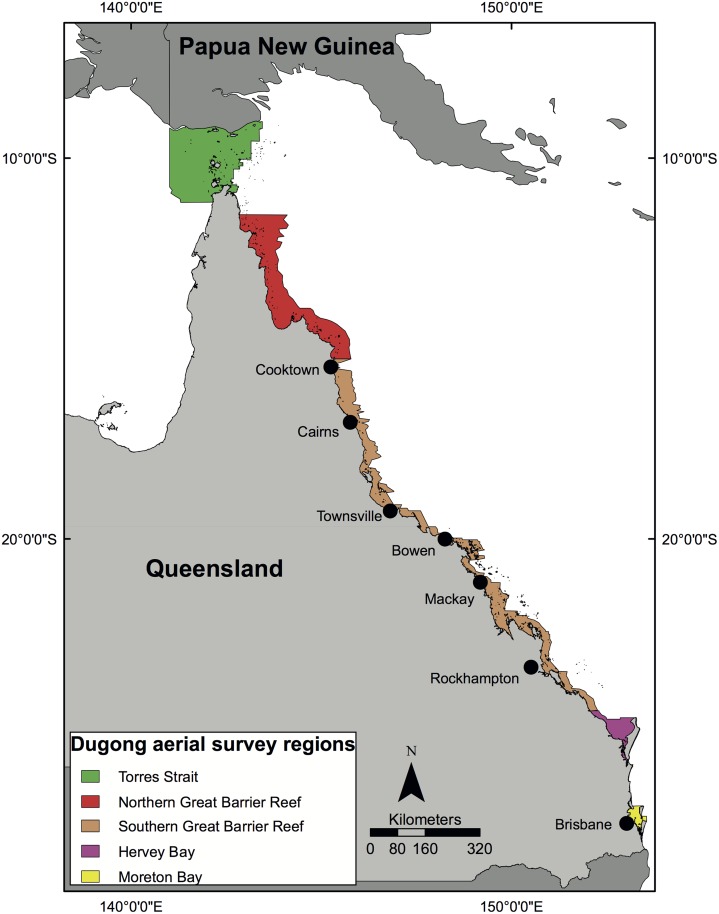
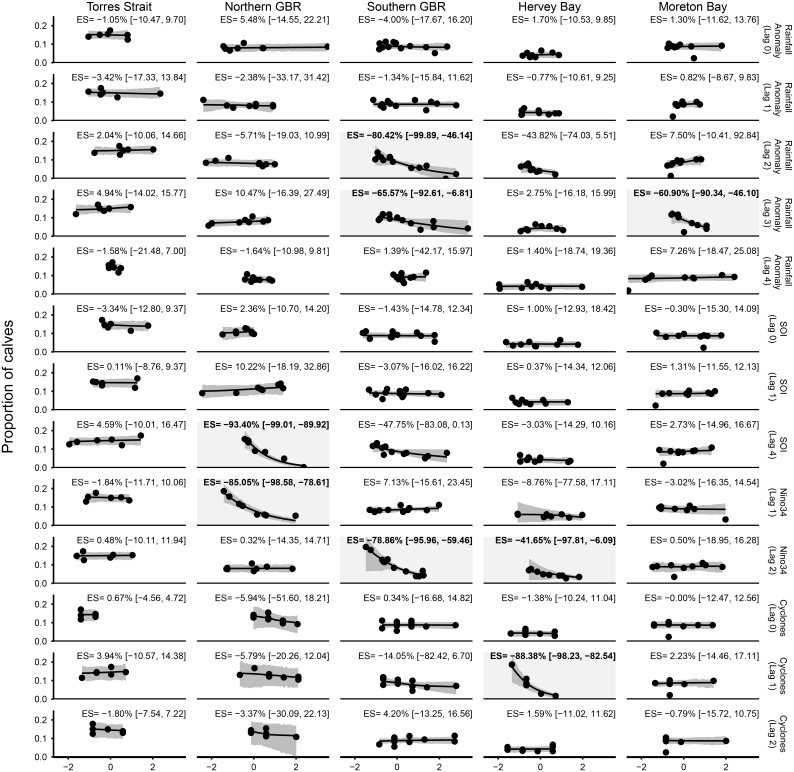
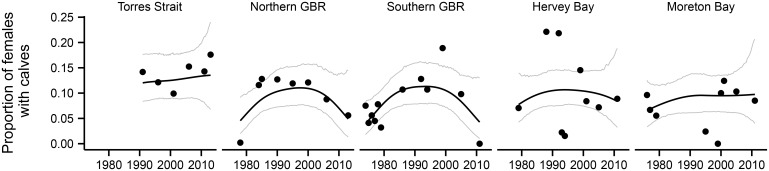
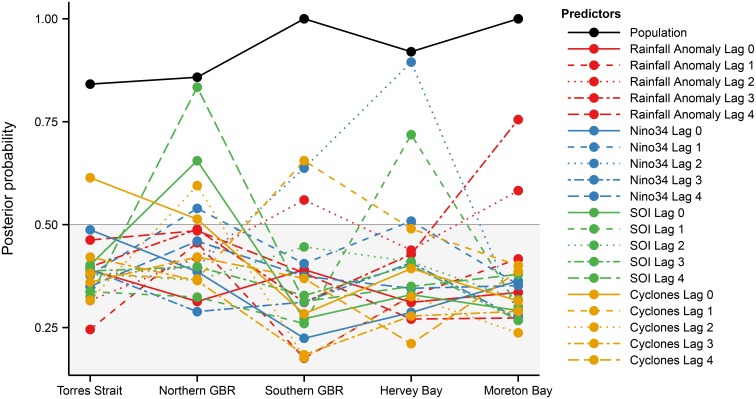
Knowledge of the relationships between environmental forcing and demographic parameters is important for predicting responses from climatic changes and to manage populations effectively. We explore the relationships between the proportion of sea cows (Dugong dugon) classified as calves and four climatic drivers (rainfall anomaly, Southern Oscillation El Niño Index [SOI], NINO 3.4 sea surface temperature index, and number of tropical cyclones) at a range of spatially distinct locations in Queensland, Australia, a region with relatively high dugong density. Dugong and calf data were obtained from standardized aerial surveys conducted along the study region. A range of lagged versions of each of the focal climatic drivers (1 to 4 years) were included in a global model containing the proportion of calves in each population crossed with each of the lagged versions of the climatic drivers to explore relationships. The relative influence of each predictor was estimated via Gibbs variable selection. The relationships between the proportion of dependent calves and the climatic drivers varied spatially and temporally, with climatic drivers influencing calf counts at sub-regional scales. Thus we recommend that the assessment of and management response to indirect climatic threats on dugongs should also occur at sub-regional scales.
了解环境强迫与人口统计学参数之间的关系对于预测气候变化的响应和有效管理种群至关重要。我们在澳大利亚昆士兰州一系列空间上不同的地点(该地区儒艮密度相对较高),探索了被归类为幼崽的儒艮(Dugong dugon)比例与四个气候驱动因素(降雨异常、南方涛动厄尔尼诺指数[SOI]、NINO 3.4海表面温度指数和热带气旋数量)之间的关系。儒艮和幼崽数据来自沿研究区域进行的标准化航空调查。在一个全球模型中纳入了每个关键气候驱动因素的一系列滞后版本(1至4年),该模型包含每个种群中幼崽的比例与气候驱动因素的每个滞后版本的交叉项,以探索关系。通过吉布斯变量选择估计每个预测变量的相对影响。依赖幼崽的比例与气候驱动因素之间的关系在空间和时间上有所不同,气候驱动因素在次区域尺度上影响幼崽数量。因此,我们建议对儒艮间接气候威胁的评估和管理应对也应在次区域尺度上进行。