Kretschmer-Trendowicz Anett, Ellis Judith A, Altgassen Mareike
Department of Psychology, Technische Universitaet Dresden, Dresden, Germany.
School of Psychology & Clinical Language Sciences, University of Reading, Reading, United Kingdom.
PLoS One. 2016 Jun 29;11(6):e0158366. doi: 10.1371/journal.pone.0158366. eCollection 2016.
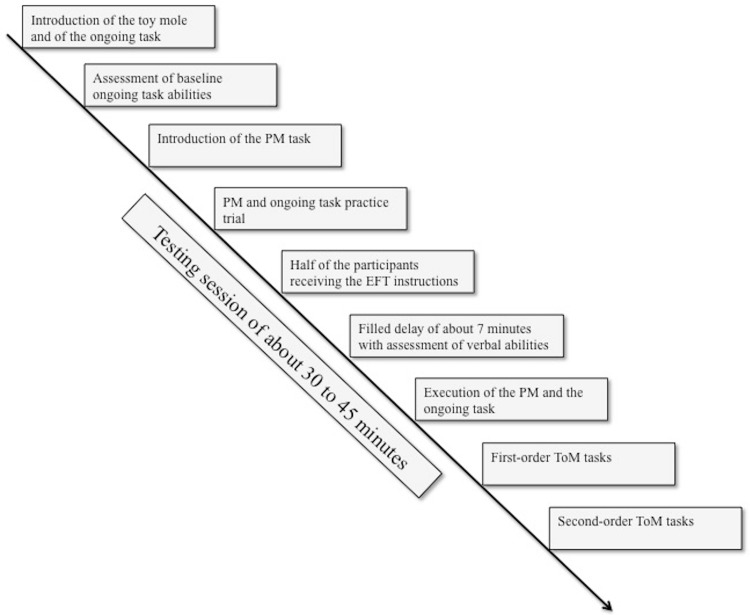
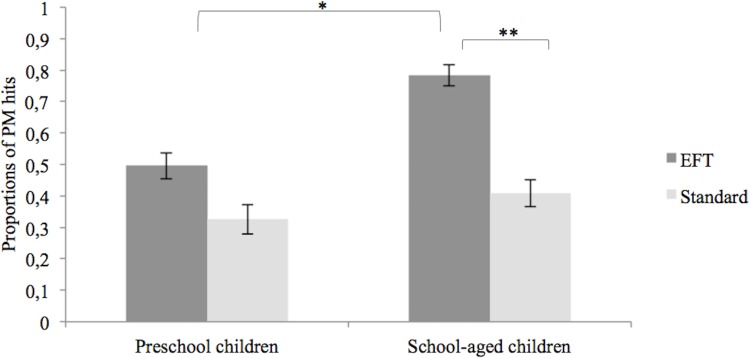
The present study is the first to investigate the benefits of episodic future thinking (EFT) at encoding on prospective memory (PM) in preschool (age: M = 66.34 months, SD = 3.28) and primary school children (age: M = 88.36 months, SD = 3.12). A second aim was to examine if self-projection influences the possible effects of EFT instructions. PM was assessed using a standard PM paradigm in children with a picture-naming task as the ongoing activity in which the PM task was embedded. Further, two first- and two second-order ToM tasks were administered as indicator of children's self-projection abilities. Forty-one preschoolers and 39 school-aged children were recruited. Half of the participants in each age group were instructed to use EFT as a strategy to encode the PM task, while the others received standard PM instructions. Results revealed a significant age effect, with school-aged children significantly outperforming preschoolers and a significant effect of encoding condition with overall better performance when receiving EFT instructions compared to the standard encoding condition. Even though the interaction between age group and encoding condition was not significant, planned comparisons revealed first evidence that compared to the younger age group, older children's PM benefitted more from EFT instructions during intention encoding. Moreover, results showed that although self-projection had a significant impact on PM performance, it did not influence the effects of EFT instructions. Overall, results indicate that children can use EFT encoding strategies to improve their PM performance once EFT abilities are sufficiently developed. Further, they provide first evidence that in addition to executive functions, which have already been shown to influence the development of PM across childhood, self-projection seems to be another key mechanism underlying this development.
本研究首次调查了学前儿童(年龄:M = 66.34个月,标准差 = 3.28)和小学儿童(年龄:M = 88.36个月,标准差 = 3.12)在编码时的情景未来思维(EFT)对前瞻记忆(PM)的益处。第二个目的是检验自我投射是否会影响EFT指令的可能效果。使用标准的PM范式对儿童的PM进行评估,其中图片命名任务作为嵌入PM任务的持续活动。此外,还进行了两项一阶和两项二阶心理理论任务,作为儿童自我投射能力的指标。招募了41名学前儿童和39名学龄儿童。每个年龄组的一半参与者被指示使用EFT作为编码PM任务的策略,而其他参与者则接受标准的PM指令。结果显示出显著的年龄效应,学龄儿童的表现明显优于学前儿童,并且编码条件有显著影响,与标准编码条件相比,接受EFT指令时整体表现更好。尽管年龄组和编码条件之间的交互作用不显著,但计划比较首次显示,与较年幼的年龄组相比,年龄较大的儿童在意图编码期间,其PM从EFT指令中获益更多。此外,结果表明,虽然自我投射对PM表现有显著影响,但它并未影响EFT指令的效果。总体而言,结果表明,一旦EFT能力得到充分发展,儿童可以使用EFT编码策略来提高他们的PM表现。此外,研究首次证明,除了已经被证明会影响整个儿童期PM发展的执行功能外,自我投射似乎是这一发展背后的另一个关键机制。