Jinap Selamat, Hajeb Parvaneh, Karim Roslina, Norliana Sarian, Yibadatihan Simayi, Abdul-Kadir Razak
Food Safety Research Centre (FOSREC), Faculty of Food Science and Technology, Universiti Putra Malaysia, Serdang, Malaysia.
Institute of Tropical Agriculture, Universiti Putra Malaysia, Serdang, Malaysia;
Food Nutr Res. 2016 Jun 27;60:30463. doi: 10.3402/fnr.v60.30463. eCollection 2016.
Excessive dietary sodium intake causes several diseases, such as hypertension, cardiovascular and renal disease, etc. Hence, reducing sodium intake has been highly recommended. In this study the effect of monosodium glutamate (MSG), as an umami substance, on saltiness and sodium reduction was investigated.
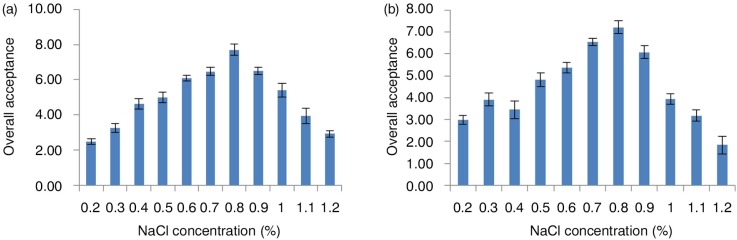
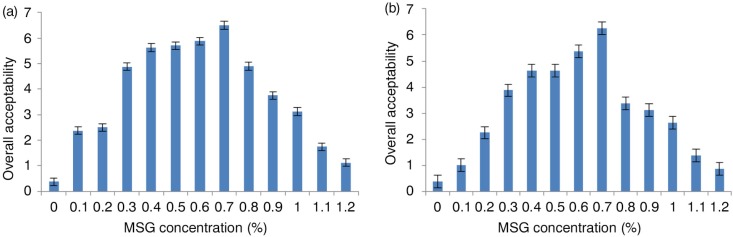
The trained panellists were presented with basic spicy soups (curry chicken and chili chicken) containing different amounts of sodium chloride (NaCl) (0-1.2%) and MSG (0-1.2%). They tasted the optimum concentrations of NaCl and MSG for the two spicy soups and the overall acceptability were 0.8% and 0.7%, respectively. There was no significant effect of spiciness level on the saltiness and umami taste of both soups. The optimum levels of combined NaCl and MSG for overall acceptance in the chili and curry soups were 0.3% and 0.7%, respectively. The results showed that with the addition of MSG, it is possible to reduce sodium intake without changing the overall acceptability of the spicy soup. A 32.5% reduction in sodium level is made feasible by adding 0.7% MSG to the spicy soups.
This study suggests that low-sodium soups can be developed by the addition of appropriate amounts of MSG, while maintaining the acceptability of the spicy soups. It was also proven that it is feasible to reduce sodium intake by replacing NaCl with MSG.
过量的膳食钠摄入会引发多种疾病,如高血压、心血管疾病和肾脏疾病等。因此,强烈建议减少钠的摄入量。在本研究中,对作为鲜味物质的味精(MSG)对咸味和钠减少的影响进行了调查。
向经过训练的评审员提供含有不同量氯化钠(NaCl)(0 - 1.2%)和味精(0 - 1.2%)的基本辣味汤(咖喱鸡和辣椒鸡)。他们品尝了两种辣味汤中氯化钠和味精的最佳浓度,总体可接受性分别为0.8%和0.7%。辣味水平对两种汤的咸味和鲜味没有显著影响。辣椒汤和咖喱汤总体接受的氯化钠和味精组合的最佳水平分别为0.3%和0.7%。结果表明,添加味精后,可以在不改变辣味汤总体可接受性的情况下减少钠的摄入量。通过在辣味汤中添加0.7%的味精,可使钠含量降低32.5%成为可能。
本研究表明,通过添加适量的味精可以开发出低钠汤,同时保持辣味汤的可接受性。还证明了用味精替代氯化钠来减少钠的摄入量是可行的。