Finney Rutten Lila J, Hesse Bradford W, St Sauver Jennifer L, Wilson Patrick, Chawla Neetu, Hartigan Danielle B, Moser Richard P, Taplin Stephen, Glasgow Russell, Arora Neeraj K
Department of Health Sciences Research, Mayo Clinic, Rochester, MN, USA.
Division of Cancer Control and Population Sciences, National Cancer Institute, Bethesda, MD, USA.
Adv Ther. 2016 Aug;33(8):1440-51. doi: 10.1007/s12325-016-0369-7. Epub 2016 Jun 29.
Using cross-sectional survey data, we assessed the association between chronic illness burden and health-related self-efficacy, evaluating whether patient-centered communication is associated with self-efficacy and if that relationship varies by chronic illness burden.
Data were from the Health Information National Trends Survey, a cross-sectional survey of the US adult population collected in 2012-2013 (n = 3630). Health-related self-efficacy was measured with the item: "Overall, how confident are you about your ability to take good care of your health?" and the prevalence of six chronic conditions and depression/anxiety was assessed. Patient-centered communication was measured as the frequency with which respondents perceived their healthcare providers allowed them to ask questions, gave attention to their emotions, involved them in decisions, made sure they understood how to take care of their health, helped them to deal with uncertainty, and if they felt they could rely on their healthcare providers to take care of their healthcare needs.
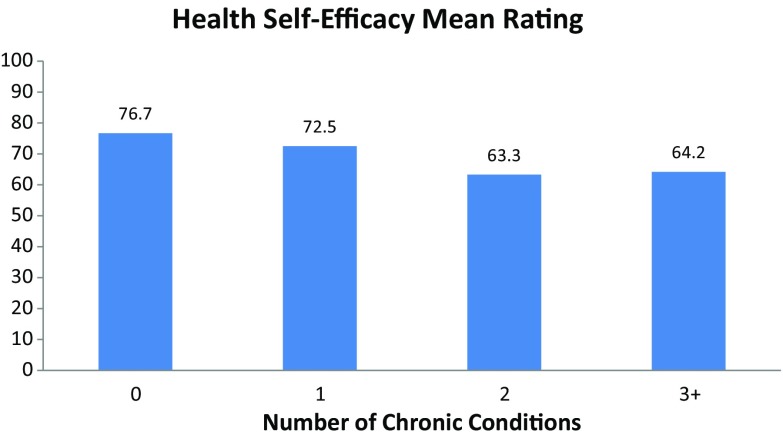
Health-related self-efficacy was significantly lower among individuals with greater illness burden. In adjusted analysis, individuals who experienced more positive patient-centered communication reported higher levels of self-efficacy (β = 0.26, P < 0.0001); this association was strongest among those with greater illness burden.
Higher levels of self-efficacy were observed among patients reporting more positive patient-centered communication; the observed association was stronger among those with greater chronic illness burden.
利用横断面调查数据,我们评估了慢性病负担与健康相关自我效能之间的关联,探讨以患者为中心的沟通是否与自我效能相关,以及这种关系是否因慢性病负担而异。
数据来自《健康信息国家趋势调查》,这是一项于2012 - 2013年对美国成年人口进行的横断面调查(n = 3630)。通过以下项目测量健康相关自我效能:“总体而言,你对自己照顾好自身健康的能力有多自信?”并评估了六种慢性病以及抑郁/焦虑的患病率。以患者为中心的沟通通过受访者感知其医疗服务提供者允许他们提问、关注他们的情绪、让他们参与决策、确保他们明白如何照顾自己的健康、帮助他们应对不确定性的频率来衡量,以及他们是否觉得可以依靠医疗服务提供者满足其医疗需求。
慢性病负担较重的个体中,健康相关自我效能显著较低。在调整分析中,经历更积极的以患者为中心沟通的个体报告的自我效能水平更高(β = 0.26,P < 0.0001);这种关联在慢性病负担较重的个体中最为明显。
报告了更积极的以患者为中心沟通的患者中观察到更高水平的自我效能;在慢性病负担较重的个体中观察到的这种关联更强。