Ma Gang, Zhang Lancui, Yungyuen Witchulada, Tsukamoto Issei, Iijima Natsumi, Oikawa Michiru, Yamawaki Kazuki, Yahata Masaki, Kato Masaya
Department of Biological and Environmental Sciences, Faculty of Agriculture, Shizuoka University, 836 Ohya, Shizuoka, Suruga, 422-8529, Japan.
The United Graduate school of Agricultural Science, Gifu University (Shizuoka University), Yanagido, Gifu, 501-1193, Japan.
BMC Plant Biol. 2016 Jun 29;16(1):148. doi: 10.1186/s12870-016-0840-2.
Xanthophylls are oxygenated carotenoids and fulfill critical roles in plant growth and development. In plants, two different types of carotene hydroxylases, non-heme di-iron and heme-containing cytochrome P450, were reported to be involved in the biosynthesis of xanthophyll. Citrus fruits accumulate a high amount of xanthophylls, especially β,β-xanthophylls. To date, however, the roles of carotene hydroxylases in regulating xanthophyll content and composition have not been elucidated.
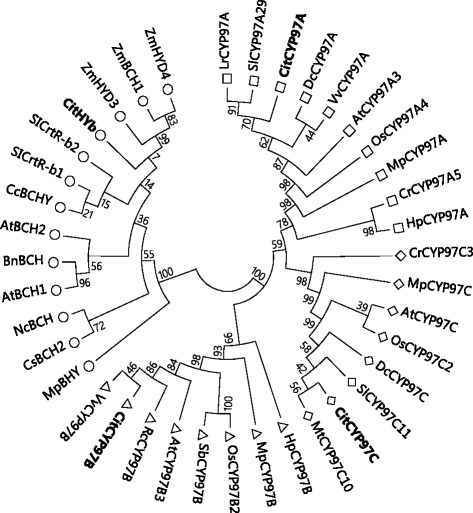
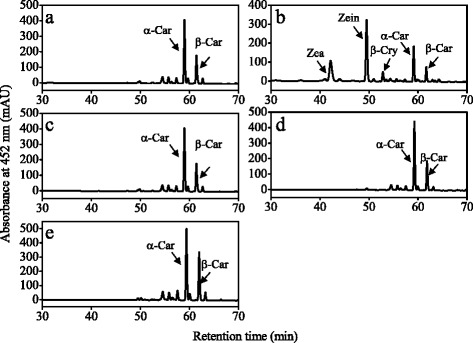
In the present study, the roles of four carotene hydroxylase genes (CitHYb, CitCYP97A, CitCYP97B, and CitCYP97C) in the biosynthesis of xanthophyll in citrus fruits were investigated. Phylogenetic analysis showed that the four citrus carotene hydroxylases presented in four distinct clusters which have been identified in higher plants. CitHYb was a non-heme di-iron carotene hydroxylase, while CitCYP97A, CitCYP97B, and CitCYP97C were heme-containing cytochrome P450-type carotene hydroxylases. Gene expression results showed that the expression of CitHYb increased in the flavedo and juice sacs during the ripening process, which was well consistent with the accumulation of β,β-xanthophyll in citrus fruits. The expression of CitCYP97A and CitCYP97C increased with a peak in November, which might lead to an increase of lutein in the juice sacs during the ripening process. The expression level of CitCYP97B was much lower than that of CitHYb, CitCYP97A, and CitCYP97C in the juice sacs during the ripening process. Functional analysis showed that the CitHYb was able to catalyze the hydroxylation of the β-rings of β-carotene and α-carotene in Escherichia coli BL21 (DE3) cells. Meanwhile, when CitHYb was co-expressed with CitCYP97C, α-carotene was hydroxylated on the β-ring and ε-ring sequentially to produce lutein.
CitHYb was a key gene for β,β-xanthophyll biosynthesis in citrus fruits. CitCYP97C functioned as an ε-ring hydroxylase to produce lutein using zeinoxanthin as a substrate. The results will contribute to elucidating xanthophyll biosynthesis in citrus fruits, and provide new strategies to improve the nutritional and commercial qualities of citrus fruits.
叶黄素是氧化类胡萝卜素,在植物生长发育中发挥着关键作用。在植物中,据报道两种不同类型的胡萝卜素羟化酶,即非血红素二价铁和含血红素的细胞色素P450,参与叶黄素的生物合成。柑橘类水果积累大量叶黄素,尤其是β,β-叶黄素。然而,迄今为止,胡萝卜素羟化酶在调节叶黄素含量和组成方面的作用尚未阐明。
在本研究中,对四个胡萝卜素羟化酶基因(CitHYb、CitCYP97A、CitCYP97B和CitCYP97C)在柑橘类水果叶黄素生物合成中的作用进行了研究。系统发育分析表明,这四种柑橘类胡萝卜素羟化酶呈现于高等植物中已鉴定出的四个不同簇中。CitHYb是一种非血红素二价铁胡萝卜素羟化酶,而CitCYP97A、CitCYP97B和CitCYP97C是含血红素的细胞色素P450型胡萝卜素羟化酶。基因表达结果表明,CitHYb的表达在成熟过程中在黄皮层和汁囊中增加,这与柑橘类水果中β,β-叶黄素的积累高度一致。CitCYP97A和CitCYP97C的表达在11月达到峰值,这可能导致成熟过程中汁囊中叶黄素增加。在成熟过程中,CitCYP97B在汁囊中的表达水平远低于CitHYb、CitCYP97A和CitCYP97C。功能分析表明,CitHYb能够在大肠杆菌BL21(DE3)细胞中催化β-胡萝卜素和α-胡萝卜素β环的羟化反应。同时,当CitHYb与CitCYP97C共表达时,α-胡萝卜素在β环和ε环上依次羟化生成叶黄素。
CitHYb是柑橘类水果中β,β-叶黄素生物合成的关键基因。CitCYP97C作为一种ε环羟化酶,以玉米黄质为底物生成叶黄素。这些结果将有助于阐明柑橘类水果中叶黄素的生物合成,并为提高柑橘类水果的营养和商业品质提供新策略。