Tavernier Elsa, Trinquart Ludovic, Giraudeau Bruno
INSERM, U1153, Paris, France.
CHRU, Tours, France.
PLoS One. 2016 Jun 30;11(6):e0158604. doi: 10.1371/journal.pone.0158604. eCollection 2016.
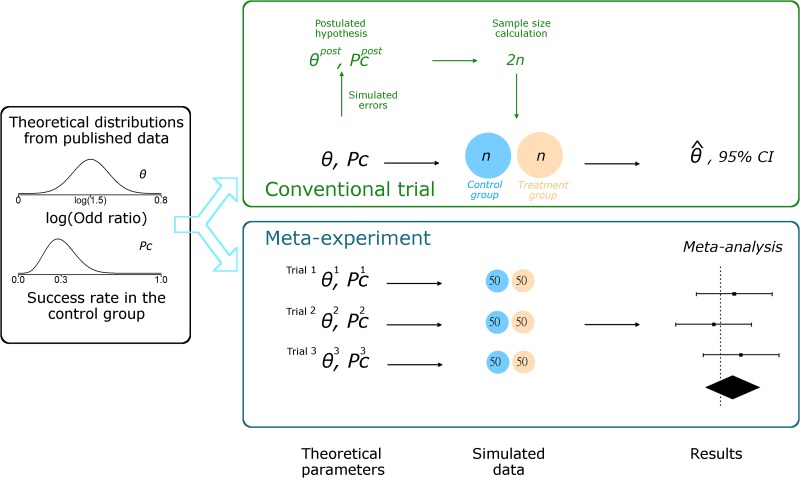
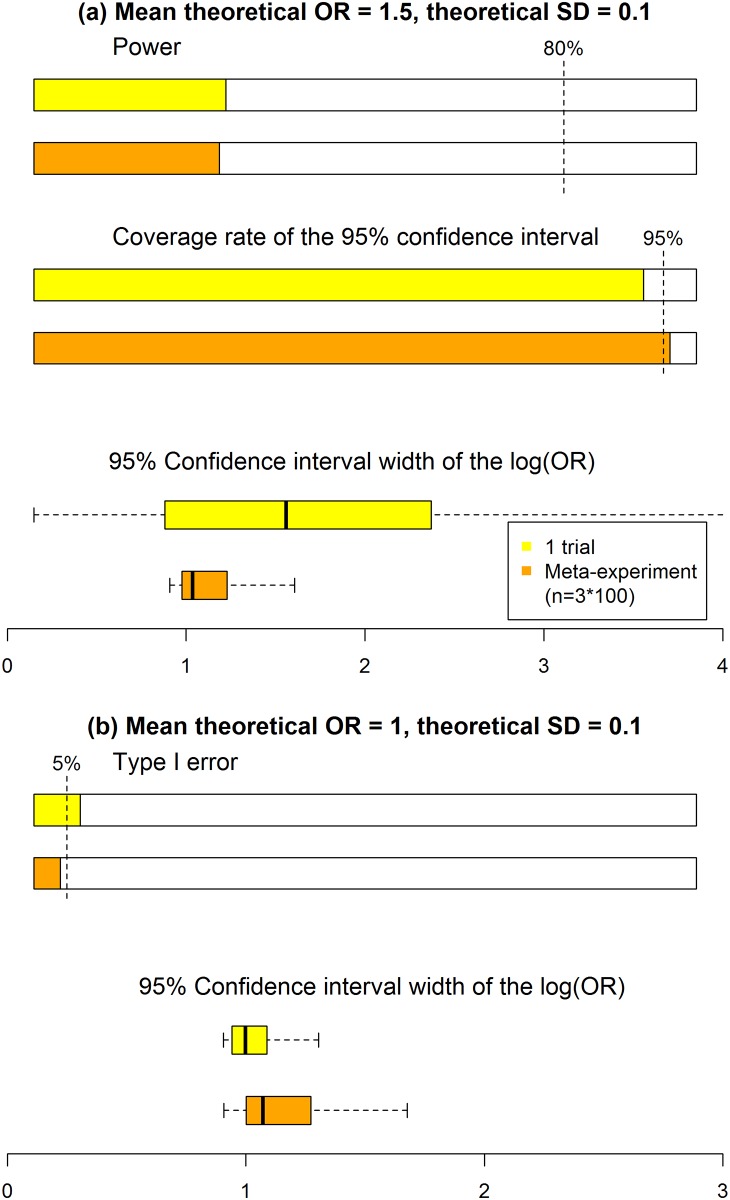
Sample sizes for randomized controlled trials are typically based on power calculations. They require us to specify values for parameters such as the treatment effect, which is often difficult because we lack sufficient prior information. The objective of this paper is to provide an alternative design which circumvents the need for sample size calculation. In a simulation study, we compared a meta-experiment approach to the classical approach to assess treatment efficacy. The meta-experiment approach involves use of meta-analyzed results from 3 randomized trials of fixed sample size, 100 subjects. The classical approach involves a single randomized trial with the sample size calculated on the basis of an a priori-formulated hypothesis. For the sample size calculation in the classical approach, we used observed articles to characterize errors made on the formulated hypothesis. A prospective meta-analysis of data from trials of fixed sample size provided the same precision, power and type I error rate, on average, as the classical approach. The meta-experiment approach may provide an alternative design which does not require a sample size calculation and addresses the essential need for study replication; results may have greater external validity.
随机对照试验的样本量通常基于功效计算。这要求我们指定一些参数的值,比如治疗效果,而这往往很困难,因为我们缺乏足够的先验信息。本文的目的是提供一种替代设计,无需进行样本量计算。在一项模拟研究中,我们将一种元实验方法与评估治疗效果的经典方法进行了比较。元实验方法涉及使用来自3项固定样本量为100名受试者的随机试验的元分析结果。经典方法涉及一项单一的随机试验,其样本量是根据预先设定的假设计算得出的。对于经典方法中的样本量计算,我们使用观察到的文章来描述在设定假设时所犯的错误。对固定样本量试验数据进行的前瞻性元分析平均提供了与经典方法相同的精度、功效和I型错误率。元实验方法可能提供一种无需样本量计算的替代设计,并满足研究重复的基本需求;结果可能具有更高的外部效度。