Sun Yuxiu, Zhao Hong, Ye Yongming, Nie Wenbin, Bai Wenjing, Liu Jia, Li Sinuo, Wang Fang, Han Mingjuan, He Liyun
Guang'anmen Hospital, China Academy of Chinese Medical Sciences, Beijing, 100053, China.
Hubei University of Chinese Medicine, Wuhan, 430061, China.
Trials. 2016 Jun 30;17(1):305. doi: 10.1186/s13063-016-1432-z.
Many previous studies have shown the potential therapeutic effect of acupuncture for allergic rhinitis. Most of these studies, however, were limited by the short duration of observations and lack of sham acupuncture as the control group. Our preliminary experiments showed that the use of a warm needling achieved a much more persistent effect in the treatment of allergic rhinitis (AR) compared with simple acupuncture therapy. Hence, we have designed a multicenter, randomized controlled trial (RCT) in which the first-line medication loratadine will be used as the control group, and the effect of warm needling therapy will be evaluated through long-term observation.
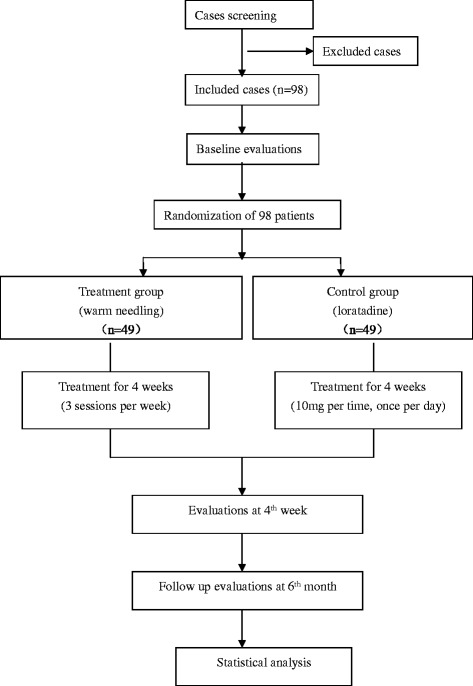
METHODS/DESIGN: The trial is designed as a multicenter, parallel-group, randomized, single-blinded (outcome assessors), non-inferiority trial. A total of 98 patients with persistent AR will be randomly assigned into two groups. Patients in the treatment group will be treated with warm needling at GV14 and acupuncture at EX-HN3, ST2, LI20, EX-HN8, GV23, LU7, LU5 and LI4 three times a week, for a total of 4 weeks. Patients in the control group will be treated with oral loratadine 10 mg/day for 4 weeks. The primary outcome will be the change in the Total Nasal Symptom Score (TNSS) from baseline to that at 6 months after treatment during the follow-up period. The secondary outcomes will include the Total Non-nasal Symptom Score and the Rhinoconjunctivitis Quality of Life Questionnaire, changes in the TNSS from baseline to that at 2 and 4 weeks during treatment, and 3 months after treatment during the follow-up period. Outcomes will be measured at 2 and 4 weeks, and 3 and 6 months after treatment. Any side effects of treatment will be observed and recorded.
We expect that the study results will provide evidence to determine the effects of warm needling compared with loratadine. Our final goal of the study is to evaluate the difference in the short-term and long-term effects between the two therapeutic methods, especially the long-term effect of warm needling.
ClinicalTrials.gov NCT02339714 . Registered on 14 January 2015.
此前许多研究已表明针刺疗法对过敏性鼻炎具有潜在治疗效果。然而,这些研究大多受限于观察时间较短且缺乏假针刺作为对照组。我们的初步实验表明,与单纯针刺疗法相比,温针疗法在治疗过敏性鼻炎(AR)方面效果更为持久。因此,我们设计了一项多中心随机对照试验(RCT),其中一线药物氯雷他定将作为对照组,通过长期观察来评估温针疗法的效果。
方法/设计:该试验设计为多中心、平行组、随机、单盲(结果评估者)、非劣效性试验。总共98例持续性AR患者将被随机分为两组。治疗组患者将接受第14颈椎棘突下(GV14)温针及印堂(EX-HN3)、胃经天枢穴(ST2)、大肠经合谷穴(LI20)、攒竹(EX-HN8)、第23颈椎棘突下(GV23)、肺经经渠穴(LU7)、肺经太渊穴(LU5)和大肠经三间穴(LI4)针刺治疗,每周3次,共4周。对照组患者将接受口服氯雷他定10毫克/天,共4周。主要结局指标为随访期间从基线到治疗后6个月总鼻症状评分(TNSS)的变化。次要结局指标将包括总非鼻症状评分和变应性鼻炎生活质量问卷、治疗期间2周和4周以及治疗后随访期间3个月时TNSS从基线的变化。结局指标将在治疗后2周和4周以及3个月和6个月进行测量。将观察并记录治疗的任何副作用。
我们期望研究结果将为确定温针与氯雷他定相比的效果提供证据。我们研究的最终目标是评估两种治疗方法在短期和长期效果上的差异,尤其是温针的长期效果。
ClinicalTrials.gov NCT02339714。于2015年1月14日注册。