Jung Sung Il, Woo Jungmin, Kim Yang-Tae, Kwak Sang Gyu
Department of Psychiatry, Catholic University of Daegu School of Medicine, Daegu, Korea .
Department of Psychiatry, Keimyung University Dongsan Medical Center, Daegu, Korea .
J Korean Med Sci. 2016 Jul;31(7):1114-20. doi: 10.3346/jkms.2016.31.7.1114. Epub 2016 May 16.
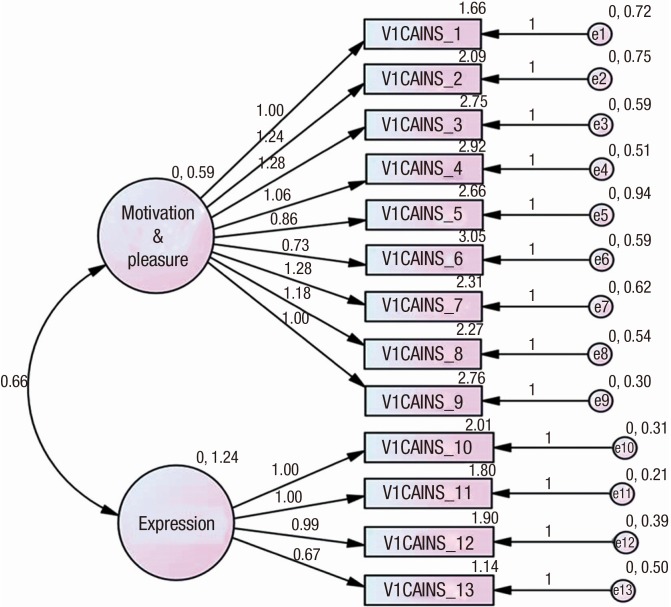
The Clinical Assessment Interview for Negative Symptoms (CAINS) was developed to overcome the limitations of existing instruments and reflect the current view of negative symptoms. The aim of the present study was to evaluate the reliability and validity of the Korean version of the Clinical Assessment Interview for Negative Symptoms (K-CAINS). Inpatients (n = 49) and outpatients (n = 70) with schizophrenia were recruited from three institutions. The confirmative factor analysis, test-retest reliability, inter-rater reliability, convergent validity, and discriminant validity were assessed. The study group consisted of 71 males (59.7%) and 48 females (40.3%). Their mean age was 42.15 years (SD = 12.2). The K-CAINS was confirmed to be divided into two subscales of 9 items related to "motivation/pleasure" and 4 items related to "expression" in concordance with the original version of the CAINS. The results showed that the K-CAINS had a good inter-rater reliability (ICC = 0.84-0.94), test-retest reliability (r = 0.90, P < 0.001). Convergent validity was proven by demonstrating a significant correlation with the Positive and Negative Syndrome Scale (PANSS) negative subscale, and the Scale for the Assessment of Negative Symptoms (SANS). Discriminant validity was proven by the lack of a significant correlation with the PANSS positive subscale, the Korean version of the Beck depression inventory (BDI), the Korean version of the Calgary depression scale for schizophrenia (K-CDSS), and the Modified Simpson Angus scale (MSAS). The K-CAINS could be a reliable and valid tool to assess the negative symptoms of Korean schizophrenia patients.
阴性症状临床评估访谈量表(CAINS)的开发旨在克服现有工具的局限性,并反映当前对阴性症状的看法。本研究的目的是评估阴性症状临床评估访谈量表韩语版(K-CAINS)的信效度。从三个机构招募了49名住院和70名门诊精神分裂症患者。评估了验证性因素分析、重测信度、评分者间信度、聚合效度和区分效度。研究组包括71名男性(59.7%)和48名女性(40.3%)。他们的平均年龄为42.15岁(标准差=12.2)。K-CAINS被证实可分为与“动机/愉悦感”相关的9个项目和与“表达”相关的4个项目两个分量表,与CAINS原版一致。结果显示,K-CAINS具有良好的评分者间信度(组内相关系数=0.84-0.94)、重测信度(r=0.90,P<0.001)。通过证明与阳性和阴性症状量表(PANSS)阴性分量表以及阴性症状评估量表(SANS)存在显著相关性,证实了聚合效度。通过与PANSS阳性分量表、贝克抑郁量表韩语版(BDI)、精神分裂症卡尔加里抑郁量表韩语版(K-CDSS)和改良辛普森安格斯量表(MSAS)缺乏显著相关性,证实了区分效度。K-CAINS可能是评估韩国精神分裂症患者阴性症状的可靠有效工具。