Shin Yeon-Jeong, Joo Yo-Han, Kim Jong-Hoon
Neuroscience Research Institute, Gachon University School of Medicine, Gachon University, Incheon, Republic of Korea; Department of Health Sciences and Technology, Gachon Advanced Institute for Health Sciences & Technology, Gachon University School of Medicine, Gachon University, Incheon, Republic of Korea.
Neuroscience Research Institute, Gachon University School of Medicine, Gachon University, Incheon, Republic of Korea.
Neuropsychiatr Dis Treat. 2016 Jun 16;12:1411-7. doi: 10.2147/NDT.S108537. eCollection 2016.
We investigated self-perceived cognitive deficits and their relationship with internalized stigma and quality of life in patients with schizophrenia in order to shed light on the clinical correlates of subjective cognitive deficits in schizophrenia.
Seventy outpatients with schizophrenia were evaluated. Patients' self-perceived cognitive deficits, internalized stigma, and subjective quality of life were assessed using the Scale to Investigate Cognition in Schizophrenia (SSTICS), the Internalized Stigma of Mental Illness Scale (ISMI), and the Schizophrenia Quality of Life Scale Revision 4 (SQLS-R4), respectively. Correlation and regression analyses controlling for the severity of symptoms of schizophrenia were performed, and a mediation analysis was conducted to examine the hypothesis that internalized stigma mediates the relationship between self-perceived cognitive deficits and subjective quality of life.
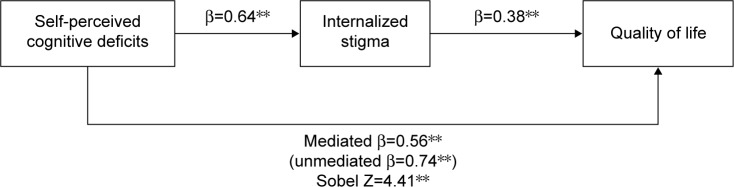
Pearson's partial correlation analysis showed significant correlations among the SSTICS, ISMI, and SQLS-R4 scores (P<0.01). Multiple regression analysis showed that the SSTICS and ISMI scores significantly predicted the SQLS-R4 score (P<0.01). Mediation analysis revealed that the strength of the association between the SSTICS and SQLS-R4 scores decreased from β=0.74 (P<0.01) to β=0.56 (P<0.01), when the ISMI score was statistically controlled. The Sobel test revealed that this difference was significant (P<0.01), indicating that internalized stigma partially mediated the relationship between self-perceived cognitive deficits and quality of life.
The present study indicates that self-perceived cognitive deficits are significantly associated with internalized stigma and quality of life. Furthermore, internalized stigma was identified as a partial mediator of the relationship between self-perceived cognitive deficits and quality of life. These findings suggest that clinicians should be aware that patients with schizophrenia experience significantly greater self-stigma when they suffer subjective cognitive deficits, and that this may further compromise their quality of life.
我们调查了精神分裂症患者自我感知的认知缺陷及其与内化耻辱感和生活质量的关系,以阐明精神分裂症主观认知缺陷的临床相关因素。
对70名精神分裂症门诊患者进行了评估。分别使用精神分裂症认知调查量表(SSTICS)、精神疾病内化耻辱感量表(ISMI)和精神分裂症生活质量量表修订版4(SQLS-R4)评估患者的自我感知认知缺陷、内化耻辱感和主观生活质量。进行了控制精神分裂症症状严重程度的相关性和回归分析,并进行了中介分析,以检验内化耻辱感介导自我感知认知缺陷与主观生活质量之间关系的假设。
Pearson偏相关分析显示SSTICS、ISMI和SQLS-R4得分之间存在显著相关性(P<0.01)。多元回归分析表明,SSTICS和ISMI得分显著预测了SQLS-R4得分(P<0.01)。中介分析显示,当对ISMI得分进行统计学控制时,SSTICS与SQLS-R4得分之间的关联强度从β=0.74(P<0.01)降至β=0.56(P<0.01)。Sobel检验显示这种差异具有统计学意义(P<0.01),表明内化耻辱感部分介导了自我感知认知缺陷与生活质量之间的关系。
本研究表明,自我感知的认知缺陷与内化耻辱感和生活质量显著相关。此外,内化耻辱感被确定为自我感知认知缺陷与生活质量之间关系的部分中介因素。这些发现表明,临床医生应意识到,精神分裂症患者在遭受主观认知缺陷时会经历更大的自我耻辱感,这可能会进一步损害他们的生活质量。