Yonamine Caio Yogi, Pinheiro-Machado Erika, Michalani Maria Luiza, Freitas Helayne Soares, Okamoto Maristela Mitiko, Corrêa-Giannella Maria Lucia, Machado Ubiratan Fabres
Department of Physiology and Biophysics, Institute of Biomedical Sciences, University of São Paulo, Av. Prof. Lineu Prestes, 1524, 05508-000 São Paulo, SP Brazil.
Laboratory of Medical Investigation 18 (LIM-18) and Cell and Molecular Therapy Center (NUCEL), Medical School, University of São Paulo, São Paulo, Brazil.
Nutr Metab (Lond). 2016 Jun 29;13:44. doi: 10.1186/s12986-016-0103-0. eCollection 2016.
Resveratrol is a natural polyphenol that has been proposed to improve glycemic control in diabetes, by mechanisms that involve improvement in insulin secretion and activity. In type 1 diabetes (T1D), in which insulin therapy is obligatory, resveratrol treatment has never been investigated. The present study aimed to evaluate resveratrol as an adjunctive agent to insulin therapy in a T1D-like experimental model.
Rats were rendered diabetic by streptozotocin (STZ) treatment. Twenty days later, four groups of animals were studied: non-diabetic (ND); diabetic treated with placebo (DP); diabetic treated with insulin (DI) and diabetic treated with insulin plus resveratrol (DIR). After 30 days of treatment, 24-hour urine was collected; then, blood, soleus muscle, proximal small intestine, renal cortex and liver were sampled. Specific glucose transporter proteins were analyzed (Western blotting) in each territory of interest. Solute carrier family 2 member 2 (Slc2a2), phosphoenolpyruvate carboxykinase (Pck1) and glucose-6-phosphatase catalytic subunit (G6pc) mRNAs (qPCR), glycogen storage and sirtuin 1 (SIRT1) activity were analyzed in liver.
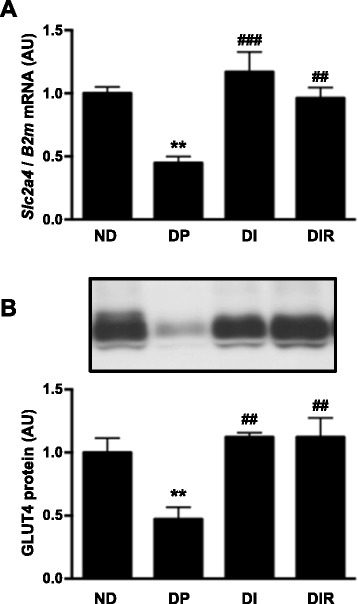
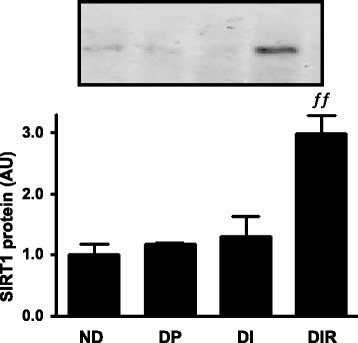
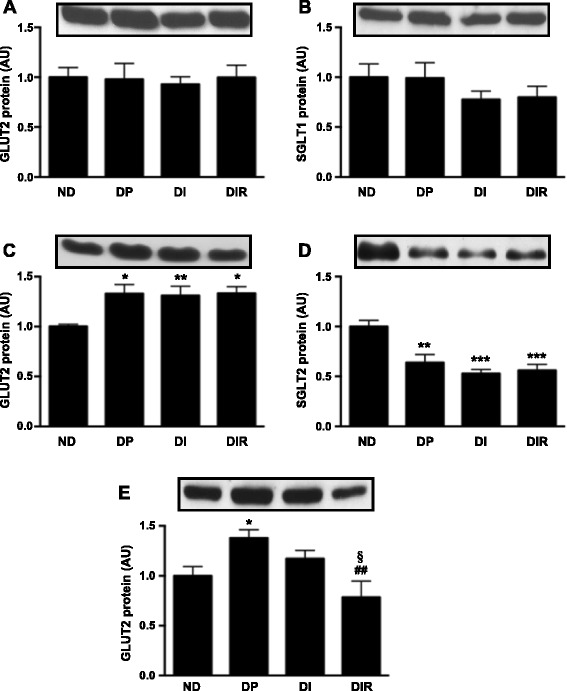
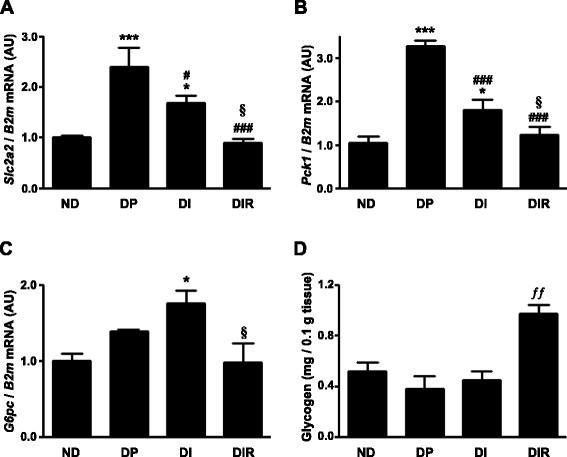
Diabetes induction increased blood glucose, plasma fructosamine concentrations, and glycosuria. Insulin therapy partially recovered the glycemic control; however, resveratrol as adjunctive therapy additionally improved glycemic control and restored plasma fructosamine concentration to values of non-diabetic rats. Resveratrol did not alter the expression of the glucose transporters GLUT2 and SGLT1 in the intestine, GLUT2 and SGLT2 in kidney and GLUT4 in soleus, suggesting that fluxes of glucose in these territories were unaltered. Differently, in liver, resveratrol promoted a reduction in Slc2a2, Pck1, and G6pc mRNAs, as well as in GLUT2 protein (P < 0.05, DIR vs. DI); besides, it increased (P < 0.01, DIR vs. DI) the hepatic glycogen content, and SIRT1 protein.
Resveratrol is able to improve glycemic control in insulin-treated T1D-like rats. This effect seems not to involve changes in glucose fluxes in the small intestine, renal proximal tubule, and soleus skeletal muscle; but to be related to several changes in the liver, where downregulation of Slc2a2/GLUT2, Pck1, and G6pc expression was observed, favoring reduction of glucose production and efflux. Besides, resveratrol increased SIRT1 nuclear protein content in liver, which may be related to the observed gene expression regulations.
白藜芦醇是一种天然多酚,有人提出它可通过改善胰岛素分泌和活性的机制来改善糖尿病患者的血糖控制。在1型糖尿病(T1D)中,胰岛素治疗是必需的,而白藜芦醇治疗从未被研究过。本研究旨在评估白藜芦醇在类似T1D的实验模型中作为胰岛素治疗辅助药物的效果。
通过链脲佐菌素(STZ)处理使大鼠患糖尿病。20天后,对四组动物进行研究:非糖尿病组(ND);接受安慰剂治疗的糖尿病组(DP);接受胰岛素治疗的糖尿病组(DI)和接受胰岛素加白藜芦醇治疗的糖尿病组(DIR)。治疗30天后,收集24小时尿液;然后,采集血液、比目鱼肌、近端小肠、肾皮质和肝脏样本。在每个感兴趣的区域分析特定的葡萄糖转运蛋白(蛋白质免疫印迹法)。分析肝脏中溶质载体家族2成员2(Slc2a2)、磷酸烯醇丙酮酸羧激酶(Pck1)和葡萄糖-6-磷酸酶催化亚基(G6pc)的mRNA(定量聚合酶链反应)、糖原储存和沉默调节蛋白1(SIRT1)活性。
糖尿病诱导增加了血糖、血浆果糖胺浓度和糖尿。胰岛素治疗部分恢复了血糖控制;然而,白藜芦醇作为辅助治疗额外改善了血糖控制,并使血浆果糖胺浓度恢复到非糖尿病大鼠的水平。白藜芦醇未改变肠道中葡萄糖转运蛋白GLUT2和SGLT1、肾脏中GLUT2和SGLT2以及比目鱼肌中GLUT4的表达,这表明这些区域的葡萄糖通量未改变。不同的是,在肝脏中,白藜芦醇促使Slc2a2、Pck1和G6pc的mRNA以及GLUT2蛋白减少(P < 0.05,DIR组与DI组相比);此外,它增加了(P < 0.01,DIR组与DI组相比)肝脏糖原含量和SIRT1蛋白。
白藜芦醇能够改善胰岛素治疗的类似T1D大鼠的血糖控制。这种作用似乎不涉及小肠、近端肾小管和比目鱼肌骨骼肌中葡萄糖通量的变化;而是与肝脏中的几种变化有关,在肝脏中观察到Slc2a2/GLUT2、Pck1和G6pc表达下调,有利于减少葡萄糖生成和流出。此外,白藜芦醇增加了肝脏中SIRT1核蛋白含量,这可能与观察到的基因表达调控有关。