Centonze Roberto, Agostini Emiliano, Massaccesi Samantha, Toninelli Stefano, Morabito Letterio
Division of Neurosurgery, Ospedali Riuniti Marche Nord Hospital, Pesaro, Italy.
Asian J Neurosurg. 2016 Jul-Sep;11(3):201-5. doi: 10.4103/1793-5482.179645.
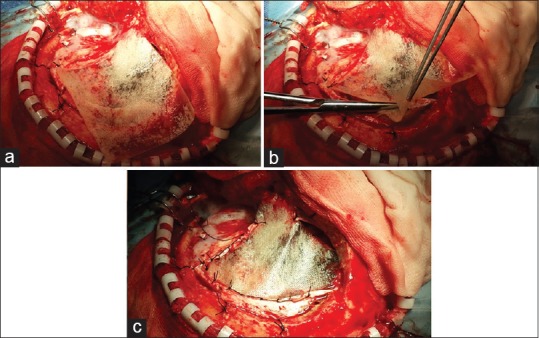
A large variety of biological and artificial materials are employed in dural repair, each of them with major limitations. Autologous grafts have limited availability and require an additional incision and surgical time. Cadaveric preparations and heterologous materials entail the risk of iatrogenic transmission of prions, whereas synthetic substitutes have been reported to cause inflammatory reactions and graft rejection. An equine-derived pericardium membrane has been developed (Heart(®), Bioteck, Vicenza, Italy) with mechanical and safety-related features that could make it suitable for neurosurgical application.
This preliminary study aimed to evaluate the short-term safety and efficacy of the Heart(®) membrane in dural repair procedures following meningioma surgeries.
Medical records of patients who were surgically treated for an intracranial meningioma and underwent duraplasty with the Heart(®) membrane were reviewed retrospectively. The occurrence of any graft-related complications such as cerebrospinal fluid (CSF) leakage, postoperative hematoma, wound infection, meningitis, and neurological symptoms was analyzed.
Eight patients were identified as meeting the inclusion criteria. A watertight closure was achieved in all of them. Postoperatively, no patients exhibited CSF leak, cerebral contusion, hemorrhage, or wound infection. The 1-month radiological follow-up revealed no evidence of pseudomeningocele, wound breakdown, or meningitis. Neurologic complications were observed in three patients but not directly imputable to the dural substitute or its application.
In all the patients, the pericardium membrane enabled achievement of a watertight dural closure without graft-related adverse events. Further investigations should be performed to assess medium- and long-term clinical outcomes in a larger set of patients.
硬脑膜修复采用了各种各样的生物材料和人工材料,每种材料都有重大局限性。自体移植物供应有限,且需要额外的切口和手术时间。尸体制品和异种材料存在医源性传播朊病毒的风险,而合成替代品据报道会引起炎症反应和移植物排斥。一种源自马的心包膜(Heart(®),Bioteck,意大利维琴察)已被研发出来,其具有的机械性能和与安全性相关的特性使其可能适用于神经外科应用。
这项初步研究旨在评估Heart(®)膜在脑膜瘤手术后硬脑膜修复手术中的短期安全性和有效性。
回顾性分析接受颅内脑膜瘤手术治疗并使用Heart(®)膜进行硬脑膜成形术的患者的病历。分析任何与移植物相关的并发症的发生情况,如脑脊液(CSF)漏、术后血肿、伤口感染、脑膜炎和神经症状。
确定8例患者符合纳入标准。所有患者均实现了水密性缝合。术后,没有患者出现脑脊液漏、脑挫伤、出血或伤口感染。1个月的影像学随访显示没有假性脑膜膨出、伤口裂开或脑膜炎的迹象。3例患者观察到神经并发症,但并非直接归因于硬脑膜替代物或其应用。
在所有患者中,心包膜能够实现水密性硬脑膜缝合,且没有与移植物相关的不良事件。应进行进一步研究以评估更大样本患者的中长期临床结果。