Treskova Marina, Kuhlmann Alexander, Bogner Johannes, Hower Martin, Heiken Hans, Stellbrink Hans-Jürgen, Mahlich Jörg, Schulenburg Johann-Matthias Graf von der, Stoll Matthias
aCenter for Health Economics Research Hannover, Hannover bSektion Klinische Infektiologie, Med IV, Klinikum der Universität München, Munich cID-Ambulanz der Medizinischen Klinik Nord, Klinikum Dortmund, Dortmund dInnere Medizin, Praxis Georgstraße, Hannover eICH Grindel, Infektionsmedizinisches Centrum Hamburg, Hamburg fHealth Economics & Pricing, Janssen-Cilag GmbH, Neuss gKlinik für Immunologie und Rheumatologie, Medizinische Hochschule Hannover, Hannover, Germany.
Medicine (Baltimore). 2016 Jun;95(26):e3961. doi: 10.1097/MD.0000000000003961.
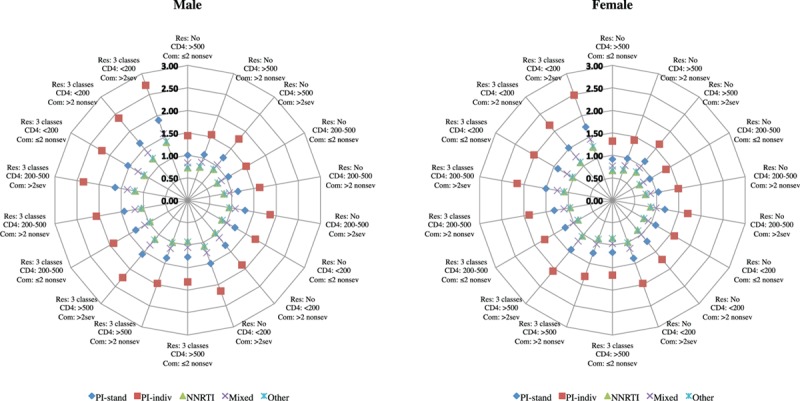
To analyze contemporary costs of HIV health care and the cost distribution across lines of combination antiretroviral therapy (cART). To identify variations in expenditures with patient characteristics and to identify main cost determinants. To compute cost ratios between patients with varying characteristics.Empirical data on costs are collected in Germany within a 2-year prospective observational noninterventional multicenter study. The database contains information for 1154 HIV-infected patients from 8 medical centers.Means and standard deviations of the total costs are estimated for each cost fraction and across cART lines and regimens. The costs are regressed against various patient characteristics using a generalized linear model. Relative costs are calculated using the resultant coefficients.The average annual total costs (SD) per patient are &OV0556;22,231.03 (8786.13) with a maximum of &OV0556;83,970. cART medication is the major cost fraction (83.8%) with a mean of &OV0556;18,688.62 (5289.48). The major cost-driving factors are cART regimen, CD4-T cell count, cART drug resistance, and concomitant diseases. Viral load, pathology tests, and demographics have no significant impact. Standard non-nucleoside reverse transcriptase inhibitor-based regimens induce 28% lower total costs compared with standard PI/r regimens. Resistance to 3 or more antiretroviral classes induces a significant increase in costs.HIV treatment in Germany continues to be expensive. Majority of costs are attributable to cART. Main cost determinants are CD4-T cells count, comorbidity, genotypic antiviral resistance, and therapy regimen. Combinations of characteristics associated with higher expenditures enhance the increasing effect on the costs and induce high cost cases.
分析当代艾滋病病毒医疗保健成本以及抗逆转录病毒联合疗法(cART)各治疗方案的成本分布。确定患者特征导致的支出差异,并找出主要成本决定因素。计算不同特征患者之间的成本比率。在德国进行了一项为期两年的前瞻性观察性非干预多中心研究,收集关于成本的实证数据。该数据库包含来自8个医疗中心的1154名艾滋病病毒感染患者的信息。估算每个成本部分、各cART治疗方案和治疗计划的总成本均值及标准差。使用广义线性模型将成本与各种患者特征进行回归分析。利用所得系数计算相对成本。每位患者的平均年度总成本(标准差)为22,231.03欧元(8786.13欧元),最高达83,970欧元。cART药物是主要成本部分(83.8%),均值为18,688.62欧元(5289.48欧元)。主要成本驱动因素为cART治疗方案、CD4-T细胞计数、cART耐药性和伴随疾病。病毒载量、病理检查和人口统计学因素无显著影响。与标准蛋白酶抑制剂/利托那韦(PI/r)治疗方案相比,基于标准非核苷类逆转录酶抑制剂的治疗方案使总成本降低28%。对三种或更多类抗逆转录病毒药物产生耐药性会导致成本显著增加。德国的艾滋病病毒治疗仍然昂贵。大部分成本归因于cART。主要成本决定因素为CD4-T细胞计数、合并症、基因型抗病毒耐药性和治疗方案。与较高支出相关的特征组合会增强对成本的递增影响,并导致高成本病例。