Sheets Anthony R, Massey Conner J, Cronk Stephen M, Iafrati Mark D, Herman Ira M
Graduate Program in Cellular & Molecular Physiology, The Sackler School of Graduate Biomedical Sciences, Tufts University, Boston, MA, 02111, USA.
Department of Developmental, Molecular and Chemical Biology, School of Medicine, Tufts University, 136 Harrison Ave, Boston, MA, 02111, USA.
J Transl Med. 2016 Jul 2;14(1):197. doi: 10.1186/s12967-016-0946-1.
Non-healing wounds are a major global health concern and account for the majority of non-traumatic limb amputations worldwide. However, compared to standard care practices, few advanced therapeutics effectively resolve these injuries stemming from cardiovascular disease, aging, and diabetes-related vasculopathies. While matrix turnover is disrupted in these injuries, debriding enzymes may promote healing by releasing matrix fragments that induce cell migration, proliferation, and morphogenesis, and plasma products may also stimulate these processes. Thus, we created matrix- and plasma-derived peptides, Comb1 and UN3, which induce cellular injury responses in vitro, and accelerate healing in rodent models of non-healing wounds. However, the effects of these peptides in non-healing wounds in diabetes are not known. Here, we interrogated whether these peptides stimulate healing in a diabetic porcine model highly reminiscent of human healing impairments in type 1 and type 2-diabetes.
After 3-6 weeks of streptozotocin-induced diabetes, full-thickness wounds were surgically created on the backs of adult female Yorkshire swine under general anesthesia. Comb1 and UN3 peptides or sterile saline (negative control) were administered to wounds daily for 3-7 days. Following sacrifice, wound tissues were harvested, and quantitative histological and immunohistochemical analyses were performed for wound closure, angiogenesis and granulation tissue deposition, along with quantitative molecular analyses of factors critical for angiogenesis, epithelialization, and dermal matrix remodeling.
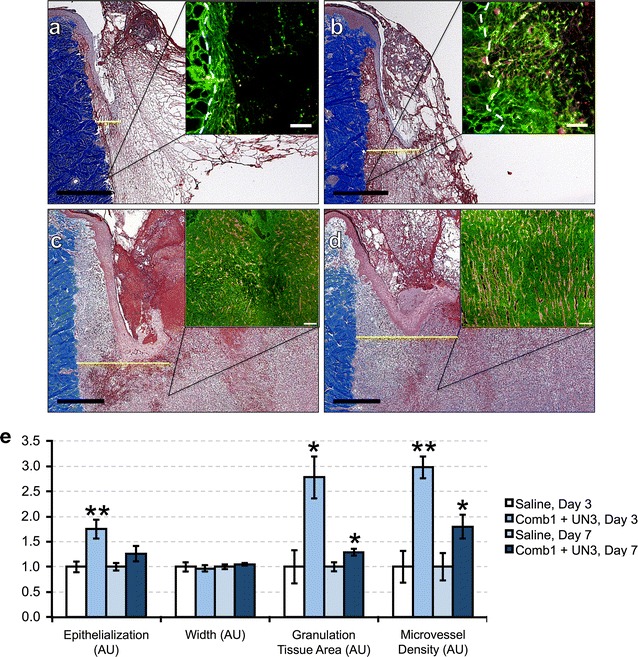
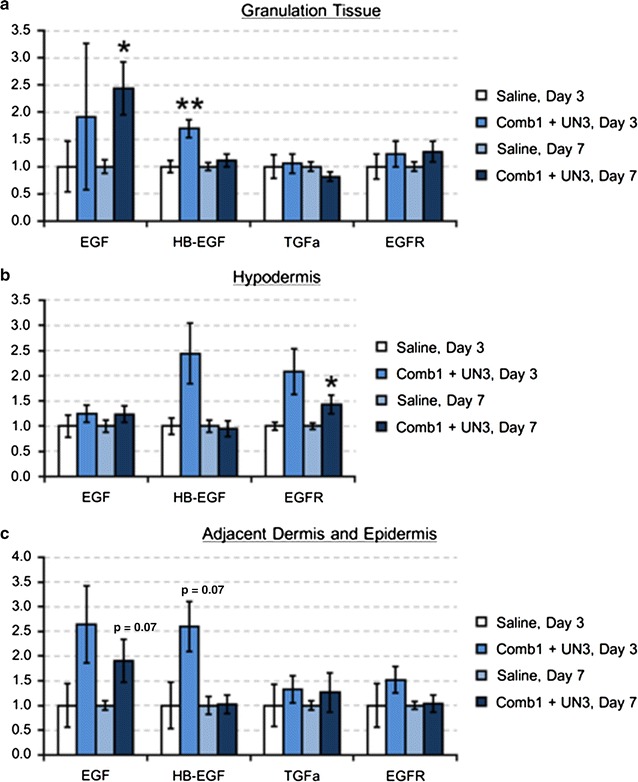
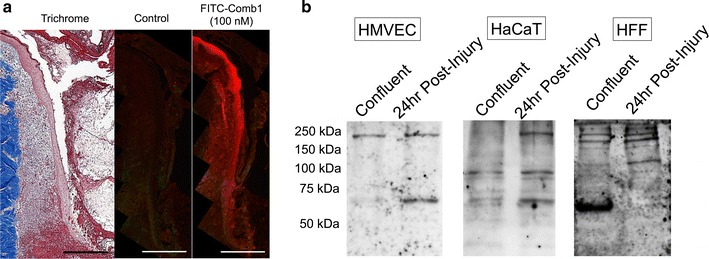
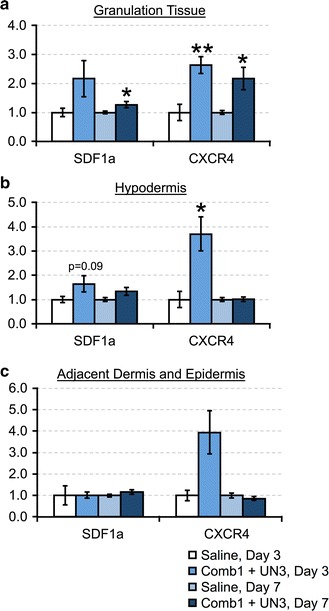
Comb1 and UN3 significantly increase re-epithelialization and angiogenesis in diabetic porcine wounds, compared to saline-treated controls. Additionally, fluorescein-conjugated Comb1 labels keratinocytes, fibroblasts, and vascular endothelial cells in porcine wounds, and Far western blotting reveals these cell populations express multiple fluorescein-Comb1-interacting proteins in vitro. Further, peptide treatment increases mRNA expression of several pro-angiogenic, epithelializing, and matrix-remodeling factors, importantly including balanced inductions in matrix metalloproteinase-2, -9, and tissue inhibitor of metalloproteinases-1, lending further insight into their mechanisms.
Comb1 and UN3 stimulate wound resolution in diabetic Yorkshire swine through upregulation of multiple reparative growth factors and cytokines, especially matrix metalloproteinases and inhibitors that may aid in reversing the proteolytic imbalance characteristic of chronically inflamed non-healing wounds. Together, these peptides should have great therapeutic potential for all patients in need of healing, regardless of injury etiology.
难愈合伤口是全球主要的健康问题,也是全球非创伤性肢体截肢的主要原因。然而,与标准护理方法相比,很少有先进的治疗方法能有效解决由心血管疾病、衰老和糖尿病相关血管病变引起的这些损伤。虽然在这些损伤中基质更新受到破坏,但清创酶可能通过释放诱导细胞迁移、增殖和形态发生的基质片段来促进愈合,血浆产物也可能刺激这些过程。因此,我们制备了基质和血浆衍生肽Comb1和UN3,它们在体外可诱导细胞损伤反应,并能加速难愈合伤口啮齿动物模型的愈合。然而,这些肽在糖尿病难愈合伤口中的作用尚不清楚。在此,我们研究了这些肽是否能在高度类似于1型和2型糖尿病患者愈合障碍的糖尿病猪模型中促进愈合。
在链脲佐菌素诱导糖尿病3 - 6周后,在全身麻醉下对成年雌性约克夏猪的背部进行全层伤口手术。每天给伤口施用Comb1和UN3肽或无菌盐水(阴性对照),持续3 - 7天。处死后,收集伤口组织,进行定量组织学和免疫组织化学分析,以评估伤口闭合、血管生成和肉芽组织沉积情况,同时对血管生成、上皮形成和真皮基质重塑的关键因子进行定量分子分析。
与盐水处理的对照组相比,Comb1和UN3显著增加了糖尿病猪伤口的再上皮化和血管生成。此外,荧光素偶联的Comb1标记猪伤口中的角质形成细胞、成纤维细胞和血管内皮细胞,Far western印迹显示这些细胞群体在体外表达多种与荧光素-Comb1相互作用的蛋白质。此外,肽处理增加了几种促血管生成、上皮形成和基质重塑因子的mRNA表达,重要的是包括基质金属蛋白酶-2、-9和金属蛋白酶组织抑制剂-1的平衡诱导,这进一步深入了解了它们的作用机制。
Comb1和UN3通过上调多种修复性生长因子和细胞因子,特别是基质金属蛋白酶和抑制剂,刺激糖尿病约克夏猪伤口的愈合,这些因子可能有助于逆转慢性炎症难愈合伤口的蛋白水解失衡特征。总之,这些肽对所有需要愈合的患者都具有巨大的治疗潜力,无论损伤病因如何。