Maßberg Désirée, Jovancevic Nikolina, Offermann Anne, Simon Annika, Baniahmad Aria, Perner Sven, Pungsrinont Thanakorn, Luko Katarina, Philippou Stathis, Ubrig Burkhard, Heiland Markus, Weber Lea, Altmüller Janine, Becker Christian, Gisselmann Günter, Gelis Lian, Hatt Hanns
Department of Cell Physiology, Ruhr-University Bochum, Bochum, Germany.
Pathology of the University Hospital of Luebeck and the Leibniz Research Center Borstel, Luebeck and Borstel, Germany.
Oncotarget. 2016 Jul 26;7(30):48231-48249. doi: 10.18632/oncotarget.10197.
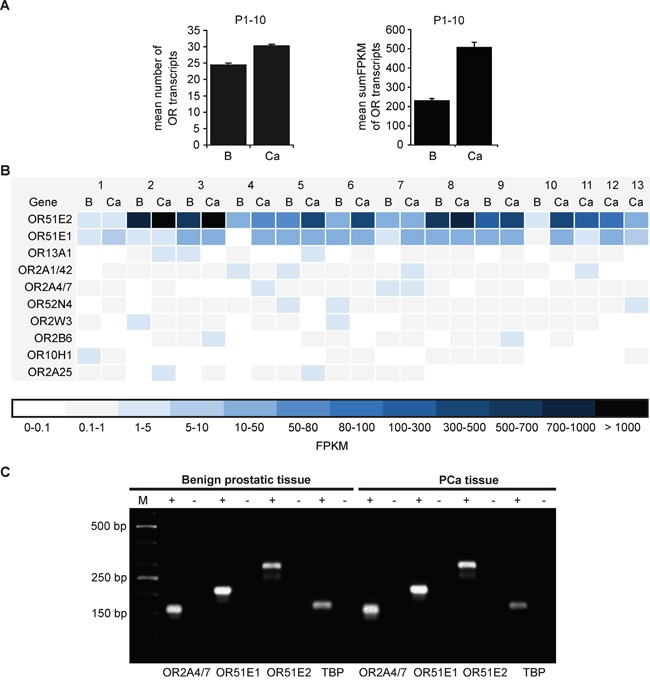
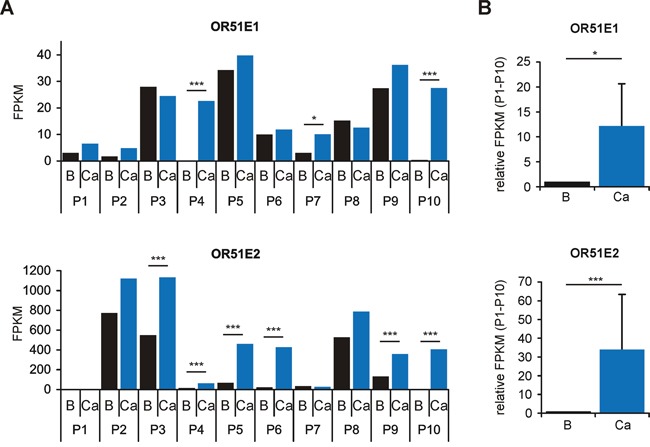
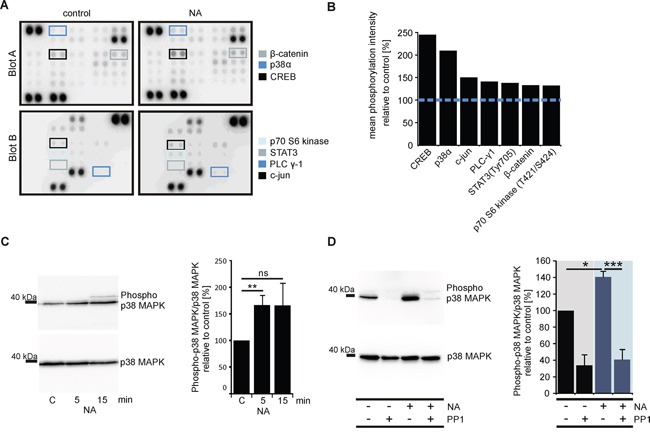
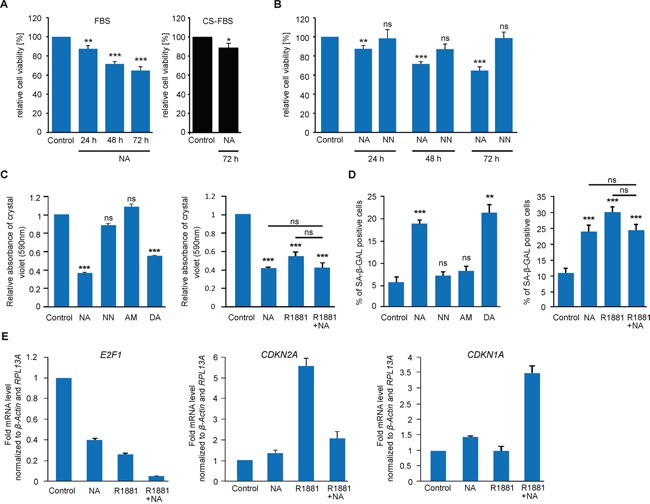
The development of prostate cancer (PCa) is regulated by the androgen-dependent activity of the androgen receptor (AR). Androgen-deprivation therapy (ADT) is therefore the gold standard treatment to suppress malignant progression of PCa. Nevertheless, due to the development of castration resistance, recurrence of disease after initial response to ADT is a major obstacle to successful treatment. As G-protein coupled receptors play a fundamental role in PCa physiology, they might represent promising alternative or combinatorial targets for advanced diseases. Here, we verified gene expression of the olfactory receptors (ORs) OR51E1 [prostate-specific G-protein coupled receptor 2 (PSGR2)] and OR51E2 (PSGR) in human PCa tissue by RNA-Seq analysis and RT-PCR and elucidated the subcellular localization of both receptor proteins in human prostate tissue. The OR51E1 agonist nonanoic acid (NA) leads to the phosphorylation of various protein kinases and growth suppression of the PCa cell line LNCaP. Furthermore, treatment with NA causes reduction of androgen-mediated AR target gene expression. Interestingly, NA induces cellular senescence, which coincides with reduced E2F1 mRNA levels. In contrast, treatment with the structurally related compound 1-nonanol or the OR2AG1 agonist amyl butyrate, neither of which activates OR51E1, did not lead to reduced cell growth or an induction of cellular senescence. However, decanoic acid, another OR51E1 agonist, also induces cellular senescence. Thus, our results suggest the involvement of OR51E1 in growth processes of PCa cells and its impact on AR-mediated signaling. These findings provide novel evidences to support the functional importance of ORs in PCa pathogenesis.
前列腺癌(PCa)的发展受雄激素受体(AR)的雄激素依赖性活性调控。因此,雄激素剥夺疗法(ADT)是抑制PCa恶性进展的金标准治疗方法。然而,由于去势抵抗的出现,在对ADT产生初始反应后疾病复发是成功治疗的主要障碍。由于G蛋白偶联受体在PCa生理学中起基本作用,它们可能是晚期疾病有前景的替代或联合靶点。在此,我们通过RNA测序分析和逆转录聚合酶链反应(RT-PCR)验证了人PCa组织中嗅觉受体(ORs)OR51E1[前列腺特异性G蛋白偶联受体2(PSGR2)]和OR51E2(PSGR)的基因表达,并阐明了这两种受体蛋白在人前列腺组织中的亚细胞定位。OR51E1激动剂壬酸(NA)导致多种蛋白激酶磷酸化并抑制PCa细胞系LNCaP的生长。此外,用NA处理会导致雄激素介导的AR靶基因表达降低。有趣的是,NA诱导细胞衰老,这与E2F1 mRNA水平降低一致。相比之下,用结构相关化合物1-壬醇或OR2AG1激动剂丁酸戊酯处理,这两种化合物均不激活OR51E1,不会导致细胞生长减少或诱导细胞衰老。然而,另一种OR51E1激动剂癸酸也诱导细胞衰老。因此,我们的结果表明OR51E1参与PCa细胞的生长过程及其对AR介导信号传导的影响。这些发现为支持ORs在PCa发病机制中的功能重要性提供了新证据。