Lamb Trevor D, Kraft Timothy W
Eccles Institute of Neuroscience, John Curtin School of Medical Research, The Australian National University, Canberra, ACT, Australia.
Department of Optometry and Vision Science, University of Alabama at Birmingham, Birmingham, AL.
Mol Vis. 2016 Jun 17;22:674-96. eCollection 2016.
To examine the predictions of alternative models for the stochastic shut-off of activated rhodopsin (R*) and their implications for the interpretation of experimentally recorded single-photon responses (SPRs) in mammalian rods.
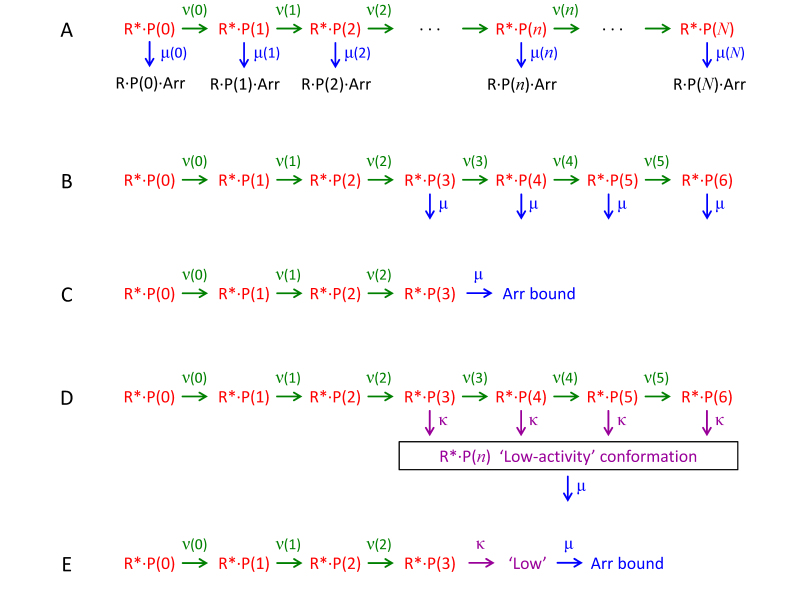
We analyze the transitions that an activated R* molecule undergoes as a result of successive phosphorylation steps and arrestin binding. We consider certain simplifying cases for the relative magnitudes of the reaction rate constants and derive the probability distributions for the time to arrestin binding. In addition to the conventional model in which R* catalytic activity declines in a graded manner with successive phosphorylations, we analyze two cases in which the activity is assumed to occur not via multiple small steps upon each phosphorylation but via a single large step. We refer to these latter two cases as the binary R* shut-off and three-state R* shut-off models.
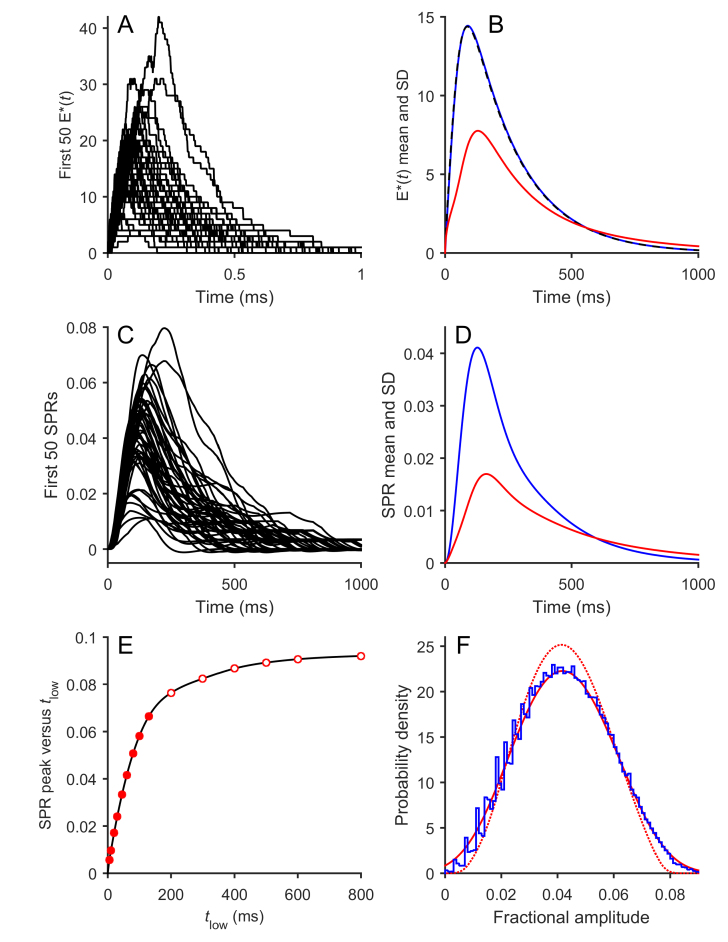
We simulate R*'s stochastic reactions numerically for the three models. In the simplifying cases for the ratio of rate constants in the binary and three-state models, we show that the probability distribution of the time to arrestin binding is accurately predicted. To simulate SPRs, we then integrate the differential equations for the downstream reactions using a standard model of the rod outer segment that includes longitudinal diffusion of cGMP and Ca(2+).
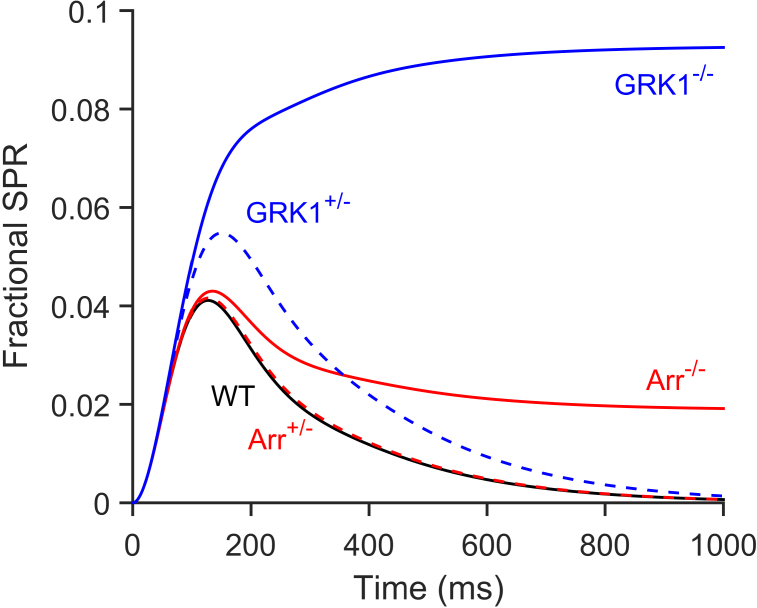
Our simulations of SPRs in the conventional model of graded shut-off of R* conform closely to the simulations in a recent study. However, the gain factor required to account for the observed mean SPR amplitude is higher than can be accounted for from biochemical experiments. In addition, a substantial minority of the simulated SPRs exhibit features that have not been reported in published experiments. Our simulations of SPRs using the model of binary R* shut-off appear to conform closely to experimental results for wild type (WT) mouse rods, and the required gain factor conforms to biochemical expectations. However, for the arrestin knockout (Arr(-/-)) phenotype, the predictions deviated from experimental findings and led us to invoke a low-activity state that R* enters before arrestin binding. Our simulations of this three-state R* shut-off model are very similar to those of the binary model in the WT case but are preferred because they appear to accurately predict the mean SPRs for four mutant phenotypes, Arr(+/-), Arr(-/-), GRK1(+/-), and GRK1(-/-), in addition to the WT phenotype. When we additionally treated the formation and shut-off of activated phosphodiesterase (E*) as stochastic, the simulated SPRs appeared even more similar to real SPRs, and there was very little change in the ensemble mean and standard deviation or in the amplitude distribution.
We conclude that the conventional model of graded reduction in R* activity through successive phosphorylation steps appears to be inconsistent with experimental results. Instead, we find that two variants of a model in which R* activity initially remains high and then declines abruptly after several phosphorylation steps appears capable of providing a better description of experimentally measured SPRs.
研究激活型视紫红质(R*)随机关闭的替代模型预测及其对哺乳动物视杆细胞中实验记录的单光子反应(SPR)解释的影响。
我们分析了激活的R分子由于连续的磷酸化步骤和抑制蛋白结合而经历的转变。我们考虑了反应速率常数相对大小的某些简化情况,并推导了抑制蛋白结合时间的概率分布。除了传统模型,即R催化活性随着连续磷酸化以分级方式下降外,我们还分析了两种情况,其中假设活性不是通过每次磷酸化的多个小步骤发生,而是通过单个大步骤发生。我们将后两种情况称为二元R关闭模型和三态R关闭模型。
我们对这三种模型进行了R*随机反应的数值模拟。在二元和三态模型中速率常数比的简化情况下,我们表明抑制蛋白结合时间的概率分布得到了准确预测。为了模拟SPR,我们随后使用包含cGMP和Ca(2+)纵向扩散的视杆细胞外段标准模型对方程进行积分。
我们在R分级关闭的传统模型中对SPR的模拟与最近一项研究中的模拟非常吻合。然而,解释观察到的平均SPR幅度所需的增益因子高于生化实验所能解释的范围。此外,相当一部分模拟的SPR表现出已发表实验中未报道的特征。我们使用二元R关闭模型对SPR的模拟似乎与野生型(WT)小鼠视杆细胞的实验结果非常吻合,并且所需的增益因子符合生化预期。然而,对于抑制蛋白敲除(Arr(-/-))表型,预测结果与实验结果偏差较大,这使我们提出R在抑制蛋白结合之前进入低活性状态。我们对这种三态R关闭模型的模拟在WT情况下与二元模型非常相似,但更受青睐,因为它们似乎能准确预测除WT表型外的四种突变表型Arr(+/-)、Arr(-/-)、GRK1(+/-)和GRK1(-/-)的平均SPR。当我们另外将激活的磷酸二酯酶(E*)的形成和关闭视为随机过程时,模拟的SPR与真实的SPR更加相似,并且总体平均值、标准差或幅度分布几乎没有变化。
我们得出结论,通过连续磷酸化步骤使R活性分级降低的传统模型似乎与实验结果不一致。相反,我们发现一种模型的两个变体,其中R活性最初保持较高,然后在几个磷酸化步骤后突然下降,似乎能够更好地描述实验测量的SPR。