Lang Martin, Mitkidis Panagiotis, Kundt Radek, Nichols Aaron, Krajčíková Lenka, Xygalatas Dimitris
Department of Anthropology, University of ConnecticutStorrs, CT, USA; LEVYNA Laboratory for the Experimental Research of Religion, Department for the Study of Religions, Masaryk UniversityBrno, Czech Republic.
Center for Advanced Hindsight, Social Science Research Institute, Duke UniversityDurham, NC, USA; Interacting Minds Centre, Department of Culture and Society, Aarhus UniversityAarhus, Denmark; Interdisciplinary Centre for Organizational Architecture, Department of Management, Aarhus UniversityAarhus, Denmark.
Front Psychol. 2016 Jun 7;7:814. doi: 10.3389/fpsyg.2016.00814. eCollection 2016.
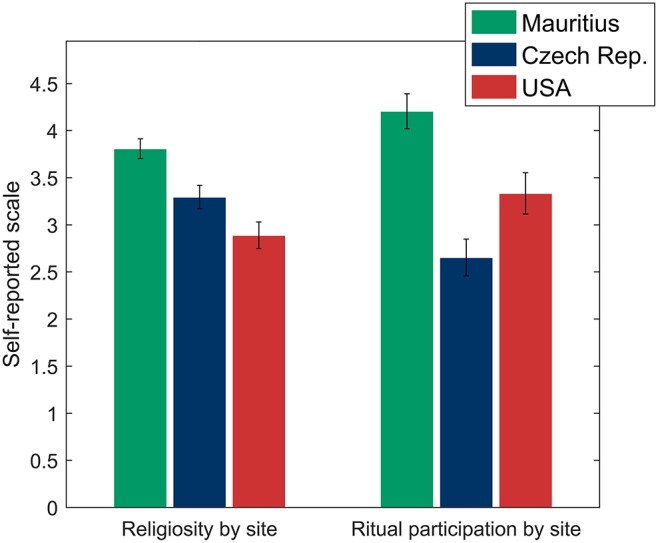
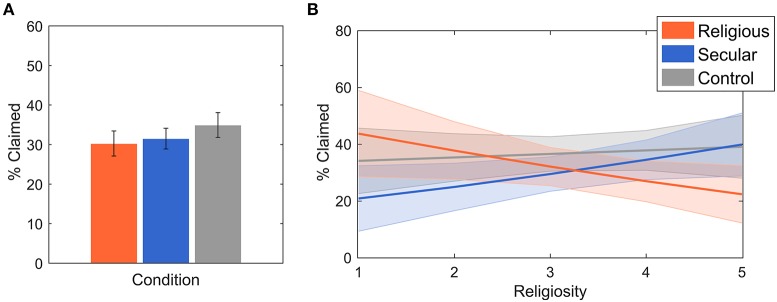
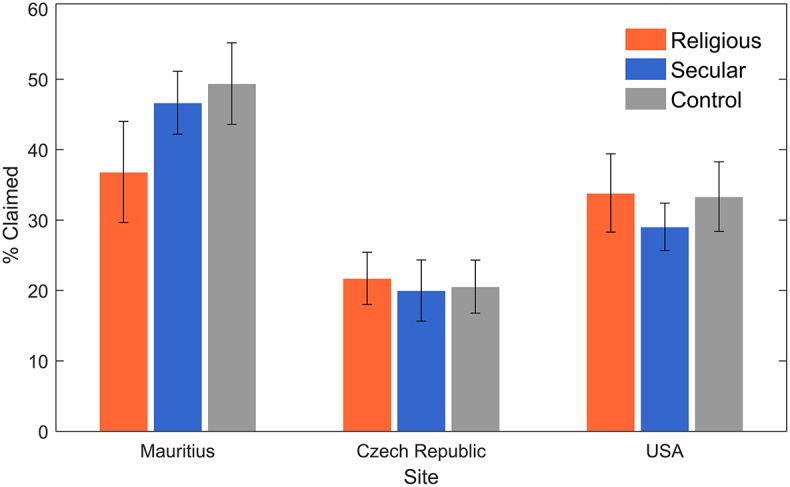
Religion can have an important influence in moral decision-making, and religious reminders may deter people from unethical behavior. Previous research indicated that religious contexts may increase prosocial behavior and reduce cheating. However, the perceptual-behavioral link between religious contexts and decision-making lacks thorough scientific understanding. This study adds to the current literature by testing the effects of purely audial religious symbols (instrumental music) on moral behavior across three different sites: Mauritius, the Czech Republic, and the USA. Participants were exposed to one of three kinds of auditory stimuli (religious, secular, or white noise), and subsequently were given a chance to dishonestly report on solved mathematical equations in order to increase their monetary reward. The results showed cross-cultural differences in the effects of religious music on moral behavior, as well as a significant interaction between condition and religiosity across all sites, suggesting that religious participants were more influenced by the auditory religious stimuli than non-religious participants. We propose that religious music can function as a subtle cue associated with moral standards via cultural socialization and ritual participation. Such associative learning can charge music with specific meanings and create sacred cues that influence normative behavior. Our findings provide preliminary support for this view, which we hope further research will investigate more closely.
宗教在道德决策中可能具有重要影响,宗教提示可能会阻止人们做出不道德行为。先前的研究表明,宗教背景可能会增加亲社会行为并减少作弊行为。然而,宗教背景与决策之间的感知-行为联系缺乏全面的科学理解。本研究通过在三个不同地点(毛里求斯、捷克共和国和美国)测试纯听觉宗教符号(器乐)对道德行为的影响,为当前文献增添了内容。参与者接触三种听觉刺激之一(宗教的、世俗的或白噪音),随后有机会不诚实地报告已解决的数学方程式,以增加他们的金钱奖励。结果表明,宗教音乐对道德行为的影响存在跨文化差异,并且在所有地点条件与宗教虔诚度之间存在显著交互作用,这表明宗教参与者比非宗教参与者更容易受到听觉宗教刺激的影响。我们认为,宗教音乐可以通过文化社会化和仪式参与,作为与道德标准相关的微妙线索发挥作用。这种联想学习可以赋予音乐特定的含义,并创造出影响规范行为的神圣线索。我们的研究结果为这一观点提供了初步支持,希望进一步的研究能更深入地探讨。