Cartaxana Paulo, Cruz Sónia, Gameiro Carla, Kühl Michael
Marine Biological Section, Department of Biology, University of Copenhagen Helsingør, Denmark.
Marine Biological Section, Department of Biology, University of CopenhagenHelsingør, Denmark; Departamento de Biologia and Centro de Estudos do Ambiente e do Mar, Universidade de AveiroAveiro, Portugal.
Front Microbiol. 2016 Jun 7;7:872. doi: 10.3389/fmicb.2016.00872. eCollection 2016.
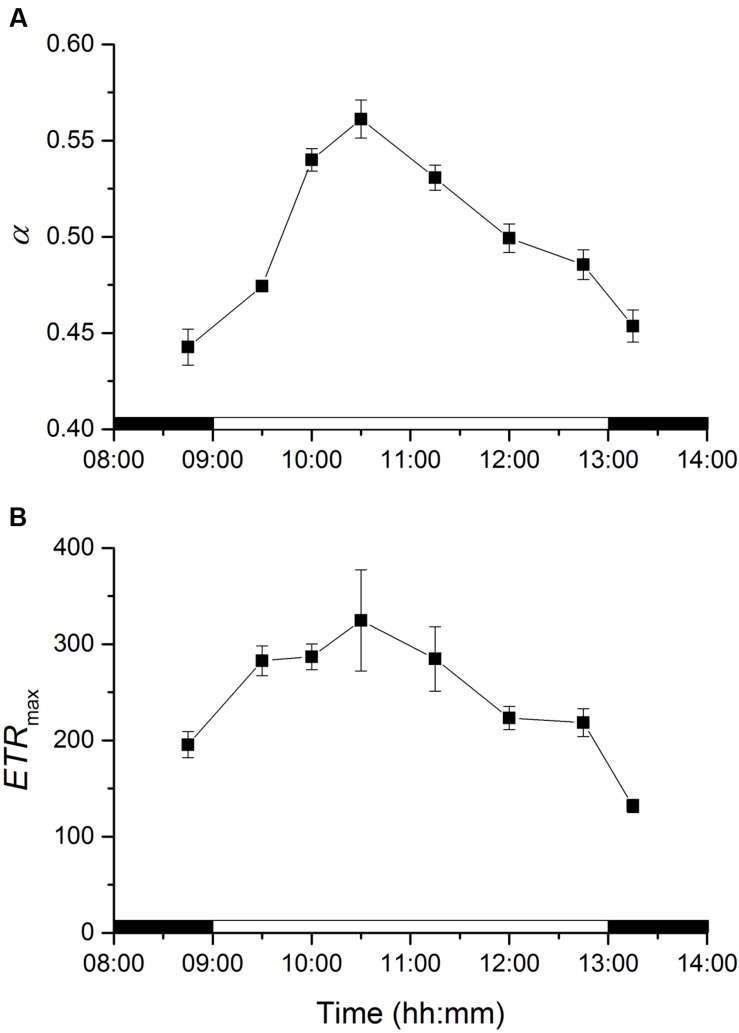
Changes in biomass and photosynthesis of a diatom-dominated microphytobenthos (MPB) intertidal community were studied over a diel emersion period using a combination of O2 and scalar irradiance microprofiling, variable chlorophyll (Chl) fluorescence, and pigment analysis. The MPB biomass in the photic zone (0-0.5 mm) of the sediment exposed to low irradiance (150 μmol photons m(-2) s(-1)) showed a >2-fold increase during the first hours of the emersion period, reaching >0.2 mg Chl a cm(-3). Concentrations of Chl a started to decrease half-way through the emersion period, almost 2 h before tidal inundation. Similarly, O2 concentrations and volumetric gross photosynthesis in the photic zone increased during the first half of the emersion period and then decreased toward the timing of incoming tide/darkness. The results suggest that intertidal MPB community-level photosynthesis is mainly controlled by changes in the productive biomass of the photic zone determined by cell migration. A diel pattern in the photosynthesis vs. irradiance parameters α (photosynthetic efficiency at limiting irradiance) and ETR max (photosynthetic capacity at saturating irradiance) was also observed, suggesting photoacclimation of MPB. Under high light exposure (2000 μmol photons m(-2) s(-1)), lower α, ETR max and sediment O2 concentrations were observed when cell migration was inhibited with the diatom motility inhibitor latrunculin A (Lat A), showing that migration is also used by MPB to maximize photosynthesis by reducing exposure to potentially photoinhibitory light levels. A higher de-epoxidation state in sediment treated with Lat A indicates that the involvement of the xanthophyll cycle in physiological photoprotection is more relevant in MPB when cells are inhibited from migrating. In the studied diatom-dominated MPB intertidal community, cell migration seems to be the key factor regulating photosynthesis over a diel emersion period and upon changes in light exposure.
利用氧气和标量辐照度微剖面分析、可变叶绿素(Chl)荧光分析以及色素分析相结合的方法,研究了以硅藻为主的微型底栖藻类(MPB)潮间带群落生物量和光合作用在一个昼夜暴露期内的变化。暴露于低辐照度(150 μmol光子 m⁻² s⁻¹)下的沉积物光区(0 - 0.5毫米)中的MPB生物量在暴露期的最初几个小时内增加了两倍多,达到>0.2毫克Chl a cm⁻³。Chl a浓度在暴露期过半时开始下降,几乎在潮水淹没前2小时。同样,光区的氧气浓度和体积总光合作用在暴露期的前半段增加,然后随着涨潮/黑暗时刻的临近而下降。结果表明,潮间带MPB群落水平的光合作用主要受细胞迁移决定的光区生产性生物量变化的控制。还观察到光合作用与辐照度参数α(限制辐照度下的光合效率)和ETR max(饱和辐照度下的光合能力)的昼夜模式,表明MPB存在光适应。在高光暴露(2000 μmol光子 m⁻² s⁻¹)下,当用硅藻运动抑制剂拉特runculin A(Lat A)抑制细胞迁移时,观察到较低的α、ETR max和沉积物氧气浓度,这表明迁移也被MPB用于通过减少对潜在光抑制光水平的暴露来最大化光合作用。用Lat A处理的沉积物中较高的脱环氧化状态表明,当细胞迁移受到抑制时,叶黄素循环在生理光保护中的参与在MPB中更为重要。在所研究的以硅藻为主的MPB潮间带群落中,细胞迁移似乎是在一个昼夜暴露期和光照变化时调节光合作用的关键因素。