Merfa Marcus V, Niza Bárbara, Takita Marco A, De Souza Alessandra A
Instituto Agronômico, Centro de Citricultura Sylvio MoreiraCordeirópolis, Brazil; Departamento de Genética, Evolução e Bioagentes, Universidade Estadual de CampinasCampinas, Brazil.
Instituto Agronômico, Centro de Citricultura Sylvio Moreira Cordeirópolis, Brazil.
Front Microbiol. 2016 Jun 10;7:904. doi: 10.3389/fmicb.2016.00904. eCollection 2016.
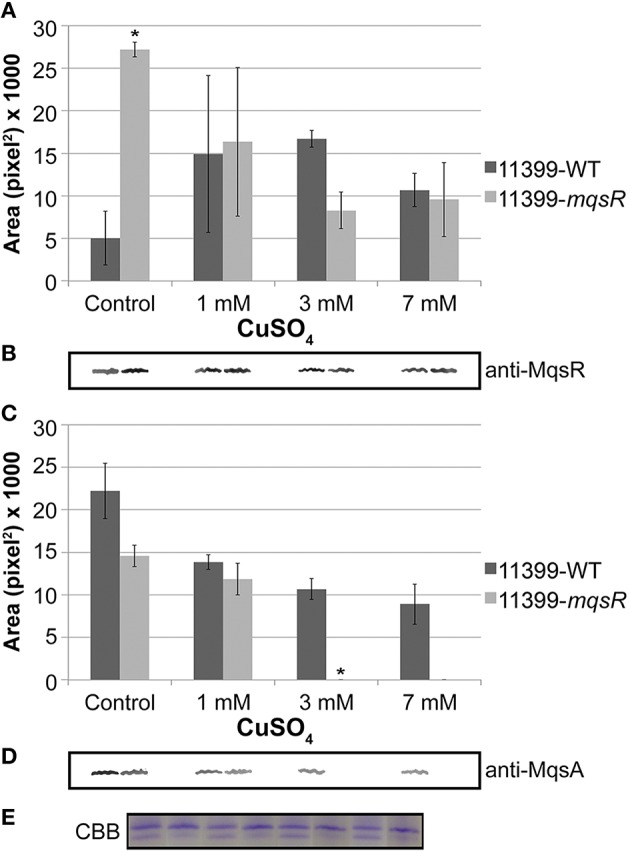
Through the formation of persister cells, bacteria exhibit tolerance to multidrug and other environmental stresses without undergoing genetic changes. The toxin-antitoxin (TA) systems are involved in the formation of persister cells because they are able to induce cell dormancy. Among the TA systems, the MqsRA system has been observed to be highly induced in persister cells of Xylella fastidiosa (causal agent of citrus variegated chlorosis-CVC) activated by copper stress, and has been described in Escherichia coli as related to the formation of persister cells and biofilms. Thus, we evaluated the role of this TA system in X. fastidiosa by overexpressing the MqsR toxin, and verified that the toxin positively regulated biofilm formation and negatively cell movement, resulting in reduced pathogenicity in citrus plants. The overexpression of MqsR also increased the formation of persister cells under copper stress. Analysis of the gene and protein expression showed that this system likely has an autoregulation mechanism to express the toxin and antitoxin in the most beneficial ratio for the cell to oppose stress. Our results suggest that this TA system plays a key role in the adaptation and survival of X. fastidiosa and reveal new insights into the physiology of phytopathogen-host interactions.
通过形成持留菌,细菌对多种药物和其他环境压力表现出耐受性,而无需经历基因变化。毒素-抗毒素(TA)系统参与持留菌的形成,因为它们能够诱导细胞休眠。在TA系统中,已观察到MqsRA系统在受到铜胁迫激活的桑氏假单胞菌(柑橘杂色黄化病-CVC的病原体)的持留菌中高度诱导,并且在大肠杆菌中已被描述为与持留菌和生物膜的形成有关。因此,我们通过过表达MqsR毒素评估了该TA系统在桑氏假单胞菌中的作用,并证实该毒素正向调节生物膜形成,负向调节细胞运动,导致柑橘植物中的致病性降低。MqsR的过表达还增加了铜胁迫下持留菌的形成。基因和蛋白质表达分析表明,该系统可能具有一种自动调节机制,以最有利于细胞对抗压力的比例表达毒素和抗毒素。我们的结果表明,该TA系统在桑氏假单胞菌的适应和存活中起关键作用,并揭示了对植物病原体-宿主相互作用生理学的新见解。