Wehbi Vanessa L, Taskén Kjetil
Nordic EMBL Partnership, Centre for Molecular Medicine Norway, Oslo University Hospital, University of Oslo, Oslo, Norway; Jebsen Inflammation Research Centre, Oslo University Hospital, Oslo, Norway; Biotechnology Centre, Oslo University Hospital, University of Oslo, Oslo, Norway.
Nordic EMBL Partnership, Centre for Molecular Medicine Norway, Oslo University Hospital, University of Oslo, Oslo, Norway; Jebsen Inflammation Research Centre, Oslo University Hospital, Oslo, Norway; Biotechnology Centre, Oslo University Hospital, University of Oslo, Oslo, Norway; Jebsen Centre for Cancer Immunotherapy, Oslo University Hospital, Oslo, Norway; Department of Infectious Diseases, Oslo University Hospital, Oslo, Norway.
Front Immunol. 2016 Jun 8;7:222. doi: 10.3389/fimmu.2016.00222. eCollection 2016.
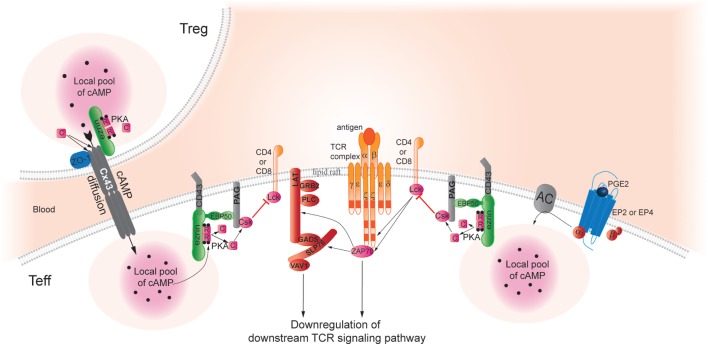
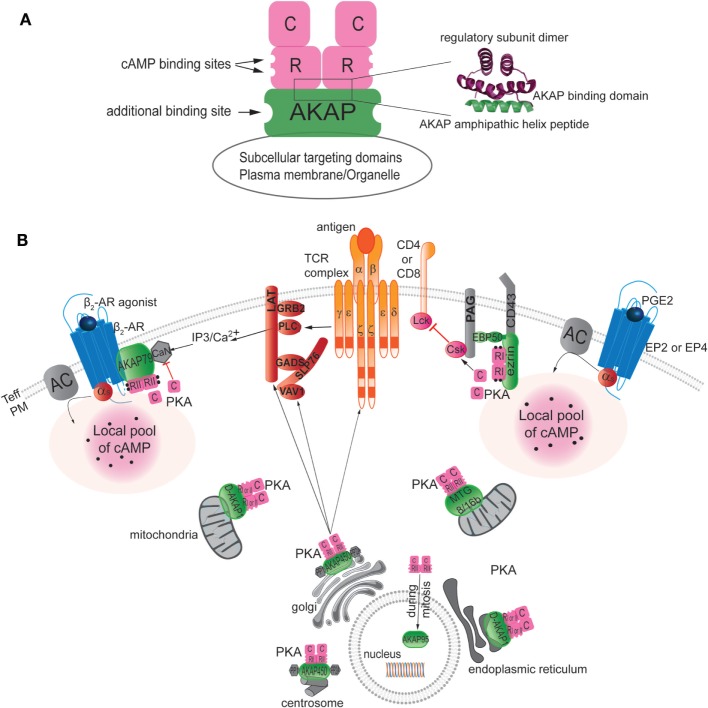
The cyclic AMP/protein kinase A (cAMP/PKA) pathway is one of the most common and versatile signal pathways in eukaryotic cells. A-kinase anchoring proteins (AKAPs) target PKA to specific substrates and distinct subcellular compartments providing spatial and temporal specificity for mediation of biological effects channeled through the cAMP/PKA pathway. In the immune system, cAMP is a potent negative regulator of T cell receptor-mediated activation of effector T cells (Teff) acting through a proximal PKA/Csk/Lck pathway anchored via a scaffold consisting of the AKAP Ezrin holding PKA, the linker protein EBP50, and the anchoring protein phosphoprotein associated with glycosphingolipid-enriched microdomains holding Csk. As PKA activates Csk and Csk inhibits Lck, this pathway in response to cAMP shuts down proximal T cell activation. This immunomodulating pathway in Teff mediates clinically important responses to regulatory T cell (Treg) suppression and inflammatory mediators, such as prostaglandins (PGs), adrenergic stimuli, adenosine, and a number of other ligands. A major inducer of T cell cAMP levels is PG E2 (PGE2) acting through EP2 and EP4 prostanoid receptors. PGE2 plays a crucial role in the normal physiological control of immune homeostasis as well as in inflammation and cancer immune evasion. Peripherally induced Tregs express cyclooxygenase-2, secrete PGE2, and elicit the immunosuppressive cAMP pathway in Teff as one tumor immune evasion mechanism. Moreover, a cAMP increase can also be induced by indirect mechanisms, such as intercellular transfer between T cells. Indeed, Treg, known to have elevated levels of intracellular cAMP, may mediate their suppressive function by transferring cAMP to Teff through gap junctions, which we speculate could also be regulated by PKA/AKAP complexes. In this review, we present an updated overview on the influence of cAMP-mediated immunoregulatory mechanisms acting through localized cAMP signaling and the therapeutical increasing prospects of AKAPs disruptors in T-cell immune function.
环磷酸腺苷/蛋白激酶A(cAMP/PKA)信号通路是真核细胞中最常见、最具通用性的信号通路之一。A激酶锚定蛋白(AKAPs)将PKA靶向特定底物和不同的亚细胞区室,为通过cAMP/PKA信号通路介导的生物学效应提供时空特异性。在免疫系统中,cAMP是T细胞受体介导的效应T细胞(Teff)激活的强效负调节因子,其作用通过近端PKA/Csk/Lck信号通路实现,该通路由一个支架锚定,该支架由结合PKA的AKAP埃兹蛋白、接头蛋白EBP50以及与富含糖鞘脂微区结合的锚定蛋白磷蛋白组成,后者结合Csk。由于PKA激活Csk且Csk抑制Lck,因此该响应cAMP的信号通路会关闭近端T细胞激活。Teff中的这种免疫调节信号通路介导了对调节性T细胞(Treg)抑制以及炎症介质(如前列腺素(PGs)、肾上腺素能刺激、腺苷和许多其他配体)的重要临床反应。T细胞cAMP水平的主要诱导剂是通过EP2和EP4前列腺素受体起作用的前列腺素E2(PGE2)。PGE2在免疫稳态的正常生理控制以及炎症和癌症免疫逃逸中都起着关键作用。外周诱导的Tregs表达环氧合酶-2,分泌PGE2,并在Teff中引发免疫抑制性cAMP信号通路,这是一种肿瘤免疫逃逸机制。此外,cAMP的增加也可由间接机制诱导,如T细胞之间的细胞间转移。事实上,已知细胞内cAMP水平升高的Treg可能通过间隙连接将cAMP转移至Teff来介导其抑制功能,我们推测这也可能受PKA/AKAP复合物调节。在本综述中,我们提供了关于通过局部cAMP信号传导发挥作用的cAMP介导的免疫调节机制的影响以及AKAPs破坏剂在T细胞免疫功能方面治疗前景的最新概述。