Diehl Alexander D, Meehan Terrence F, Bradford Yvonne M, Brush Matthew H, Dahdul Wasila M, Dougall David S, He Yongqun, Osumi-Sutherland David, Ruttenberg Alan, Sarntivijai Sirarat, Van Slyke Ceri E, Vasilevsky Nicole A, Haendel Melissa A, Blake Judith A, Mungall Christopher J
Department of Neurology, University at Buffalo School of Medicine and Biomedical Sciences, Buffalo, NY, 14203, USA.
European Molecular Biology Laboratory, European Bioinformatics Institute, Hinxton, Cambridge, CB10 1SD, UK.
J Biomed Semantics. 2016 Jul 4;7(1):44. doi: 10.1186/s13326-016-0088-7.
The Cell Ontology (CL) is an OBO Foundry candidate ontology covering the domain of canonical, natural biological cell types. Since its inception in 2005, the CL has undergone multiple rounds of revision and expansion, most notably in its representation of hematopoietic cells. For in vivo cells, the CL focuses on vertebrates but provides general classes that can be used for other metazoans, which can be subtyped in species-specific ontologies.
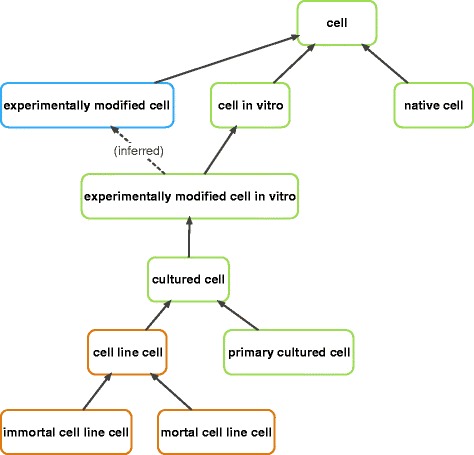
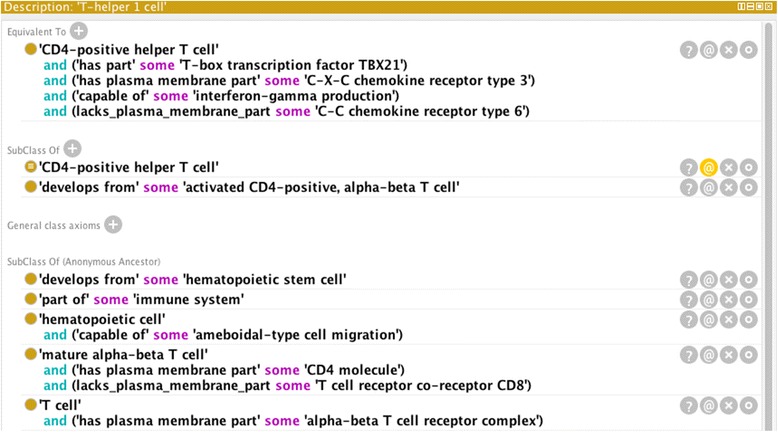
Recent work on the CL has focused on extending the representation of various cell types, and developing new modules in the CL itself, and in related ontologies in coordination with the CL. For example, the Kidney and Urinary Pathway Ontology was used as a template to populate the CL with additional cell types. In addition, subtypes of the class 'cell in vitro' have received improved definitions and labels to provide for modularity with the representation of cells in the Cell Line Ontology and Reagent Ontology. Recent changes in the ontology development methodology for CL include a switch from OBO to OWL for the primary encoding of the ontology, and an increasing reliance on logical definitions for improved reasoning.
The CL is now mandated as a metadata standard for large functional genomics and transcriptomics projects, and is used extensively for annotation, querying, and analyses of cell type specific data in sequencing consortia such as FANTOM5 and ENCODE, as well as for the NIAID ImmPort database and the Cell Image Library. The CL is also a vital component used in the modular construction of other biomedical ontologies-for example, the Gene Ontology and the cross-species anatomy ontology, Uberon, use CL to support the consistent representation of cell types across different levels of anatomical granularity, such as tissues and organs.
The ongoing improvements to the CL make it a valuable resource to both the OBO Foundry community and the wider scientific community, and we continue to experience increased interest in the CL both among developers and within the user community.
细胞本体(CL)是OBO铸造厂候选本体,涵盖标准自然生物细胞类型领域。自2005年创建以来,CL经历了多轮修订和扩展,最显著的是在造血细胞的表示方面。对于体内细胞,CL专注于脊椎动物,但提供了可用于其他后生动物的通用类,这些类可在物种特异性本体中进行细分。
CL的近期工作重点是扩展各种细胞类型的表示,在CL本身以及与CL协调的相关本体中开发新模块。例如,肾脏和泌尿途径本体被用作模板,为CL添加额外的细胞类型。此外,“体外细胞”类的子类型已获得改进的定义和标签,以便与细胞系本体和试剂本体中的细胞表示实现模块化。CL本体开发方法的近期变化包括从OBO转换为OWL用于本体的主要编码,以及越来越依赖逻辑定义以改进推理。
CL现在被指定为大型功能基因组学和转录组学项目的元数据标准,并广泛用于注释、查询和分析测序联盟(如FANTOM5和ENCODE)中细胞类型特异性数据,以及用于NIAID ImmPort数据库和细胞图像库。CL也是用于构建其他生物医学本体的重要组成部分——例如,基因本体和跨物种解剖本体Uberon使用CL来支持跨不同解剖粒度级别(如组织和器官)的细胞类型的一致表示。
CL的持续改进使其成为OBO铸造厂社区和更广泛科学界的宝贵资源,并且我们继续看到开发者和用户社区对CL的兴趣不断增加。