Haendel Melissa A, Balhoff James P, Bastian Frederic B, Blackburn David C, Blake Judith A, Bradford Yvonne, Comte Aurelie, Dahdul Wasila M, Dececchi Thomas A, Druzinsky Robert E, Hayamizu Terry F, Ibrahim Nizar, Lewis Suzanna E, Mabee Paula M, Niknejad Anne, Robinson-Rechavi Marc, Sereno Paul C, Mungall Christopher J
Department of Medical Informatics & Epidemiology, Oregon Health & Science University, Portland, OR, USA.
Department of Biology, University of North Carolina, Chapel Hill, NC 27599-3280, USA ; National Evolutionary Synthesis Center, Durham, NC, USA.
J Biomed Semantics. 2014 May 19;5:21. doi: 10.1186/2041-1480-5-21. eCollection 2014.
Elucidating disease and developmental dysfunction requires understanding variation in phenotype. Single-species model organism anatomy ontologies (ssAOs) have been established to represent this variation. Multi-species anatomy ontologies (msAOs; vertebrate skeletal, vertebrate homologous, teleost, amphibian AOs) have been developed to represent 'natural' phenotypic variation across species. Our aim has been to integrate ssAOs and msAOs for various purposes, including establishing links between phenotypic variation and candidate genes.
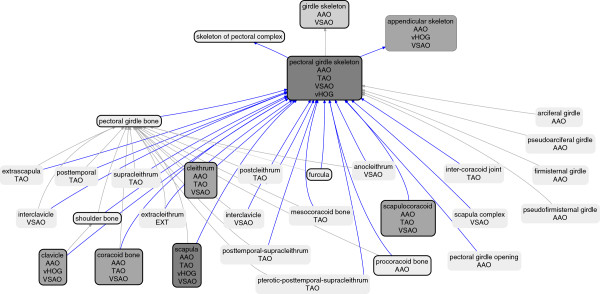
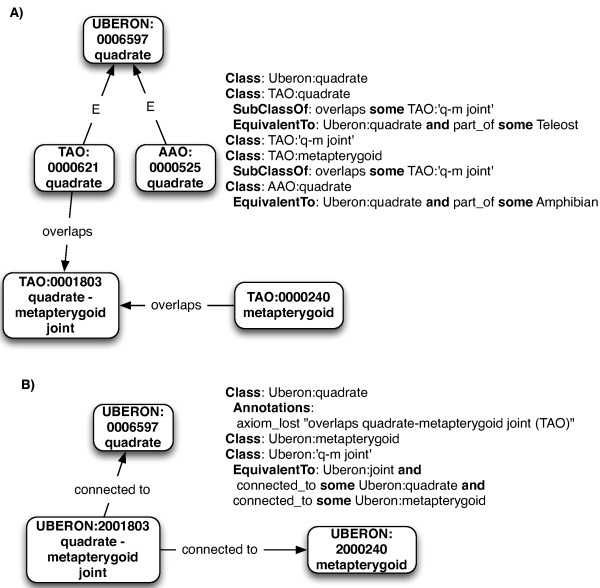
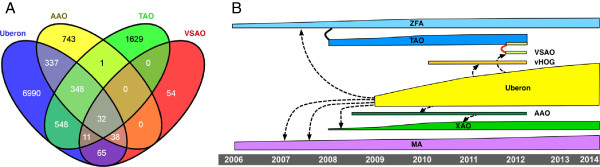
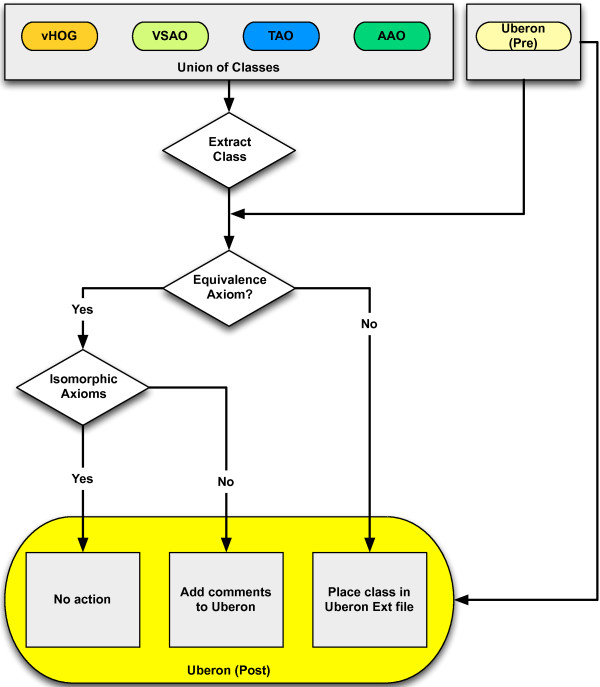
Previously, msAOs contained a mixture of unique and overlapping content. This hampered integration and coordination due to the need to maintain cross-references or inter-ontology equivalence axioms to the ssAOs, or to perform large-scale obsolescence and modular import. Here we present the unification of anatomy ontologies into Uberon, a single ontology resource that enables interoperability among disparate data and research groups. As a consequence, independent development of TAO, VSAO, AAO, and vHOG has been discontinued.
The newly broadened Uberon ontology is a unified cross-taxon resource for metazoans (animals) that has been substantially expanded to include a broad diversity of vertebrate anatomical structures, permitting reasoning across anatomical variation in extinct and extant taxa. Uberon is a core resource that supports single- and cross-species queries for candidate genes using annotations for phenotypes from the systematics, biodiversity, medical, and model organism communities, while also providing entities for logical definitions in the Cell and Gene Ontologies. THE ONTOLOGY RELEASE FILES ASSOCIATED WITH THE ONTOLOGY MERGE DESCRIBED IN THIS MANUSCRIPT ARE AVAILABLE AT: http://purl.obolibrary.org/obo/uberon/releases/2013-02-21/ CURRENT ONTOLOGY RELEASE FILES ARE AVAILABLE ALWAYS AVAILABLE AT: http://purl.obolibrary.org/obo/uberon/releases/
阐明疾病和发育功能障碍需要了解表型变异。已经建立了单物种模式生物解剖本体(ssAO)来表示这种变异。多物种解剖本体(msAO;脊椎动物骨骼、脊椎动物同源、硬骨鱼、两栖动物AO)已被开发用于表示跨物种的“自然”表型变异。我们的目标是出于各种目的整合ssAO和msAO,包括建立表型变异与候选基因之间的联系。
以前,msAO包含独特和重叠内容的混合。由于需要维护与ssAO的交叉引用或本体间等价公理,或者进行大规模过时和模块化导入,这阻碍了整合与协调。在这里,我们展示了将解剖本体统一到Uberon中,这是一个单一的本体资源,可实现不同数据和研究组之间的互操作性。因此,TAO、VSAO、AAO和vHOG的独立开发已停止。
新扩展的Uberon本体是后生动物(动物)的统一跨分类资源,已大幅扩展以包括广泛多样的脊椎动物解剖结构,允许对已灭绝和现存分类群的解剖变异进行推理。Uberon是一个核心资源,支持使用来自系统学、生物多样性、医学和模式生物群落的表型注释对候选基因进行单物种和跨物种查询,同时还为细胞和基因本体中的逻辑定义提供实体。与本手稿中描述的本体合并相关的本体发布文件可在以下网址获取:http://purl.obolibrary.org/obo/uberon/releases/2013-02-21/ 当前的本体发布文件始终可在以下网址获取:http://purl.obolibrary.org/obo/uberon/releases/