Steiner Markus, Harrer Andrea, Himly Martin
Division Allergy and Immunology, Department Molecular Biology, University of SalzburgSalzburg, Austria; Laboratory for Immunological and Molecular Cancer Research, Paracelsus Medical UniversitySalzburg, Austria.
Division Allergy and Immunology, Department Molecular Biology, University of SalzburgSalzburg, Austria; Department Neurology, Paracelsus Medical UniversitySalzburg, Austria.
Front Pharmacol. 2016 Jun 17;7:171. doi: 10.3389/fphar.2016.00171. eCollection 2016.
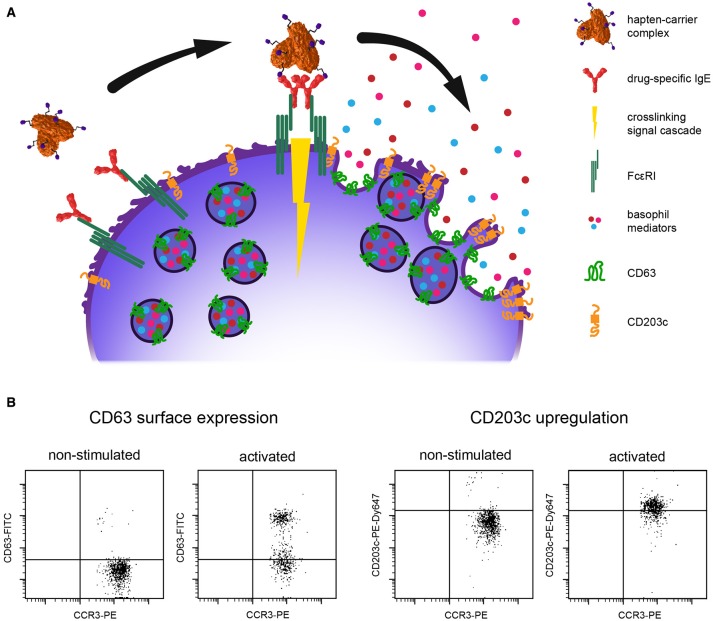
Immediate drug hypersensitivity reactions (DHRs) resemble typical immunoglobulin E (IgE)-mediated symptoms. Clinical manifestations range from local skin reactions, gastrointestinal and/or respiratory symptoms to severe systemic involvement with potential fatal outcome. Depending on the substance group of the eliciting drug the correct diagnosis is a major challenge. Skin testing and in vitro diagnostics are often unreliable and not reproducible. The involvement of drug-specific IgE is questionable in many cases. The culprit substance (parent drug or metabolite) and potential cross-reacting compounds are difficult to identify, patient history and drug provocation testing often remain the only means for diagnosis. Hence, several groups proposed basophil activation test (BAT) for the diagnosis of immediate DHRs as basophils are well-known effector cells in allergic reactions. However, the usefulness of BAT in immediate DHRs is highly variable and dependent on the drug itself plus its capacity to spontaneously conjugate to serum proteins. Stimulation with pure solutions of the parent drug or metabolites thereof vs. drug-protein conjugates may influence sensitivity and specificity of the test. We thus, reviewed the available literature about the use of BAT for diagnosing immediate DHRs against drug classes such as antibiotics, radio contrast media, neuromuscular blocking agents, non-steroidal anti-inflammatory drugs, and biologicals. Influencing factors like the selection of stimulants or of the identification and activation markers, the stimulation protocol, gating strategies, and cut-off definition are addressed in this overview on BAT performance. The overall aim is to evaluate the suitability of BAT as biomarker for the diagnosis of immediate drug-induced hypersensitivity reactions.
速发型药物过敏反应(DHRs)类似于典型的免疫球蛋白E(IgE)介导的症状。临床表现范围从局部皮肤反应、胃肠道和/或呼吸道症状到严重的全身受累,甚至可能导致致命后果。根据引发药物的物质类别进行正确诊断是一项重大挑战。皮肤试验和体外诊断通常不可靠且不可重复。在许多情况下,药物特异性IgE的参与存在疑问。引发过敏的物质(原药或代谢物)以及潜在的交叉反应化合物难以识别,患者病史和药物激发试验往往仍是唯一的诊断手段。因此,一些研究团队提出了嗜碱性粒细胞活化试验(BAT)用于速发型DHRs的诊断,因为嗜碱性粒细胞是过敏反应中众所周知的效应细胞。然而,BAT在速发型DHRs中的效用差异很大,并且取决于药物本身及其与血清蛋白自发结合的能力。用原药或其代谢物的纯溶液与药物 - 蛋白质结合物进行刺激可能会影响试验的敏感性和特异性。因此,我们回顾了关于使用BAT诊断针对抗生素、放射性造影剂、神经肌肉阻滞剂、非甾体抗炎药和生物制品等药物类别的速发型DHRs的现有文献。本关于BAT性能的综述探讨了诸如刺激物的选择、识别和激活标记物、刺激方案、门控策略以及临界值定义等影响因素。总体目标是评估BAT作为速发型药物诱导的过敏反应诊断生物标志物的适用性。