Fortini Paola, Iorio Egidio, Dogliotti Eugenia, Isidoro Ciro
Department of Environment and Primary Prevention, Istituto Superiore di Sanità Rome, Italy.
Department of Cell Biology and Neurosciences, Istituto Superiore di Sanità Rome, Italy.
Front Physiol. 2016 Jun 16;7:237. doi: 10.3389/fphys.2016.00237. eCollection 2016.
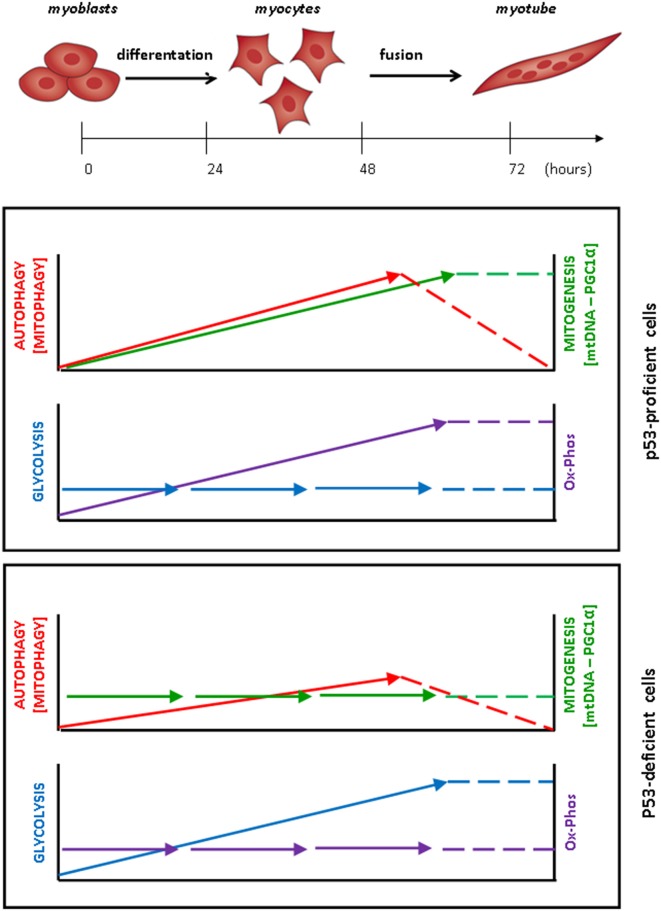
Autophagy undergoes a fine tuning during tissue differentiation and organ remodeling in order to meet the dynamic changes in the metabolic needs. While the involvement of autophagy in the homeostasis of mature muscle tissues has been intensively studied, no study has so far addressed the regulation of autophagy in relation to the metabolic state during the myogenic differentiation. In our recently published study (Fortini et al., 2016) we investigated the metabolic profile and regulation of autophagy that accompany the differentiation process of mouse skeletal muscle satellite cells (MSC)-derived myoblasts into myotubes. Here, we briefly present these findings also in the light of similar studies conducted by other authors. We show that during myogenic differentiation mitochondrial function and activity are greatly increased, and the activation of autophagy accompanies the transition from myoblasts to myotube. Autophagy is mTORC1 inactivation-independent and, remarkably, is required to allow the myocyte fusion process, as shown by impaired cell fusion when the autophagic flux is inhibited either by genetic or drug manipulation. Further, we found that myoblasts derived from p53 null mice show defective terminal differentiation into myotubes and reduced activation of basal autophagy. Of note, glycolysis prevails and mitochondrial biogenesis is strongly impaired in p53-null myoblasts. Thus, autophagy, mitochondrial homeostasis, and differentiation are finely tuned in a coordinate manner during muscle biogenesis.
在组织分化和器官重塑过程中,自噬会进行精细调节,以满足代谢需求的动态变化。虽然自噬在成熟肌肉组织稳态中的作用已得到深入研究,但迄今为止,尚无研究探讨成肌分化过程中自噬与代谢状态相关的调节机制。在我们最近发表的研究(Fortini等人,2016年)中,我们研究了小鼠骨骼肌卫星细胞(MSC)来源的成肌细胞分化为肌管过程中伴随的代谢特征和自噬调节。在此,我们也结合其他作者进行的类似研究简要介绍这些发现。我们发现,在成肌分化过程中,线粒体功能和活性显著增强,自噬的激活伴随着成肌细胞向肌管的转变。自噬不依赖于mTORC1失活,值得注意的是,自噬是肌细胞融合过程所必需的,当通过基因或药物操作抑制自噬流时,细胞融合受损就证明了这一点。此外,我们发现源自p53基因敲除小鼠的成肌细胞在向肌管的终末分化方面存在缺陷,基础自噬的激活也减少。值得注意的是,在p53基因敲除的成肌细胞中,糖酵解占主导,线粒体生物发生受到严重损害。因此,在肌肉生成过程中,自噬、线粒体稳态和分化以协调的方式进行精细调节。