Sun Yuting, Ge Yejing, Drnevich Jenny, Zhao Yong, Band Mark, Chen Jie
Department of Cell and Developmental Biology, University of Illinois at Urbana-Champaign, Champaign, IL 61820, USA.
J Cell Biol. 2010 Jun 28;189(7):1157-69. doi: 10.1083/jcb.200912093. Epub 2010 Jun 21.
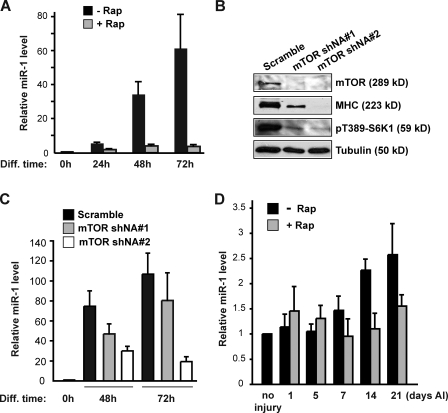
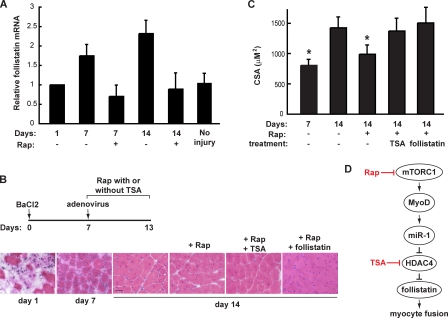
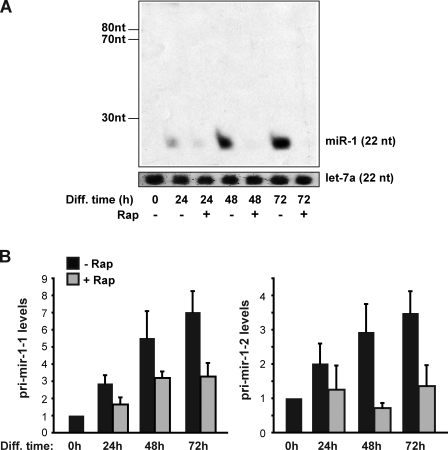
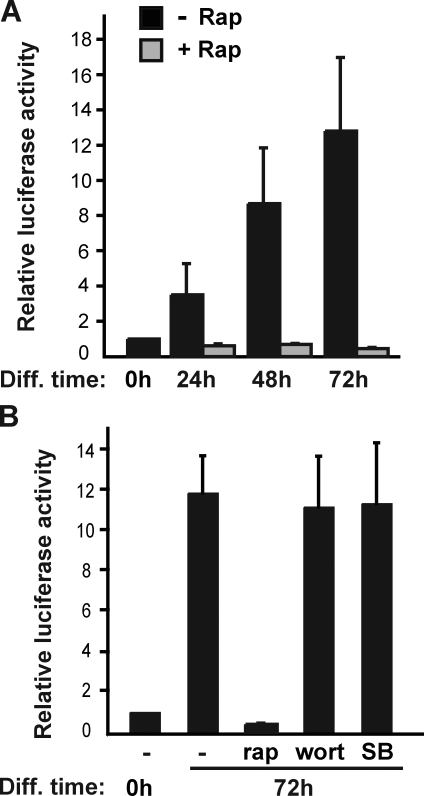
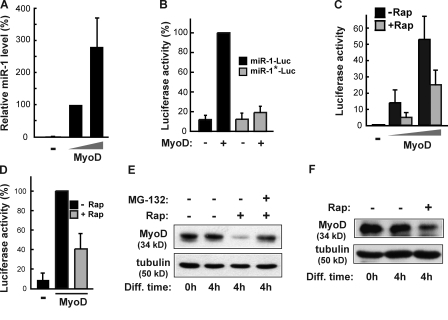
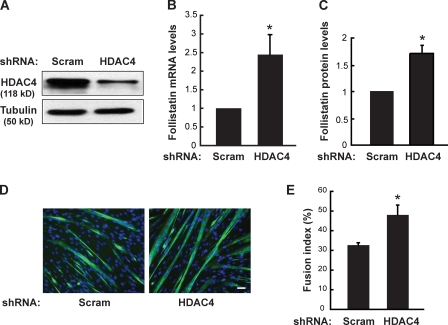
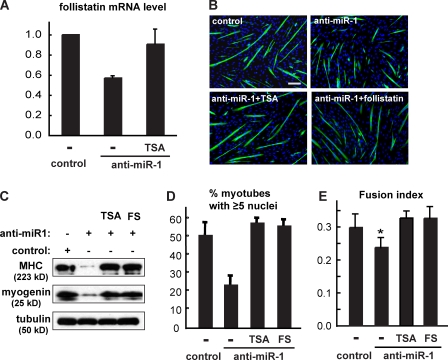
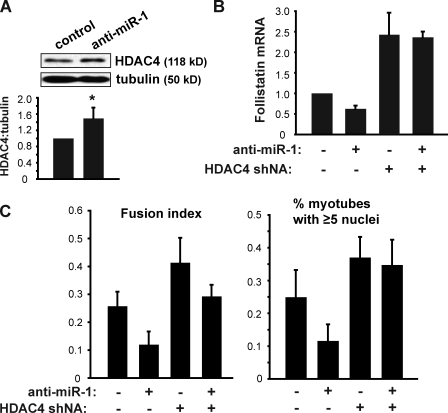
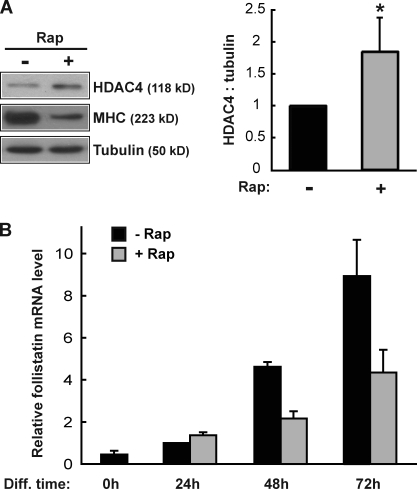
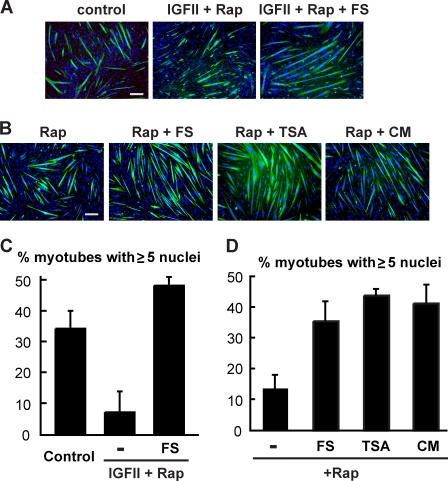
Mammalian target of rapamycin (mTOR) has emerged as a key regulator of skeletal muscle development by governing distinct stages of myogenesis, but the molecular pathways downstream of mTOR are not fully understood. In this study, we report that expression of the muscle-specific micro-RNA (miRNA) miR-1 is regulated by mTOR both in differentiating myoblasts and in mouse regenerating skeletal muscle. We have found that mTOR controls MyoD-dependent transcription of miR-1 through its upstream enhancer, most likely by regulating MyoD protein stability. Moreover, a functional pathway downstream of mTOR and miR-1 is delineated, in which miR-1 suppression of histone deacetylase 4 (HDAC4) results in production of follistatin and subsequent myocyte fusion. Collective evidence strongly suggests that follistatin is the long-sought mTOR-regulated fusion factor. In summary, our findings unravel for the first time a link between mTOR and miRNA biogenesis and identify an mTOR-miR-1-HDAC4-follistatin pathway that regulates myocyte fusion during myoblast differentiation in vitro and skeletal muscle regeneration in vivo.
雷帕霉素哺乳动物靶点(mTOR)已成为骨骼肌发育的关键调节因子,通过调控肌生成的不同阶段发挥作用,但mTOR下游的分子途径尚未完全明确。在本研究中,我们报道了肌肉特异性微小RNA(miRNA)miR-1的表达在分化的成肌细胞和小鼠再生骨骼肌中均受mTOR调控。我们发现mTOR通过其上游增强子控制MyoD依赖的miR-1转录,很可能是通过调节MyoD蛋白稳定性来实现的。此外,还描绘了一条mTOR和miR-1下游的功能途径,其中miR-1对组蛋白去乙酰化酶4(HDAC4)的抑制导致卵泡抑素的产生及随后的肌细胞融合。综合证据有力地表明卵泡抑素就是长期以来寻找的mTOR调节的融合因子。总之,我们的研究结果首次揭示了mTOR与miRNA生物合成之间的联系,并确定了一条mTOR-miR-1-HDAC4-卵泡抑素途径,该途径在体外成肌细胞分化和体内骨骼肌再生过程中调节肌细胞融合。