Koole Sander L, Tschacher Wolfgang
Department of Social Psychology, Vrije Universiteit Amsterdam Amsterdam, Netherlands.
Front Psychol. 2016 Jun 14;7:862. doi: 10.3389/fpsyg.2016.00862. eCollection 2016.
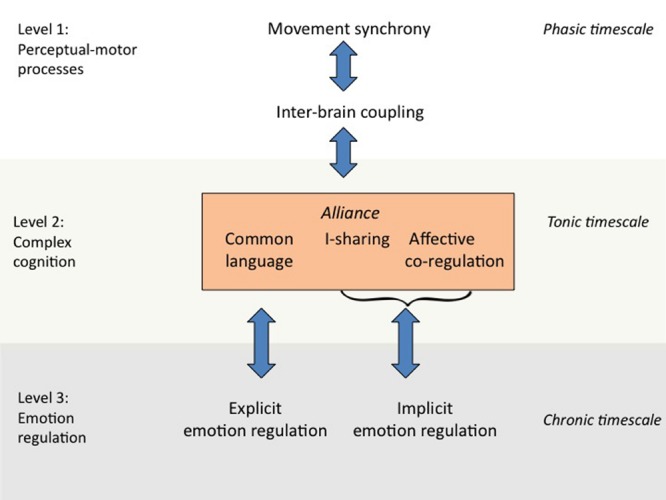
During psychotherapy, patient and therapist tend to spontaneously synchronize their vocal pitch, bodily movements, and even their physiological processes. In the present article, we consider how this pervasive phenomenon may shed new light on the therapeutic relationship- or alliance- and its role within psychotherapy. We first review clinical research on the alliance and the multidisciplinary area of interpersonal synchrony. We then integrate both literatures in the Interpersonal Synchrony (In-Sync) model of psychotherapy. According to the model, the alliance is grounded in the coupling of patient and therapist's brains. Because brains do not interact directly, movement synchrony may help to establish inter-brain coupling. Inter-brain coupling may provide patient and therapist with access to another's internal states, which facilitates common understanding and emotional sharing. Over time, these interpersonal exchanges may improve patients' emotion-regulatory capacities and related therapeutic outcomes. We discuss the empirical assessment of interpersonal synchrony and review preliminary research on synchrony in psychotherapy. Finally, we summarize our main conclusions and consider the broader implications of viewing psychotherapy as the product of two interacting brains.
在心理治疗过程中,患者和治疗师往往会自发地使他们的语调、身体动作甚至生理过程同步。在本文中,我们探讨这种普遍现象如何能为治疗关系或联盟及其在心理治疗中的作用带来新的启示。我们首先回顾关于联盟和人际同步多学科领域的临床研究。然后我们将这两方面的文献整合到心理治疗的人际同步(同步)模型中。根据该模型,联盟基于患者和治疗师大脑的耦合。由于大脑不会直接相互作用,动作同步可能有助于建立脑间耦合。脑间耦合可能使患者和治疗师能够了解对方的内部状态,这有助于达成共同理解和情感共享。随着时间的推移,这些人际交流可能会提高患者的情绪调节能力及相关治疗效果。我们讨论人际同步的实证评估,并回顾心理治疗中同步的初步研究。最后,我们总结主要结论,并思考将心理治疗视为两个相互作用大脑的产物所具有的更广泛意义。