Frossard Aline, Hammes Frederik, Gessner Mark O
Forest Soils and Biogeochemistry, Swiss Federal Institute for Forest, Snow and Landscape Research (WSL)Birmensdorf Switzerland; Department of Aquatic Ecology, Swiss Federal Institute of Aquatic Science and Technology (Eawag)Dübendorf Switzerland; Department of Experimental Limnology, Leibniz Institute of Freshwater Ecology and Inland Fisheries (IGB), StechlinGermany; Institute of Integrative Biology (IBZ), ETH ZürichZürich Switzerland.
Department of Environmental Microbiology, Swiss Federal Institute of Aquatic Science and Technology (Eawag) Dübendorf Switzerland.
Front Microbiol. 2016 Jun 14;7:903. doi: 10.3389/fmicb.2016.00903. eCollection 2016.
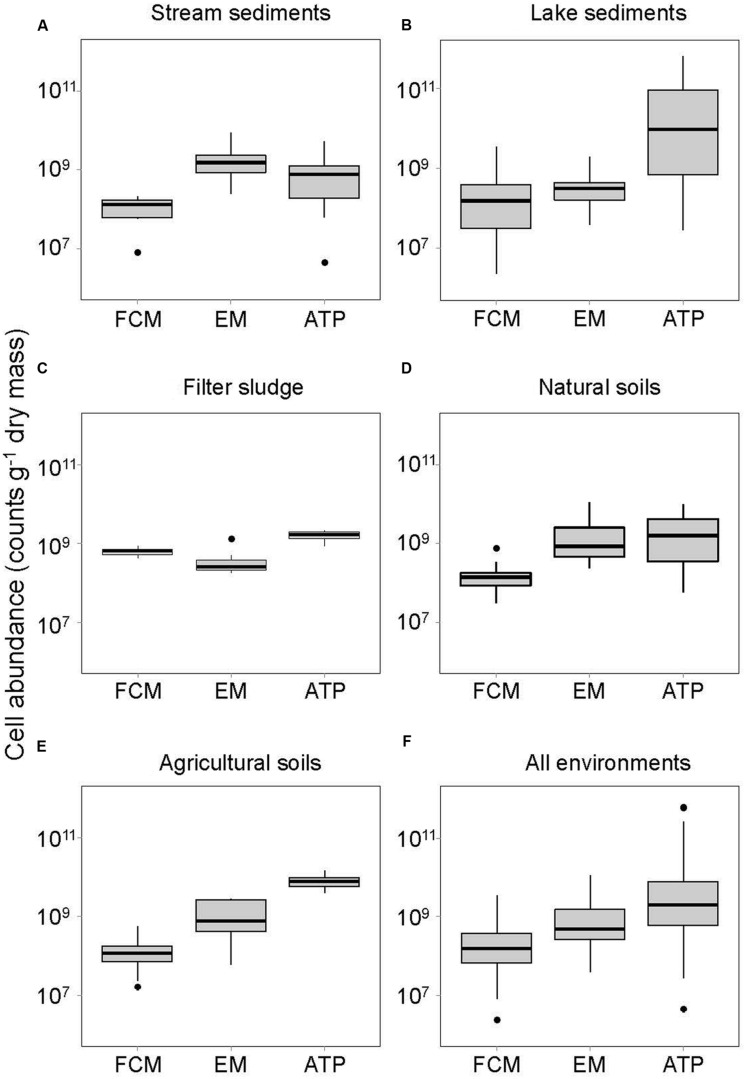
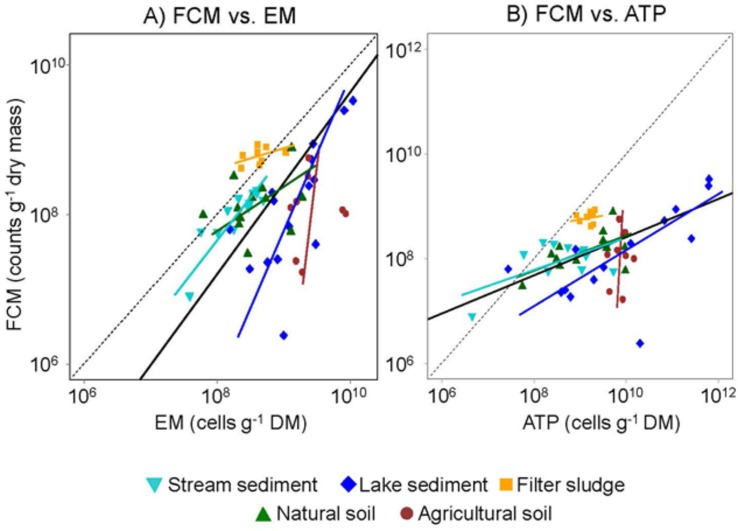
Bacterial abundance is a fundamental measure in microbiology, but its assessment is often tedious, especially for soil, and sediment samples. To overcome this limitation, we adopted a time-efficient flow-cytometric (FCM) counting method involving cell detachment and separation from matrix particles by centrifugation in tubes receiving sample suspensions and Histodenz(®) solution. We used this approach to assess bacterial abundances in diverse soils (natural and agricultural), sediments (streams and lakes) and sludge from sand-filters in a drinking water treatment plant and compared the results to bacterial abundances determined by two established methods, epifluorescence microscopy (EM) and adenosine triphosphate (ATP) quantification. Cell abundances determined by FCM and EM correlated fairly well, although absolute cell abundances were generally lower when determined by FCM. FCM also showed significant relations with cell counts converted from ATP concentrations, although estimates derived from ATP determinations were typically higher, indicating the presence of ATP sources other than bacteria. Soil and sediment organic matter (OM) content influenced the goodness of fit between counts obtained with EM and FCM. In particular, bacterial abundance determined by FCM in samples containing less than 10% OM, such as stream sediment, was particularly well correlated with the cell counts assessed by EM. Overall, these results suggest that FCM following cell detachment and purification is a useful approach to increase sample throughput for determining bacterial abundances in soils, sediments and sludge. However, notable scatter and only partial concordance among the FCM and reference methods suggests that protocols require further improvement for assessments requiring high precision, especially when OM contents in samples are high.
细菌丰度是微生物学中的一项基本指标,但其评估往往繁琐,尤其是对于土壤和沉积物样本。为克服这一局限性,我们采用了一种省时的流式细胞术(FCM)计数方法,该方法包括在装有样品悬浮液和Histodenz(®)溶液的试管中通过离心使细胞从基质颗粒中分离出来。我们使用这种方法评估了不同土壤(天然土壤和农业土壤)、沉积物(溪流和湖泊沉积物)以及饮用水处理厂砂滤器中的污泥中的细菌丰度,并将结果与通过两种既定方法(落射荧光显微镜法(EM)和三磷酸腺苷(ATP)定量法)测定的细菌丰度进行了比较。尽管通过FCM测定的绝对细胞丰度通常较低,但通过FCM和EM测定的细胞丰度相关性相当好。FCM还显示与从ATP浓度换算得到的细胞计数有显著关系,尽管从ATP测定得出的估计值通常较高,这表明存在除细菌以外的ATP来源。土壤和沉积物中的有机质(OM)含量影响了EM和FCM计数之间的拟合优度。特别是,在OM含量低于10%的样品(如溪流沉积物)中,通过FCM测定的细菌丰度与通过EM评估的细胞计数相关性特别好。总体而言,这些结果表明,细胞分离和纯化后的FCM是一种增加样品通量以测定土壤、沉积物和污泥中细菌丰度的有用方法。然而,FCM与参考方法之间存在明显的离散和仅部分一致性,这表明对于需要高精度的评估,尤其是当样品中OM含量较高时,方案需要进一步改进。