Smith Andrea D, Fildes Alison, Cooke Lucy, Herle Moritz, Shakeshaft Nicholas, Plomin Robert, Llewellyn Clare
Health Behaviour Research Centre, Department of Epidemiology and Public Health, University College London, London, United Kingdom;
Health Behaviour Research Centre, Department of Epidemiology and Public Health, University College London, London, United Kingdom; Great Ormond Street Hospital, Children's NHS Foundation Trust, London, United Kingdom; and.
Am J Clin Nutr. 2016 Aug;104(2):446-53. doi: 10.3945/ajcn.116.133983. Epub 2016 Jul 6.
Food preferences vary substantially among adults and children. Twin studies have established that genes and aspects of the shared family environment both play important roles in shaping children's food preferences. The transition from childhood to adulthood is characterized by large gains in independence, but the relative influences of genes and the environment on food preferences in late adolescence are unknown.
The aim of this study was to quantify the contribution of genetic and environmental influences on food preferences in older adolescents.
Participants were 2865 twins aged 18-19 y from the TEDS (Twins Early Development Study), a large population-based cohort of British twins born during 1994-1996. Food preferences were measured by using a self-report questionnaire of 62 individual foods. Food items were categorized into 6 food groups (fruit, vegetables, meat or fish, dairy, starch foods, and snacks) by using factor analysis. Maximum likelihood structural equation modeling established genetic and environmental contributions to variations in preferences for each food group.
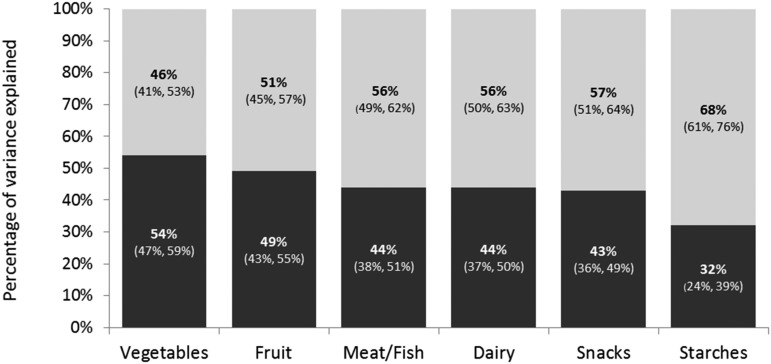
Genetic factors influenced a significant and substantial proportion of the variation in preference scores of all 6 food groups: vegetables (0.54; 95% CI: 0.47, 0.59), fruit (0.49; 95% CI: 0.43, 0.55), starchy foods (0.32; 95% CI: 0.24, 0.39), meat or fish (0.44; 95% CI: 0.38, 0.51), dairy (0.44; 95% CI: 0.37, 0.50), and snacks (0.43; 95% CI: 0.36, 0.49). Aspects of the environment that are not shared by 2 twins in a family explained all of the remaining variance in food preferences.
Food preferences had a moderate genetic basis in late adolescence, in keeping with findings in children. However, by this older age, the influence of the shared family environment had disappeared, and only aspects of the environment unique to each individual twin influenced food preferences. This finding suggests that shared environmental experiences that influence food preferences in childhood may not have effects that persist into adulthood.
成年人和儿童的食物偏好差异很大。双胞胎研究表明,基因和共同家庭环境因素在塑造儿童食物偏好方面都起着重要作用。从童年到成年的转变以独立性的大幅提升为特征,但基因和环境对青少年晚期食物偏好的相对影响尚不清楚。
本研究旨在量化基因和环境对大龄青少年食物偏好的影响程度。
参与者为来自TEDS(双胞胎早期发育研究)的2865名18 - 19岁的双胞胎,TEDS是一个基于英国1994 - 1996年出生的双胞胎的大型队列研究。通过一份包含62种单一食物的自我报告问卷来测量食物偏好。利用因子分析将食物项目分为6个食物组(水果、蔬菜、肉类或鱼类、乳制品、淀粉类食物和零食)。最大似然结构方程模型确定了基因和环境对每个食物组偏好差异的贡献。
基因因素影响了所有6个食物组偏好得分差异的很大一部分:蔬菜(0.54;95%置信区间:0.47,0.59)、水果(0.49;95%置信区间:0.43,0.55)、淀粉类食物(0.32;95%置信区间:0.24,0.39)、肉类或鱼类(0.44;95%置信区间:0.38,0.51)、乳制品(0.44;95%置信区间:0.37,0.50)和零食(0.43;95%置信区间:0.36,0.49)。家庭中双胞胎不共享的环境因素解释了食物偏好中所有剩余的差异。
青少年晚期的食物偏好有适度的遗传基础,这与儿童的研究结果一致。然而,到了这个年龄,共同家庭环境的影响已经消失,只有每个双胞胎个体特有的环境因素影响食物偏好。这一发现表明,在童年时期影响食物偏好的共同环境经历可能不会持续到成年。