Fildes Alison, van Jaarsveld Cornelia H M, Cooke Lucy, Wardle Jane, Llewellyn Clare H
Health Behavior Research Centre, Department of Epidemiology and Public Health, University College London, London, United Kingdom; and
Department for Health Evidence and Department of Primary and Community Care, Radboud University Medical Center, Nijmegen, Netherlands.
Am J Clin Nutr. 2016 Apr;103(4):1099-104. doi: 10.3945/ajcn.115.122945. Epub 2016 Feb 10.
Food fussiness (FF) is common in early childhood and is often associated with the rejection of nutrient-dense foods such as vegetables and fruit. FF and liking for vegetables and fruit are likely all heritable phenotypes; the genetic influence underlying FF may explain the observed genetic influence on liking for vegetables and fruit. Twin analyses make it possible to get a broad-based estimate of the extent of the shared genetic influence that underlies these traits.
We quantified the extent of the shared genetic influence that underlies FF and liking for vegetables and fruit in early childhood with the use of a twin design.
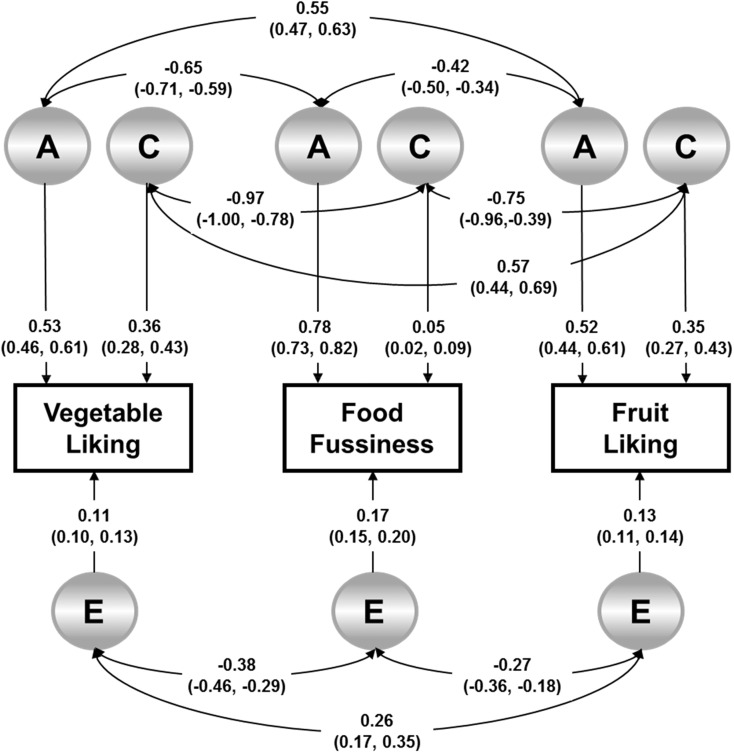
Data were from the Gemini cohort, which is a population-based sample of twins born in England and Wales in 2007. Parents of 3-y-old twins (n= 1330 pairs) completed questionnaire measures of their children's food preferences (liking for vegetables and fruit) and the FF scale from the Children's Eating Behavior Questionnaire. Multivariate quantitative genetic modeling was used to estimate common genetic influences that underlie FF and liking for vegetables and fruit.
Genetic correlations were significant and moderate to large in size between FF and liking for both vegetables (-0.65) and fruit (-0.43), which indicated that a substantial proportion of the genes that influence FF also influence liking. Common genes that underlie FF and liking for vegetables and fruit largely explained the observed phenotypic correlations between them (68-70%).
FF and liking for fruit and vegetables in young children share a large proportion of common genetic factors. The genetic influence on FF may determine why fussy children typically reject fruit and vegetables.
食物挑剔(FF)在幼儿期很常见,并且常常与拒绝诸如蔬菜和水果等营养丰富的食物有关。FF以及对蔬菜和水果的喜好可能都是可遗传的表型;FF背后的遗传影响可能解释了观察到的对蔬菜和水果喜好的遗传影响。双胞胎分析使得能够广泛估计这些性状背后共同遗传影响的程度。
我们采用双胞胎设计,量化了幼儿期FF以及对蔬菜和水果喜好背后共同遗传影响的程度。
数据来自双子座队列,该队列是基于2007年在英格兰和威尔士出生的双胞胎的人群样本。3岁双胞胎(n = 1330对)的父母完成了关于其孩子食物偏好(对蔬菜和水果的喜好)的问卷调查以及儿童饮食行为问卷中的FF量表。多变量定量遗传模型用于估计FF以及对蔬菜和水果喜好背后的共同遗传影响。
FF与对蔬菜(-0.65)和水果(-0.43)的喜好之间的遗传相关性显著且大小适中到较大,这表明影响FF的基因中有很大一部分也影响喜好。FF以及对蔬菜和水果喜好背后的共同基因在很大程度上解释了观察到的它们之间的表型相关性(68 - 70%)。
幼儿期的FF以及对水果和蔬菜的喜好共享很大一部分共同遗传因素。对FF的遗传影响可能决定了挑食的孩子通常为何会拒绝水果和蔬菜。