Department of Biology, Colgate University, Hamilton, NY, USA.
Department of Mathematics, Colgate University, Hamilton, NY, USA.
Sci Rep. 2016 Jul 8;6:29392. doi: 10.1038/srep29392.
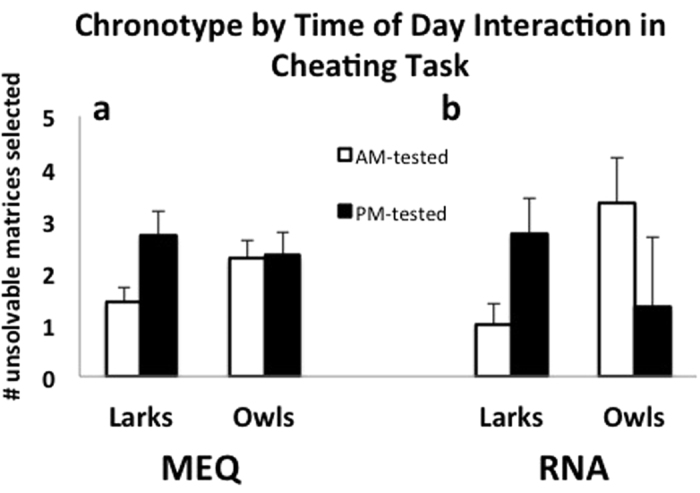
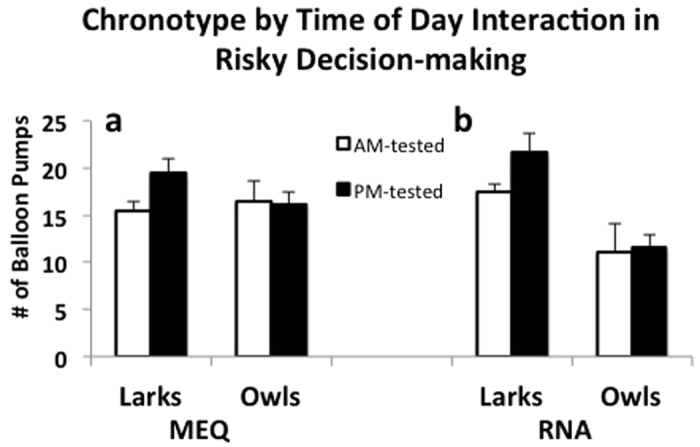
Recent reports highlight that human decision-making is influenced by the time of day and whether one is a morning or evening person (i.e., chronotype). Here, we test whether these behavioral effects are associated with endogenous biological rhythms. We asked participants to complete two well-established decision-making tasks in the morning or evening: the matrix task (an ethical decision task) and the balloon analog risk task (BART; a risk-taking task), and we measured their chronotype in two ways. First, participants completed a self-report measure, the Horne-Östberg Morningness-Eveningness Questionnaire (MEQ). Second, we measured the expression of two circadian clock-regulated genes-Per3 and Nr1d2-from peripheral clock cells in participants' hair follicle samples. Using a cosinor model, we estimated the phase of the peripheral clock and assigned RNA chronotypes to participants with advanced (larks) or delayed (owls) phases. The behavioral data were analyzed independently for self-reported (MEQ) and RNA-based chronotypes. We find that significant chronotype and/or time-of-day effects between larks and owls in decision-making tasks occur only in RNA-based chronotypes. Our results provide evidence that time-of-day effects on decision-making can be explained by phase differences in oscillating clock genes and suggest that variation in the molecular clockwork may influence inter-individual differences in decision-making behavior.
最近的报告强调,人的决策会受到一天中的时间以及一个人是早起型还是晚睡型(即生物钟类型)的影响。在这里,我们测试这些行为效应是否与内源性生物节律有关。我们要求参与者在早上或晚上完成两项成熟的决策任务:矩阵任务(一项道德决策任务)和气球模拟风险任务(BART;一项冒险任务),我们用两种方法测量他们的生物钟类型。首先,参与者完成了一份自我报告的量表,即霍恩-奥斯特伯格清晨-傍晚问卷(MEQ)。其次,我们测量了参与者毛囊样本中两种生物钟调节基因-Per3 和 Nr1d2 的表达。使用余弦模型,我们估计了外周时钟的相位,并为相位提前(百灵鸟型)或延迟(猫头鹰型)的参与者分配了 RNA 生物钟类型。对基于自我报告(MEQ)和基于 RNA 的生物钟类型的行为数据进行了独立分析。我们发现,仅在基于 RNA 的生物钟类型中,决策任务中早起型和晚睡型之间存在显著的生物钟类型和/或时间效应。我们的研究结果提供了证据,表明生物钟基因的相位差异可以解释决策时的时间效应,并表明分子钟的变化可能会影响个体间的决策行为差异。