Gaedigk Andrea, Sangkuhl Katrin, Whirl-Carrillo Michelle, Klein Teri, Leeder J Steven
Division of Clinical Pharmacology, Toxicology & Therapeutic Innovation, Children's Mercy-Kansas City, Kansas City, Missouri, USA.
School of Medicine, University of Missouri-Kansas City, Kansas City, Missouri, USA.
Genet Med. 2017 Jan;19(1):69-76. doi: 10.1038/gim.2016.80. Epub 2016 Jul 7.
Owing to its highly polymorphic nature and major contribution to the metabolism and bioactivation of numerous clinically used drugs, CYP2D6 is one of the most extensively studied drug-metabolizing enzymes and pharmacogenes. CYP2D6 alleles confer no, decreased, normal, or increased activity and cause a wide range of activity among individuals and between populations. However, there is no standard approach to translate diplotypes into predicted phenotype.
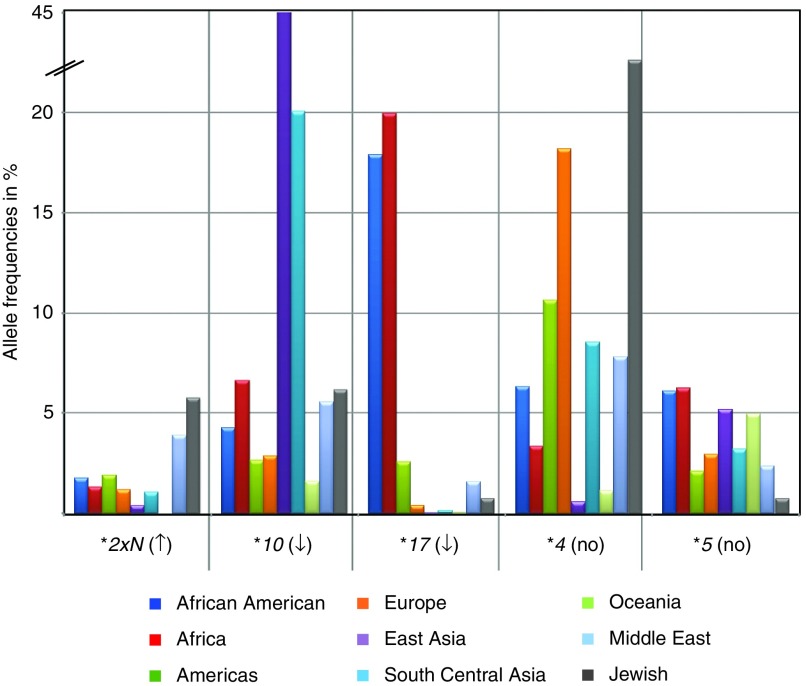
We exploited CYP2D6 allele-frequency data that have been compiled for Clinical Pharmacogenetics Implementation Consortium (CPIC) guidelines (>60,000 subjects, 173 reports) in order to estimate genotype-predicted phenotype status across major world populations based on activity score (AS) assignments.
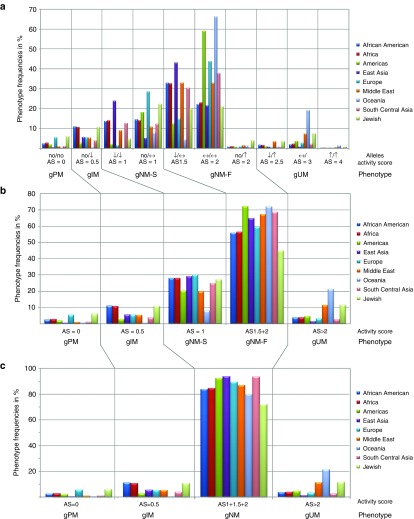
Allele frequencies vary considerably across the major ethnic groups predicting poor metabolizer status (AS = 0) between 0.4 and 5.4% across world populations. The prevalence of genotypic intermediate (AS = 0.5) and normal (AS = 1, 1.5, or 2) metabolizers ranges between 0.4 and 11% and between 67 and 90%, respectively. Finally, 1 to 21% of subjects (AS >2) are predicted to have ultrarapid metabolizer status.
This comprehensive study summarizes allele frequencies, diplotypes, and predicted phenotype across major populations, providing a rich data resource for clinicians and researchers. Challenges of phenotype prediction from genotype data are highlighted and discussed.Genet Med 19 1, 69-76.
由于细胞色素P450 2D6(CYP2D6)具有高度多态性,且对众多临床使用药物的代谢和生物活化起主要作用,它是研究最为广泛的药物代谢酶和药物基因之一。CYP2D6等位基因可导致无活性、活性降低、正常活性或活性增加,从而在个体之间以及群体之间造成广泛的活性差异。然而,目前尚无将双倍型转化为预测表型的标准方法。
我们利用为临床药物基因组学实施联盟(CPIC)指南汇编的CYP2D6等位基因频率数据(>60,000名受试者,173份报告),以便根据活性评分(AS)赋值来估计全球主要人群中基因型预测的表型状态。
在世界各人群中,预测代谢不良状态(AS = 0)的主要种族群体的等位基因频率差异很大,介于0.4%至5.4%之间。基因型中间代谢者(AS = 0.5)和正常代谢者(AS = 1、1.5或2)的患病率分别在0.4%至11%和67%至90%之间。最后,预计1%至21%的受试者(AS>2)具有超快代谢者状态。
这项全面的研究总结了主要人群中的等位基因频率、双倍型和预测表型,为临床医生和研究人员提供了丰富的数据资源。同时强调并讨论了从基因型数据预测表型所面临的挑战。《遗传医学》19(1):69 - 76。