Smith Caroline J W, Poehlmann Max L, Li Sara, Ratnaseelan Aarane M, Bredewold Remco, Veenema Alexa H
Neurobiology of Social Behavior Laboratory, Department of Psychology, Boston College, McGuinn 300, 140 Commonwealth Ave, Chestnut Hill, MA, 02467, USA.
Brain Struct Funct. 2017 Mar;222(2):981-1006. doi: 10.1007/s00429-016-1260-7. Epub 2016 Jul 7.
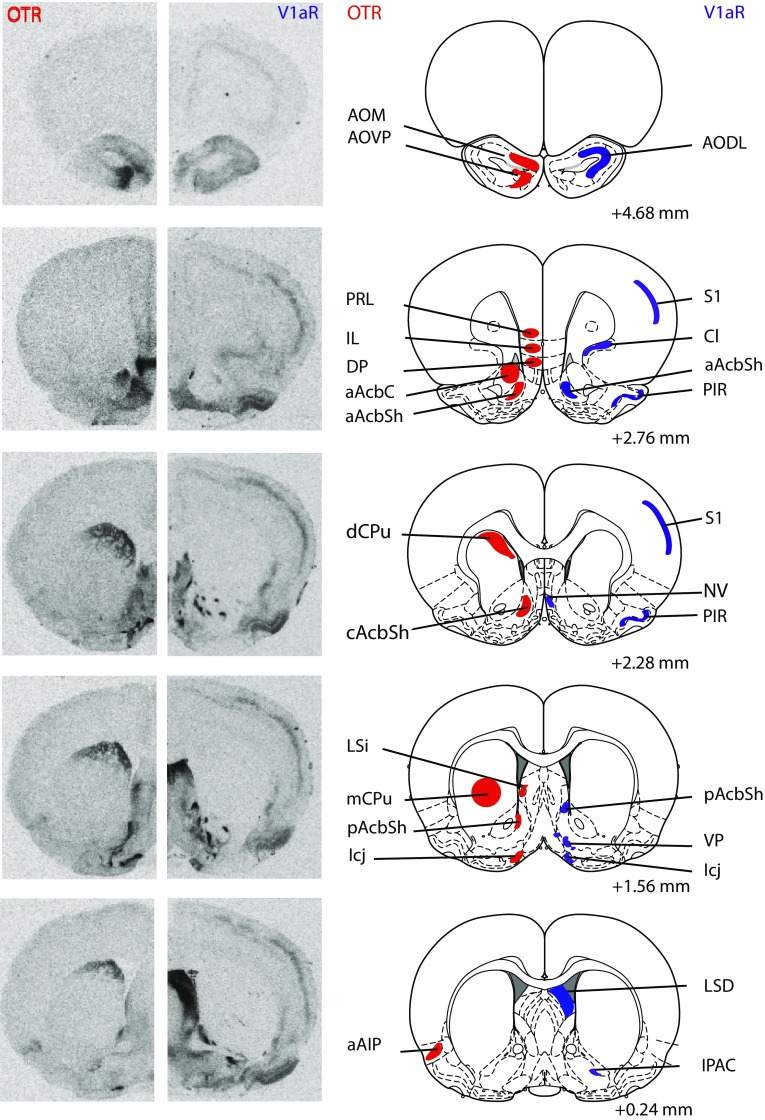
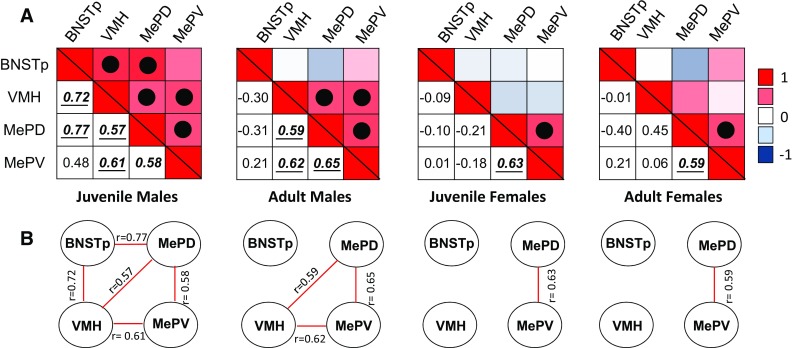
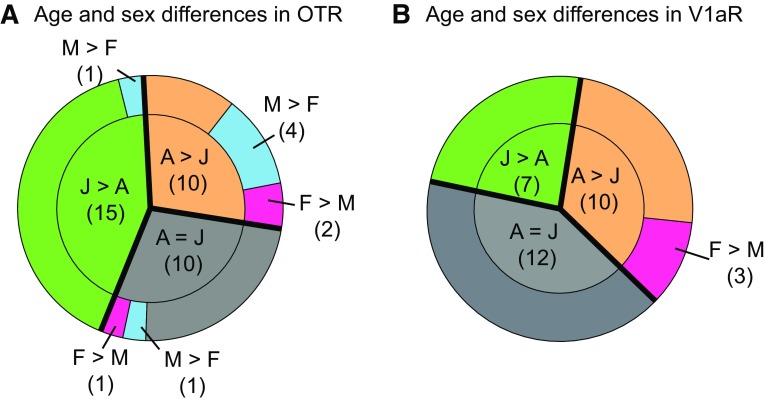
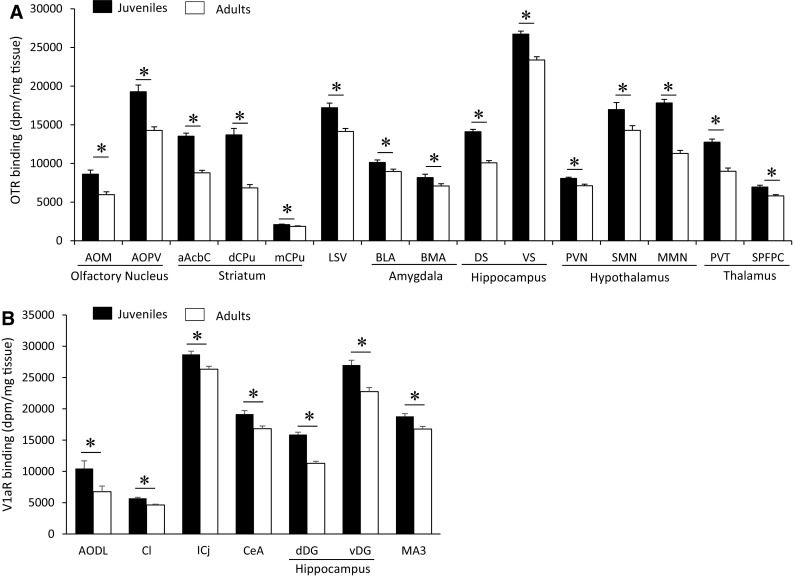
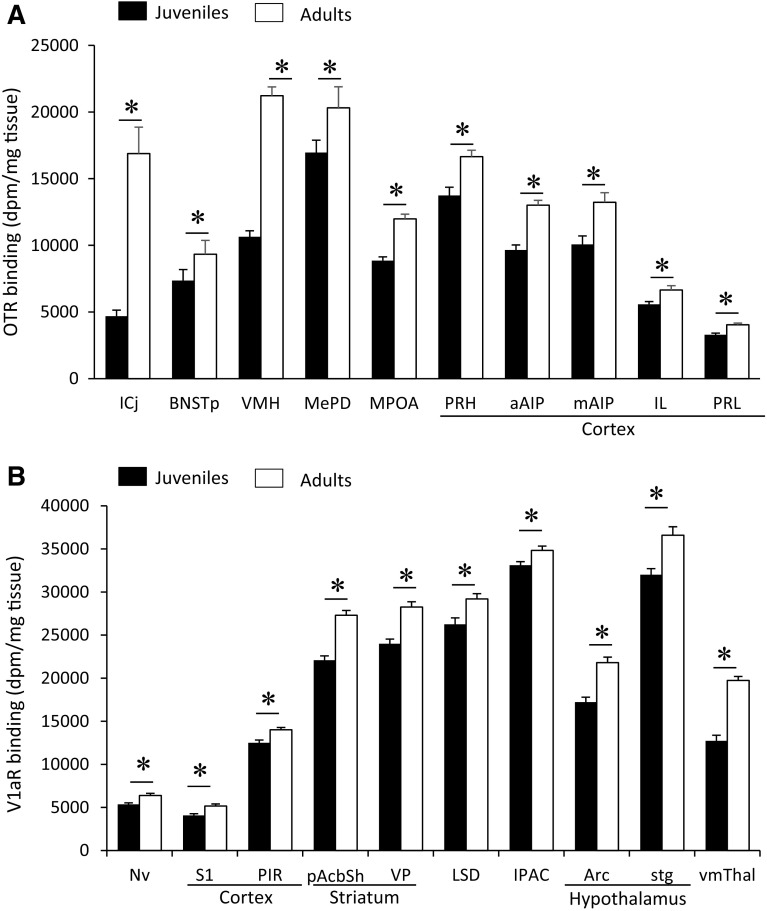
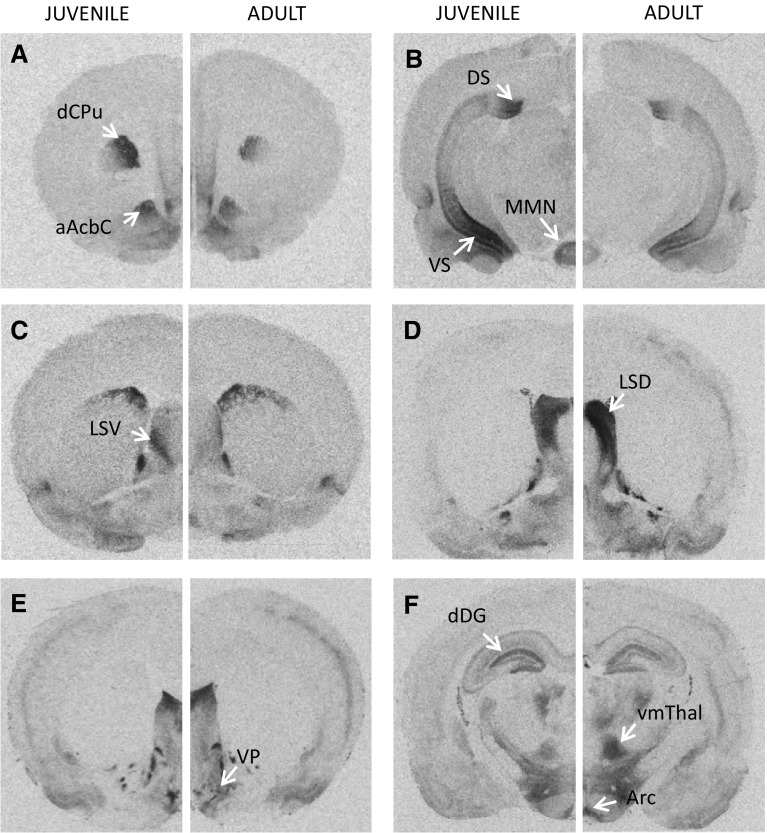
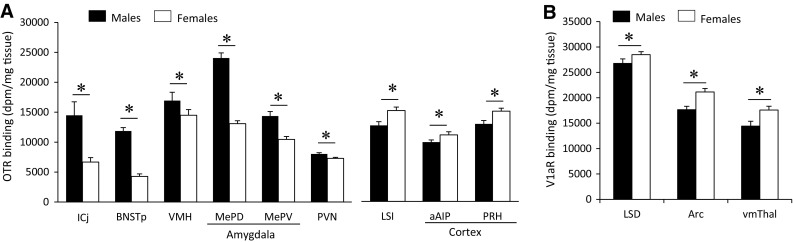
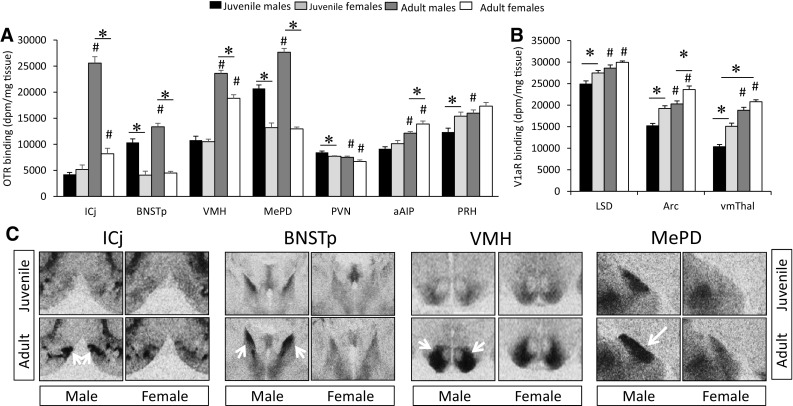
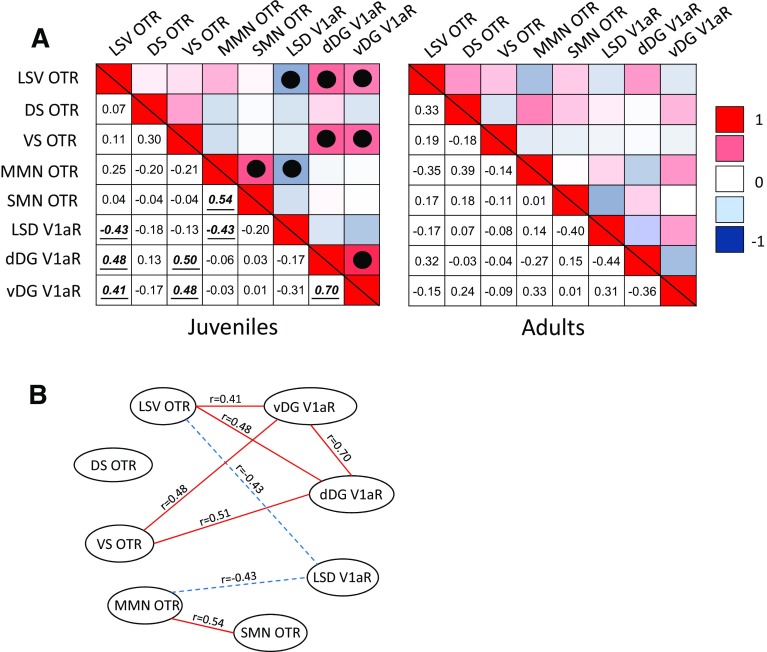
Oxytocin (OT) and vasopressin (AVP) regulate various social behaviors via activation of the OT receptor (OTR) and the AVP V1a receptor (V1aR) in the brain. Social behavior often differs across development and between the sexes, yet our understanding of age and sex differences in brain OTR and V1aR binding remains incomplete. Here, we provide an extensive analysis of OTR and V1aR binding density throughout the brain in juvenile and adult male and female rats, with a focus on regions within the social decision-making network. OTR and V1aR binding density were higher in juveniles than in adults in regions associated with reward and socio-spatial memory and higher in adults than in juveniles in key regions of the social decision-making network and in cortical regions. We discuss possible implications of these shifts in OTR and V1aR binding density for the age-specific regulation of social behavior. Furthermore, sex differences in OTR and V1aR binding density were less numerous than age differences. The direction of these sex differences was region-specific for OTR but consistently higher in females than in males for V1aR. Finally, almost all sex differences in OTR and V1aR binding density were already present in juveniles and occurred in regions with denser binding in adults compared to juveniles. Possible implications of these sex differences for the sex-specific regulation of behavior, as well potential underlying mechanisms, are discussed. Overall, these findings provide an important framework for testing age- and sex-specific roles of OTR and V1aR in the regulation of social behavior.
催产素(OT)和加压素(AVP)通过激活大脑中的OT受体(OTR)和AVP V1a受体(V1aR)来调节各种社会行为。社会行为在整个发育过程以及两性之间往往存在差异,然而我们对大脑中OTR和V1aR结合的年龄和性别差异的理解仍不完整。在此,我们对幼年和成年雄性及雌性大鼠全脑的OTR和V1aR结合密度进行了广泛分析,重点关注社会决策网络中的区域。在与奖励和社会空间记忆相关的区域,幼年大鼠的OTR和V1aR结合密度高于成年大鼠;而在社会决策网络的关键区域和皮质区域,成年大鼠的OTR和V1aR结合密度高于幼年大鼠。我们讨论了OTR和V1aR结合密度的这些变化对社会行为年龄特异性调节的可能影响。此外,OTR和V1aR结合密度的性别差异比年龄差异少。这些性别差异的方向对于OTR而言是区域特异性的,但对于V1aR而言,雌性始终高于雄性。最后,OTR和V1aR结合密度的几乎所有性别差异在幼年大鼠中就已存在,且发生在成年大鼠中结合比幼年大鼠更密集的区域。我们讨论了这些性别差异对行为性别特异性调节的可能影响以及潜在的潜在机制。总体而言,这些发现为测试OTR和V1aR在社会行为调节中的年龄和性别特异性作用提供了一个重要框架。