Beyene Yoseph, Semagn Kassa, Mugo Stephen, Prasanna Boddupalli M, Tarekegne Amsal, Gakunga John, Sehabiague Pierre, Meisel Barbara, Oikeh Sylvester O, Olsen Michael, Crossa Jose
International Maize and Wheat Improvement Center (CIMMYT), P.O. Box 1041, Village Market, Nairobi, 00621 Kenya.
CIMMYT, 12.5 km peg Mazowe Road, Mount Pleasant, P.O. Box MP163, Harare, Zimbabwe.
Euphytica. 2016;208:285-297. doi: 10.1007/s10681-015-1590-1. Epub 2015 Nov 9.
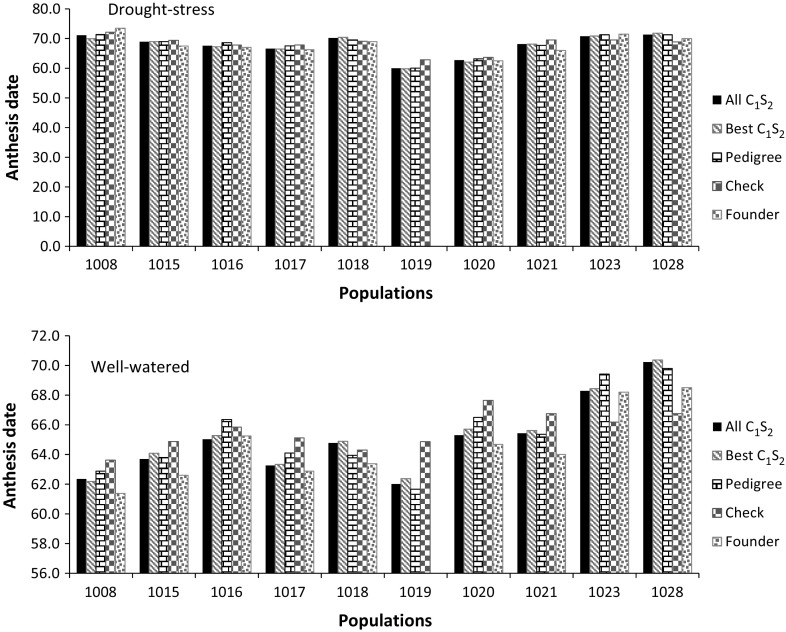
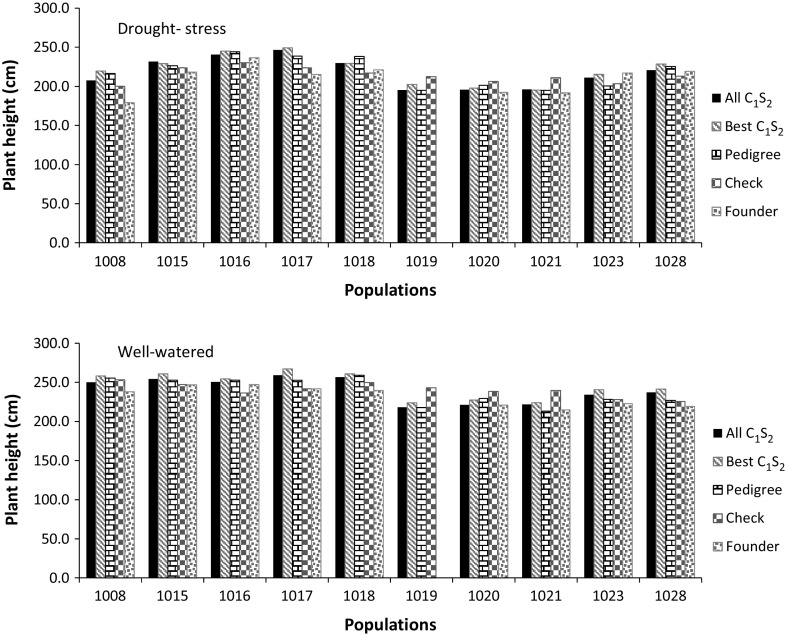
A marker-assisted recurrent selection (MARS) program was undertaken in sub-Saharan Africa to improve grain yield under drought-stress in 10 biparental tropical maize populations. The objectives of the present study were to evaluate the performance of CS-derived hybrids obtained after three MARS cycles (one cycle of recombination (C), followed by two generations of selfing (S), and to study yield stability under both drought-stress (DS) and well-watered (WW) conditions. For each of the 10 populations, we evaluated hybrids developed by crossing 47-74 CS lines advanced through MARS, the best five S lines developed through pedigree selection, and the founder parents with a single-cross tester from a complementary heterotic group. The hybrids and five commercial checks were evaluated in Kenya under 1-3 DS and 3-5 WW conditions with two replications. Combined across DS locations, the top 10 CS-derived hybrids from each of the 10 biparental populations produced 0.5-46.3 and 11.1-55.1 % higher mean grain yields than hybrids developed using pedigree selection and the commercial checks, respectively. Across WW locations, the best 10 hybrids derived from CS of each population produced 3.4-13.3 and 7.9-36.5 % higher grain yields than hybrids derived using conventional pedigree breeding and the commercial checks, respectively. Mean days to anthesis of the best 10 CS hybrids were comparable to those of hybrids developed using the pedigree method, the founder parents and the commercial checks, with a maximum difference of 3.5 days among the different groups. However, plant height was significantly (P < 0.01) different in most pairwise comparisons. Our results showed the superiority of MARS over pedigree selection for improving diverse tropical maize populations as sources of improved lines for stress-prone environments and thus MARS can be effectively integrated into mainstream maize breeding programs.
在撒哈拉以南非洲开展了一项标记辅助轮回选择(MARS)计划,以提高10个双亲热带玉米群体在干旱胁迫下的籽粒产量。本研究的目的是评估经过三个MARS周期(一个重组周期(C),随后两代自交(S))后获得的CS衍生杂种的表现,并研究在干旱胁迫(DS)和充分灌溉(WW)条件下的产量稳定性。对于这10个群体中的每一个,我们评估了通过与经过MARS选育的47 - 74个CS系杂交育成的杂种、通过系谱选择育成的最佳5个S系,以及来自互补杂种优势群的单交测验种的创始亲本。这些杂种和5个商业对照品种在肯尼亚1 - 3个干旱胁迫和3 - 5个充分灌溉条件下进行评估,设置两个重复。在干旱胁迫地点综合分析,10个双亲群体中每个群体的前10个CS衍生杂种的平均籽粒产量分别比使用系谱选择育成的杂种和商业对照品种高出0.5 - 46.3%和11.1 - 55.1%。在充分灌溉地点,每个群体CS衍生的最佳10个杂种的籽粒产量分别比使用传统系谱育种育成的杂种和商业对照品种高出3.4 - 13.3%和7.9 - 36.5%。最佳10个CS杂种的平均抽雄天数与使用系谱法育成的杂种、创始亲本和商业对照品种相当,不同组间最大差异为3.5天。然而,在大多数两两比较中,株高差异显著(P < 0.01)。我们的结果表明,在改良不同的热带玉米群体作为易受胁迫环境下改良系的来源方面,MARS优于系谱选择,因此MARS可以有效地整合到主流玉米育种计划中。