Zhang Bin, Chen Yaping, Shen Qiang, Liu Guiyan, Ye Jingxue, Sun Guibo, Sun Xiaobo
Institute of Medicinal Plant Development, Peking Union Medical College and Chinese Academy of Medical Sciences, Beijing 100193, China.
Key Laboratory of Bioactive Substances and Resources Utilization of Chinese Herbal Medicine, Ministry of Education, Beijing 100193, China.
Molecules. 2016 Jul 5;21(7):880. doi: 10.3390/molecules21070880.
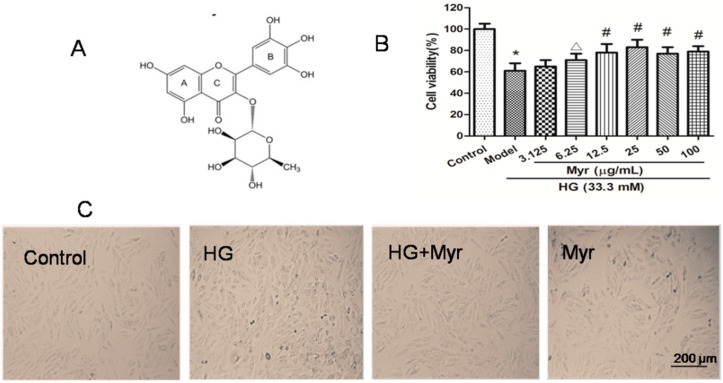
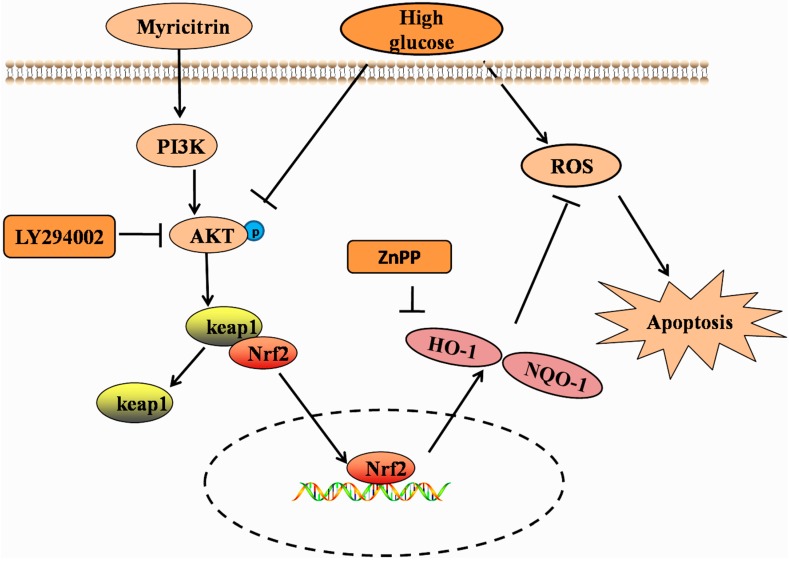
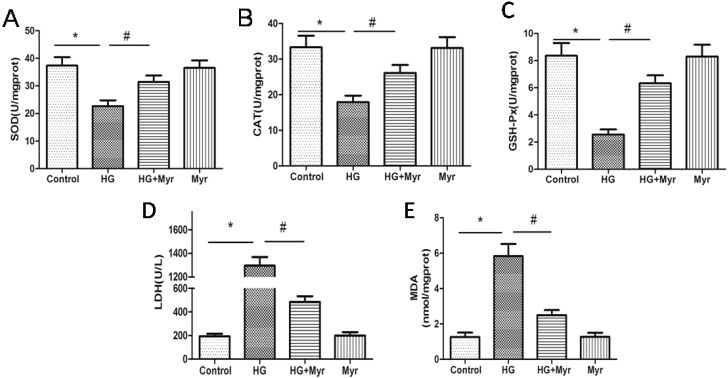
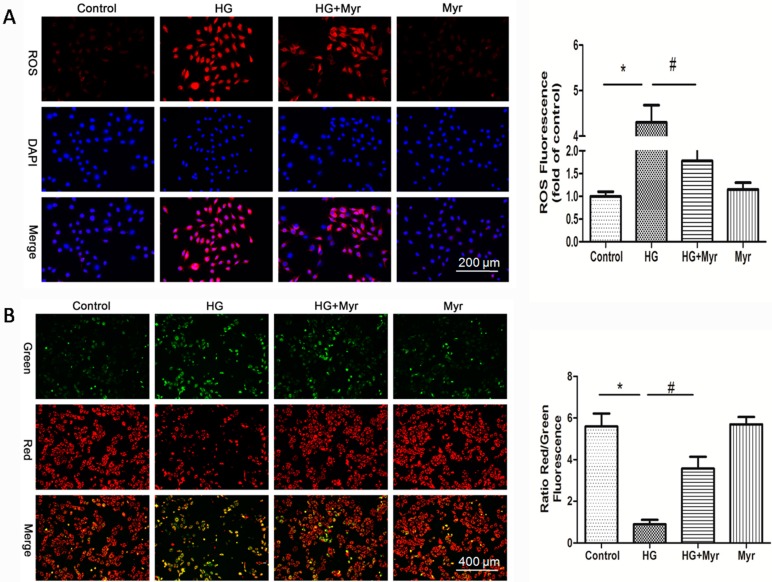
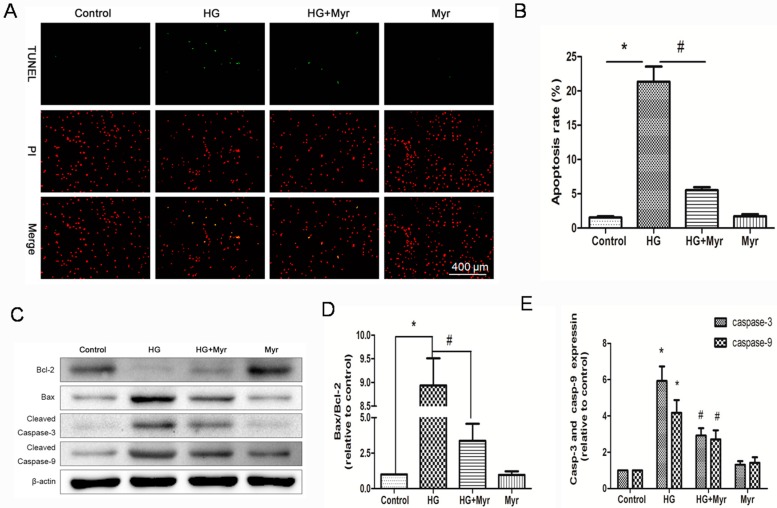
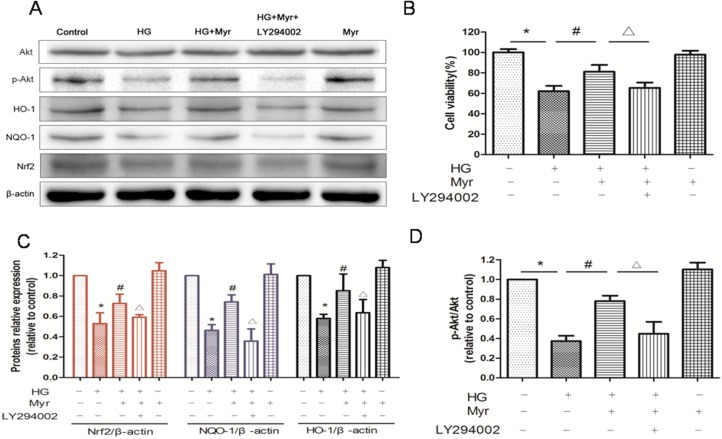
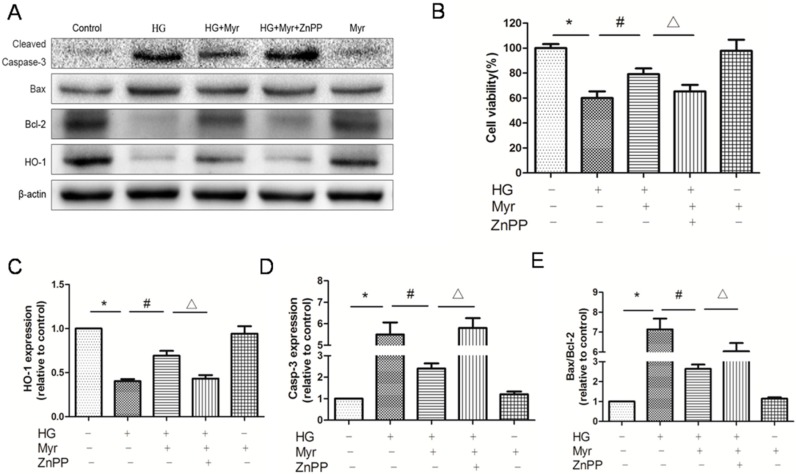
Hyperglycemia, as well as diabetes mellitus, has been shown to trigger cardiac cell apoptosis. We have previously demonstrated that myricitrin prevents endothelial cell apoptosis. However, whether myricitrin can attenuate H9c2 cell apoptosis remains unknown. In this study, we established an experiment model in H9c2 cells exposed to high glucose. We tested the hypothesis that myricitrin may inhibit high glucose (HG)-induced cardiac cell apoptosis as determined by TUNEL staining. Furthermore, myricitrin promoted antioxidative enzyme production, suppressed high glucose-induced reactive oxygen species (ROS) production and decreased mitochondrial membrane potential (MMP) in H9c2 cells. This agent significantly inhibited apoptotic protein expression, activated Akt and facilitated the transcription of NF-E2-related factor 2 (Nrf2)-mediated protein (heme oxygenase-1 (HO-1) and quinone oxidoreductase 1 (NQO-1) expression as determined by Western blotting. Significantly, an Akt inhibitor (LY294002) or HO-1 inhibitor (ZnPP) not only inhibited myricitrin-induced HO-1/NQO-1 upregulation but also alleviated its anti-apoptotic effects. In summary, these observations demonstrate that myricitrin activates Nrf2-mediated anti-oxidant signaling and attenuates H9c2 cell apoptosis induced by high glucose via activation of Akt signaling.
高血糖以及糖尿病已被证明会引发心脏细胞凋亡。我们之前已经证明杨梅素可防止内皮细胞凋亡。然而,杨梅素是否能减轻H9c2细胞凋亡仍不清楚。在本研究中,我们建立了高糖处理的H9c2细胞实验模型。我们检验了这样一个假设,即杨梅素可能抑制高糖(HG)诱导的心脏细胞凋亡,这通过TUNEL染色来确定。此外,杨梅素促进抗氧化酶的产生,抑制高糖诱导的H9c2细胞中活性氧(ROS)的产生,并降低线粒体膜电位(MMP)。该药物显著抑制凋亡蛋白表达,激活Akt,并促进核因子E2相关因子2(Nrf2)介导的蛋白(血红素加氧酶-1(HO-1)和醌氧化还原酶1(NQO-1))的转录,这通过蛋白质免疫印迹法来确定。值得注意的是,Akt抑制剂(LY294002)或HO-1抑制剂(ZnPP)不仅抑制杨梅素诱导的HO-1/NQO-1上调,还减轻其抗凋亡作用。总之,这些观察结果表明,杨梅素通过激活Akt信号通路激活Nrf2介导的抗氧化信号,并减轻高糖诱导的H9c2细胞凋亡。