Smither Sophie, Phelps Amanda, Eastaugh Lin, Ngugi Sarah, O'Brien Lyn, Dutch Andrew, Lever Mark Stephen
CBR Division, Defence Science and Technology Laboratory (Dstl), Room 201, Building 7a. Dstl, Porton Down, Salisbury, Wiltshire SP4 0JQ, UK.
MIG-CCHS2/C2, 1710 Naval Air Squadron, Room 104c, Unicorn House, Yeovilton BA22 8HW, UK.
Viruses. 2016 Jul 7;8(7):185. doi: 10.3390/v8070185.
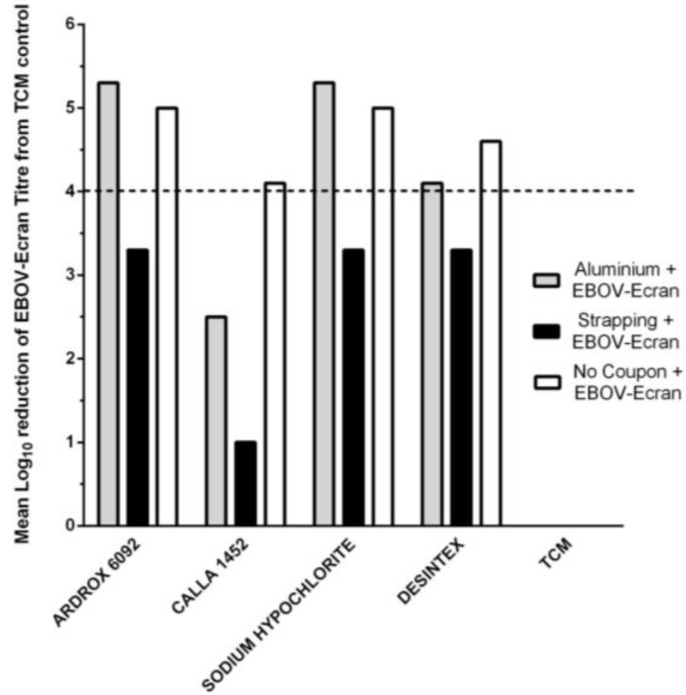
The West Africa Ebola virus (EBOV) outbreak has highlighted the need for effective disinfectants capable of reducing viral load in a range of sample types, equipment and settings. Although chlorine-based products are widely used, they can also be damaging to equipment or apparatus that needs continuous use such as aircraft use for transportation of infected people. Two aircraft cleaning solutions were assessed alongside two common laboratory disinfectants in a contact kill assay with EBOV on two aircraft relevant materials representative of a porous and non-porous surface. A decimal log reduction of viral titre of 4 is required for a disinfectant to be deemed effective and two of the disinfectants fulfilled this criteria under the conditions tested. One product, Ardrox 6092, was found to perform similarly to sodium hypochlorite, but as it does not have the corrosive properties of sodium hypochlorite, it could be an alternative disinfectant solution to be used for decontamination of EBOV on sensitive apparatus.
西非埃博拉病毒(EBOV)疫情凸显了对有效消毒剂的需求,这种消毒剂需要能够在一系列样本类型、设备和环境中降低病毒载量。尽管含氯产品被广泛使用,但它们也可能对需要持续使用的设备或仪器造成损害,比如用于运送感染者的飞机。在一项接触杀灭试验中,将两种飞机清洁溶液与两种常见的实验室消毒剂一起,在代表多孔和无孔表面的两种飞机相关材料上,针对EBOV进行测试。一种消毒剂要被视为有效,需要使病毒滴度对数减少4,在测试条件下,有两种消毒剂符合这一标准。发现一种产品Ardrox 6092的性能与次氯酸钠相似,但由于它不具备次氯酸钠的腐蚀性,它可能是用于对敏感仪器上的EBOV进行去污处理的替代消毒剂溶液。