• 文献检索
  • 文档翻译
  • 深度研究
  • 学术资讯
  • Suppr Zotero 插件Zotero 插件
  • 邀请有礼
  • 套餐&价格
  • 历史记录
应用&插件
Suppr Zotero 插件Zotero 插件浏览器插件Mac 客户端Windows 客户端微信小程序
定价
高级版会员购买积分包购买API积分包
服务
文献检索文档翻译深度研究API 文档MCP 服务
关于我们
关于 Suppr公司介绍联系我们用户协议隐私条款
关注我们

Suppr 超能文献

核心技术专利:CN118964589B侵权必究
粤ICP备2023148730 号-1Suppr @ 2026

文献检索

告别复杂PubMed语法,用中文像聊天一样搜索,搜遍4000万医学文献。AI智能推荐,让科研检索更轻松。

立即免费搜索

文件翻译

保留排版,准确专业,支持PDF/Word/PPT等文件格式,支持 12+语言互译。

免费翻译文档

深度研究

AI帮你快速写综述,25分钟生成高质量综述,智能提取关键信息,辅助科研写作。

立即免费体验

脑室内颅内压监测可改善老年重度创伤性脑损伤患者的预后:一项观察性前瞻性研究。

Intraventricular intracranial pressure monitoring improves the outcome of older adults with severe traumatic brain injury: an observational, prospective study.

作者信息

You Wendong, Feng Junfeng, Tang Qilin, Cao Jun, Wang Lei, Lei Jin, Mao Qing, Gao Guoyi, Jiang Jiyao

机构信息

Department of Neurosurgery, Renji Hospital, School of Medicine, Shanghai Jiao Tong University, Shanghai, 200127, People's Republic of China.

Shanghai Institute of Head Trauma, Shanghai, 200127, People's Republic of China.

出版信息

BMC Anesthesiol. 2016 Jul 11;16(1):35. doi: 10.1186/s12871-016-0199-9.

DOI:10.1186/s12871-016-0199-9
PMID:27401211
原文链接:https://pmc.ncbi.nlm.nih.gov/articles/PMC4940906/
Abstract

BACKGROUND

Intracranial pressure (ICP) monitoring is widely used in the management of patients with severe traumatic brain injury (TBI). However, there is limited evidence about the efficacy of ICP monitoring in older subjects (aged ≥65 years). This study evaluated the effect of intraventricular ICP monitoring on the outcome of older adults suffering from a severe TBI.

METHODS

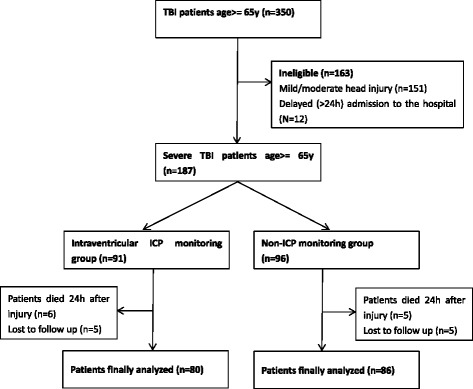
This prospective, observational study included 166 older TBI patients (aged ≥65 years) with Glasgow Coma scale (GCS) scores lower than 9 at admission. The study cohort was divided into two groups, intraventricular ICP monitoring and non-ICP monitoring. The primary outcome was in-hospital mortality. The secondary outcomes included the Glasgow Outcome Scale (GOS) score 6 months after injury, the ICU and total hospital lengths of stay, and mechanical ventilation days.

RESULTS

There were 80 patients in the intraventricular ICP monitoring group and 86 patients in non-ICP monitoring group. There was no statistical difference between groups in demographics and severity of head injury. Patients treated with intraventricular ICP monitoring had lower in-hospital mortality (33.8 % vs 51.2 %, P < 0.05), a higher 6-month GOS score (3.0 ± 1.4 vs 2.5 ± 1.2 P < 0.05), and a lower dosage (514 ± 246 g vs 840 ± 323 g, P < 0.0001) and shorter duration (7.2 ± 3.6 days vs 8.4 ± 4.3 days, P < 0.01) of mannitol use. However, the ICU length of stay (14.3 ± 6.4 days vs 11.6 ± 5.8 days, P < 0.01) and mechanical ventilation days (6.7 ± 3.5 days vs 5.6 ± 2.4 days, P < 0.05) were longer in the ICP monitoring group. The total length of hospital stay did not differ between the two groups (28.5 ± 12.1 days vs 26.1 ± 13.5 days, P = 0.23).

CONCLUSIONS

Intraventricular ICP monitoring may have beneficial effects on the decreased in-hospital mortality and improved 6-month outcome of older patients with severe TBI. However, given that this was an observational study conducted in a single institution, further well-designed randomized control trials are needed to evaluate the effect of intraventricular ICP monitoring on the outcome of older severe TBI patients.

摘要

背景

颅内压(ICP)监测广泛应用于重度创伤性脑损伤(TBI)患者的治疗中。然而,关于ICP监测在老年患者(年龄≥65岁)中的疗效证据有限。本研究评估了脑室内ICP监测对重度TBI老年患者预后的影响。

方法

这项前瞻性观察性研究纳入了166例老年TBI患者(年龄≥65岁),入院时格拉斯哥昏迷量表(GCS)评分低于9分。研究队列分为两组,即脑室内ICP监测组和非ICP监测组。主要结局是院内死亡率。次要结局包括伤后6个月的格拉斯哥预后量表(GOS)评分、ICU住院时间和总住院时间以及机械通气天数。

结果

脑室内ICP监测组有80例患者,非ICP监测组有86例患者。两组在人口统计学和颅脑损伤严重程度方面无统计学差异。接受脑室内ICP监测治疗的患者院内死亡率较低(33.8%对51.2%,P<0.05),伤后6个月GOS评分较高(3.0±1.4对2.5±1.2,P<0.05),甘露醇使用剂量较低(514±246克对840±323克,P<0.0001)且使用时间较短(7.2±3.6天对8.4±4.3天,P<0.01)。然而,ICP监测组的ICU住院时间(14.3±6.4天对11.6±5.8天,P<0.01)和机械通气天数(6.7±3.5天对5.6±2.4天,P<0.05)更长。两组的总住院时间无差异(28.5±12.1天对26.1±13.5天,P=0.23)。

结论

脑室内ICP监测可能对降低重度TBI老年患者的院内死亡率和改善其伤后6个月的预后有有益影响。然而,鉴于这是在单一机构进行的观察性研究,需要进一步设计完善的随机对照试验来评估脑室内ICP监测对重度TBI老年患者预后的影响。
https://cdn.ncbi.nlm.nih.gov/pmc/blobs/188b/4940906/ea265c3fce9f/12871_2016_199_Fig1_HTML.jpg

相似文献

1
Intraventricular intracranial pressure monitoring improves the outcome of older adults with severe traumatic brain injury: an observational, prospective study.脑室内颅内压监测可改善老年重度创伤性脑损伤患者的预后:一项观察性前瞻性研究。
BMC Anesthesiol. 2016 Jul 11;16(1):35. doi: 10.1186/s12871-016-0199-9.
2
Intracranial Pressure Monitoring in Children With Severe Traumatic Brain Injury: National Trauma Data Bank-Based Review of Outcomes.儿童严重创伤性脑损伤的颅内压监测:基于国家创伤数据库的结局回顾性研究。
JAMA Surg. 2014 Jun;149(6):544-8. doi: 10.1001/jamasurg.2013.4329.
3
Intracranial Pressure Monitoring in the Intensive Care Unit for Patients with Severe Traumatic Brain Injury: Analysis of the CENTER-TBI China Registry.重症监护病房严重创伤性脑损伤患者颅内压监测:CENTER-TBI 中国登记分析。
Neurocrit Care. 2022 Aug;37(1):160-171. doi: 10.1007/s12028-022-01463-w. Epub 2022 Mar 4.
4
The Value of Managing Severe Traumatic Brain Injury During the Perioperative Period Using Intracranial Pressure Monitoring.围手术期使用颅内压监测管理重度创伤性脑损伤的价值
J Craniofac Surg. 2019 Oct;30(7):2217-2223. doi: 10.1097/SCS.0000000000005861.
5
Intracranial pressure monitoring in patients with acute brain injury in the intensive care unit (SYNAPSE-ICU): an international, prospective observational cohort study.重症监护病房中急性脑损伤患者的颅内压监测(SYNAPSE-ICU):一项国际、前瞻性观察性队列研究。
Lancet Neurol. 2021 Jul;20(7):548-558. doi: 10.1016/S1474-4422(21)00138-1.
6
Intracranial pressure monitoring in severe traumatic brain injuries: a closer look at level 1 trauma centers in the United States.严重创伤性脑损伤的颅内压监测:深入研究美国的一级创伤中心
Injury. 2017 Sep;48(9):1944-1950. doi: 10.1016/j.injury.2017.04.033. Epub 2017 Apr 20.
7
Hypertonic saline reduces cumulative and daily intracranial pressure burdens after severe traumatic brain injury.高渗盐水可降低重度创伤性脑损伤后的颅内压累积负担和每日负担。
J Neurosurg. 2015 Jan;122(1):202-10. doi: 10.3171/2014.10.JNS132545.
8
Intracranial pressure monitoring in severe blunt head trauma: does the type of monitoring device matter?严重钝性颅脑外伤的颅内压监测:监测设备的类型重要吗?
J Neurosurg. 2018 Mar;128(3):828-833. doi: 10.3171/2016.11.JNS162198. Epub 2017 May 26.
9
Intraparenchymal vs extracranial ventricular drain intracranial pressure monitors in traumatic brain injury: less is more?脑外伤患者使用脑实质内与颅外脑室内压力监测探头的比较:少即是多?
J Am Coll Surg. 2012 Jun;214(6):950-7. doi: 10.1016/j.jamcollsurg.2012.03.004. Epub 2012 Apr 26.
10
Introduction of severe traumatic brain injury care protocol is associated with reduction in mortality for pediatric patients: a case study of Children's Healthcare of Atlanta's neurotrauma program.重度创伤性脑损伤护理方案的引入与儿科患者死亡率的降低相关:以亚特兰大儿童医疗中心神经创伤项目为例的一项案例研究。
J Neurosurg Pediatr. 2018 Aug;22(2):165-172. doi: 10.3171/2018.2.PEDS17562. Epub 2018 May 25.

引用本文的文献

1
Intracranial pressure monitoring in patients with geriatric trauma may not improve outcome but is associated with increases in resource utilization.老年创伤患者的颅内压监测可能无法改善预后,但与资源利用增加有关。
Trauma Surg Acute Care Open. 2025 Mar 18;10(1):e001644. doi: 10.1136/tsaco-2024-001644. eCollection 2025.
2
Global traumatic brain injury intracranial pressure: from monitoring to surgical decision.全球创伤性脑损伤颅内压:从监测到手术决策
Front Neurol. 2024 Sep 17;15:1423329. doi: 10.3389/fneur.2024.1423329. eCollection 2024.
3
Establishment and external validation of a nomogram for predicting 28-day mortality in patients with skull fracture.

本文引用的文献

1
Effects and Clinical Characteristics of Intracranial Pressure Monitoring-Targeted Management for Subsets of Traumatic Brain Injury: An Observational Multicenter Study.颅内压监测目标管理对创伤性脑损伤亚组的影响和临床特征:一项观察性多中心研究。
Crit Care Med. 2015 Jul;43(7):1405-14. doi: 10.1097/CCM.0000000000000965.
2
Intracranial pressure monitor in patients with traumatic brain injury.创伤性脑损伤患者的颅内压监测器
J Surg Res. 2015 Apr;194(2):565-570. doi: 10.1016/j.jss.2014.11.017. Epub 2014 Nov 18.
3
External Ventricular Drains versus Intraparenchymal Intracranial Pressure Monitors in Traumatic Brain Injury: A Prospective Observational Study.
用于预测颅骨骨折患者28天死亡率的列线图的建立及外部验证
Front Neurol. 2024 Jan 12;14:1338545. doi: 10.3389/fneur.2023.1338545. eCollection 2023.
4
The establishment and validation of a prediction model for traumatic intracranial injury patients: a reliable nomogram.创伤性颅内损伤患者预测模型的建立与验证:一个可靠的列线图
Front Neurol. 2023 May 25;14:1165020. doi: 10.3389/fneur.2023.1165020. eCollection 2023.
5
Current Status of Intracranial Pressure Monitoring in Patients with Severe Traumatic Brain Injury in Korea : A Post Hoc Analysis of Korea Neurotrauma Databank Project with a Nationwide Survey.韩国重型颅脑损伤患者颅内压监测的现状:韩国神经创伤数据库项目的事后分析及全国性调查
J Korean Neurosurg Soc. 2023 Aug;66(5):543-551. doi: 10.3340/jkns.2023.0019. Epub 2023 Apr 4.
6
The Significance of Intracranial Pressure Monitoring for Reducing Mortality in Patients with Traumatic Brain Injury: A Systematic Review and Meta-Analysis.颅内压监测对降低创伤性脑损伤患者死亡率的意义:系统评价和荟萃分析。
Comput Math Methods Med. 2022 Oct 8;2022:1956908. doi: 10.1155/2022/1956908. eCollection 2022.
7
Factors associated with receipt of intracranial pressure monitoring in older adults with traumatic brain injury.创伤性脑损伤老年患者接受颅内压监测的相关因素。
Trauma Surg Acute Care Open. 2021 Jul 23;6(1):e000733. doi: 10.1136/tsaco-2021-000733. eCollection 2021.
8
An overview of management of intracranial hypertension in the intensive care unit.颅内高压在重症监护病房的管理概述。
J Anesth. 2020 Oct;34(5):741-757. doi: 10.1007/s00540-020-02795-7. Epub 2020 May 21.
9
Intracranial pressure monitoring associated with increased mortality in pediatric brain injuries.小儿脑损伤中颅内压监测与死亡率增加相关。
Pediatr Surg Int. 2020 Mar;36(3):391-398. doi: 10.1007/s00383-020-04618-y. Epub 2020 Jan 14.
10
Respect your elders: effects of ageing on intracranial pressure monitor use in traumatic brain injury.尊重年长者:年龄对创伤性脑损伤患者颅内压监测使用的影响
Trauma Surg Acute Care Open. 2019 Jun 17;4(1):e000306. doi: 10.1136/tsaco-2019-000306. eCollection 2019.
创伤性脑损伤中外侧脑室引流与脑实质内颅内压监测器的比较:一项前瞻性观察研究
World Neurosurg. 2015 May;83(5):794-800. doi: 10.1016/j.wneu.2014.12.040. Epub 2014 Dec 23.
4
Intracranial Pressure Monitoring in Children With Severe Traumatic Brain Injury: National Trauma Data Bank-Based Review of Outcomes.儿童严重创伤性脑损伤的颅内压监测:基于国家创伤数据库的结局回顾性研究。
JAMA Surg. 2014 Jun;149(6):544-8. doi: 10.1001/jamasurg.2013.4329.
5
A trial of intracranial pressure monitoring in traumatic brain injury.创伤性脑损伤颅内压监测的一项试验。
Crit Care. 2014 Jan 31;18(1):302. doi: 10.1186/cc13713.
6
Traumatic brain injury among older adults at level I and II trauma centers.老年创伤性脑损伤在一级和二级创伤中心。
J Neurotrauma. 2013 Dec 15;30(24):2001-13. doi: 10.1089/neu.2013.3047. Epub 2013 Nov 26.
7
Decreased risk of acute kidney injury with intracranial pressure monitoring in patients with moderate or severe brain injury.颅内压监测可降低中重度颅脑损伤患者急性肾损伤的风险。
J Neurosurg. 2013 Nov;119(5):1228-32. doi: 10.3171/2013.7.JNS122131. Epub 2013 Aug 2.
8
Lessons from the intracranial pressure-monitoring trial in patients with traumatic brain injury.创伤性脑损伤患者颅内压监测试验的经验教训。
World Neurosurg. 2014 Jul-Aug;82(1-2):e393-5. doi: 10.1016/j.wneu.2013.07.012. Epub 2013 Jul 23.
9
A trial of intracranial-pressure monitoring in traumatic brain injury.颅脑创伤患者颅内压监测的临床试验。
N Engl J Med. 2012 Dec 27;367(26):2471-81. doi: 10.1056/NEJMoa1207363. Epub 2012 Dec 12.
10
Mortality among older adults after a traumatic brain injury: a meta-analysis.创伤性脑损伤后老年人的死亡率:一项荟萃分析。
Brain Inj. 2013;27(1):31-40. doi: 10.3109/02699052.2012.700086. Epub 2012 Nov 19.