O'Connell Grant, Graff Donald W, D'Ruiz Carl D
a Fontem Ventures, B.V, Scientific and Regulatory Affairs , Amsterdam , The Netherlands ;
b Celerion Inc, Lincoln , USA ;
Toxicol Mech Methods. 2016 Jul;26(6):443-54. doi: 10.1080/15376516.2016.1196282. Epub 2016 Jul 12.
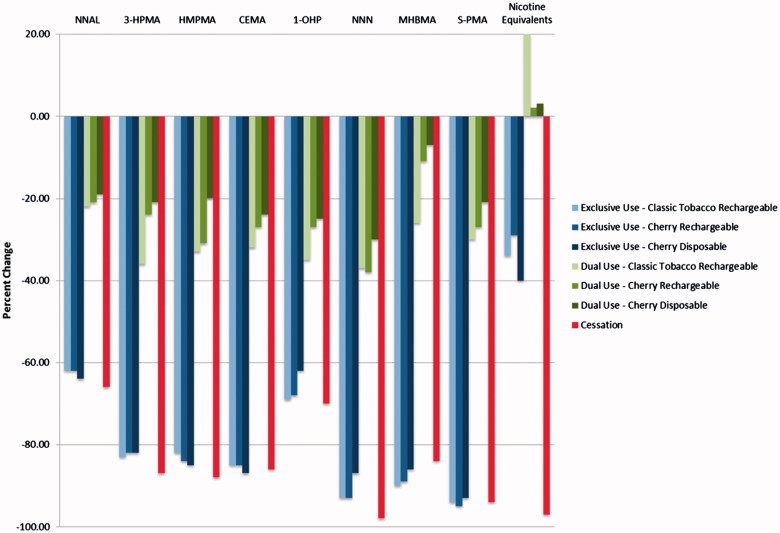
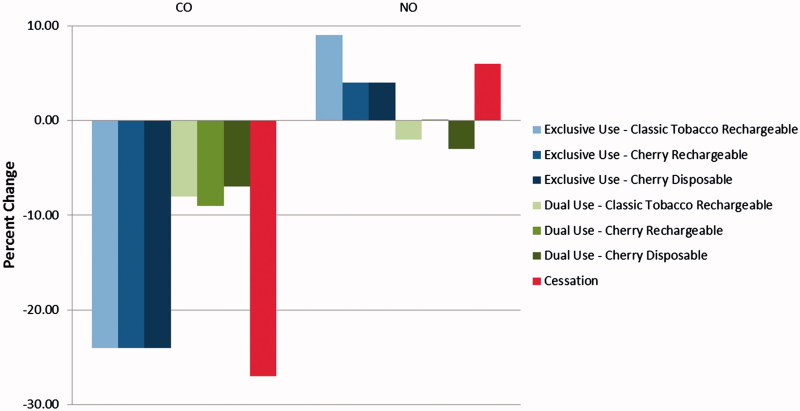
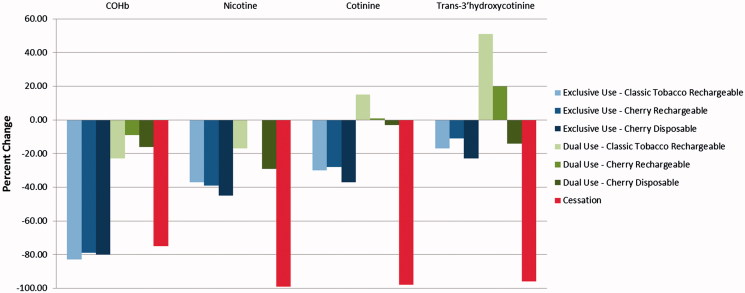
Changes in fifteen urine, blood and exhaled breath BoEs of HPHCs representing classes of compounds reported by FDA to be significant contributors to smoking-associated disease risks were measured in 105 clinical-confined subjects following randomization and a five-day forced-switch from usual brand conventional combustible cigarettes to: (i) exclusive commercial e-cigarette use; (ii) dual-use of commercial e-cigarettes and the subject's usual cigarette brand; or (iii) discontinued use of all tobacco or nicotine products. Levels of urinary biomarkers in subjects that completely substituted their usual cigarette with e-cigarettes were significantly lower (29-95%) after 5 days. Percent reductions in eight of nine urinary BoEs were indistinguishable to smokers who had quit smoking, except for nicotine equivalents, which declined by 25-40%. Dual users who halved self-reported daily cigarette consumption with e-cigarettes exhibited reductions (7-38%) in eight of nine urinary biomarkers, but had increase (1-20%) in nicotine equivalents. Reductions were broadly proportional to the reduced numbers of cigarettes smoked. Dual user urinary nicotine equivalents were slightly higher, but not statistically significant. After 5 days, blood nicotine biomarker levels were lower in the cessation (75-96%) and exclusive use groups (11-83%); with dual users experiencing no significant reductions. All subjects experienced significant decreases in exhaled CO. Decreases in the cessation and exclusive groups ranged from 88-89% and 27-32% in dual users. Exhaled NO increased in the cessation and exclusive groups (46-63% respectively), whereas the dual users experienced minimal changes. Overall, smokers who completely or partially substituted conventional cigarettes with e-cigarettes over five days, experienced reductions in HPHCs.
在105名临床受限受试者中,在随机分组以及从常规品牌传统可燃香烟强制转换至以下情况五天后,测量了代表美国食品药品监督管理局(FDA)报告的对吸烟相关疾病风险有重大影响的化合物类别的15种尿液、血液和呼出气体生物标志物(BoE)的变化:(i)仅使用商业电子烟;(ii)同时使用商业电子烟和受试者常用的香烟品牌;或(iii)停止使用所有烟草或尼古丁产品。完全用电子烟替代其常用香烟的受试者的尿液生物标志物水平在5天后显著降低(29%-95%)。除尼古丁当量下降25%-40%外,九种尿液BoE中的八种的降低幅度与戒烟者无法区分。将自我报告的每日香烟消费量减半并使用电子烟的双重使用者,其九种尿液生物标志物中的八种出现了降低(7%-38%),但尼古丁当量有所增加(1%-20%)。降低幅度大致与吸烟数量的减少成比例。双重使用者的尿液尼古丁当量略高,但无统计学意义。5天后,戒烟组(75%-96%)和仅使用电子烟组(11%-83%)的血液尼古丁生物标志物水平较低;双重使用者没有显著降低。所有受试者呼出的一氧化碳均显著减少。戒烟组和仅使用电子烟组的减少幅度分别为88%-89%和双重使用者中的27%-32%。呼出的一氧化氮在戒烟组和仅使用电子烟组中增加(分别为46%-63%),而双重使用者变化极小。总体而言,在五天内完全或部分用电子烟替代传统香烟的吸烟者,其有害和潜在有害成分(HPHC)减少。