Choi Chel Hun, Chung Joon-Yong, Chung Eun Joo, Sears John D, Lee Jeong-Won, Bae Duk-Soo, Hewitt Stephen M
Experimental Pathology Laboratory, Laboratory of Pathology, Center for Cancer Research, National Cancer Institute, National Institutes of Health, MSC 1500, Bethesda, MD, 20892, USA.
Department of Obstetrics and Gynecology, Samsung Medical Center, Sungkyunkwan University School of Medicine, 50 Irwon-dong, Gangnam-gu, Seoul, 135-710, Republic of Korea.
BMC Cancer. 2016 Jul 11;16:448. doi: 10.1186/s12885-016-2459-y.
The annexins (ANXs) have diverse roles in tumor development and progression, however, their clinical significance in cervical cancer has not been elucidated. The present study was to investigate the clinical significance of annexin A2 (ANXA2) and annexin A4 (ANXA4) expression in cervical cancer.
ANXA2 and ANXA4 immunohistochemical staining were performed on a cervical cancer tissue microarray consisting of 46 normal cervical epithelium samples and 336 cervical cancer cases and compared the data with clinicopathological variables, including the survival of cervical cancer patients.
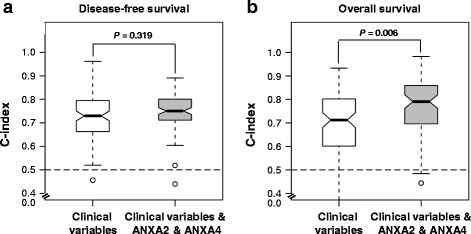
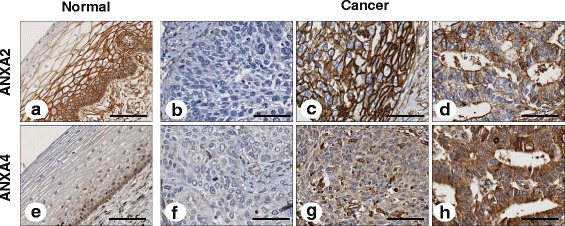
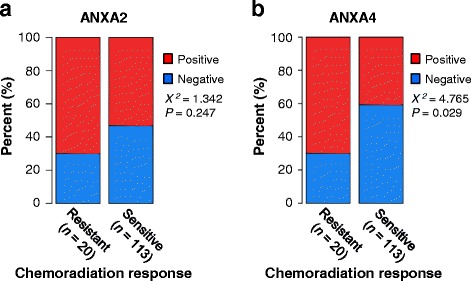
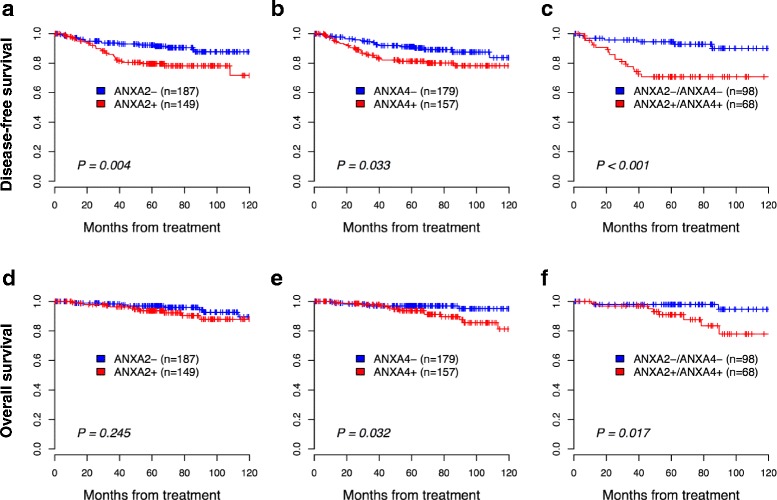
ANXA2 expression was lower in cancer tissue (p = 0.002), whereas ANXA4 staining increased significantly in cancer tissues (p < 0.001). ANXA2 expression was more prominent in squamous cell carcinoma (p < 0.001), whereas ANXA4 was more highly expressed in adeno/adenosquamous carcinoma (p < 0.001). ANXA2 overexpression was positively correlated with advanced cancer phenotypes, whereas ANXA4 expression was associated with resistance to radiation with or without chemotherapy (p = 0.029). Notably, high ANXA2 and ANXA4 expression was significantly associated with shorter disease-free survival (p = 0.004 and p = 0.033, respectively). Multivariate analysis indicated that ANXA2+ (HR = 2.72, p = 0.003) and ANXA2+/ANXA4+ (HR = 2.69, p = 0.039) are independent prognostic factors of disease-free survival in cervical cancer. Furthermore, a random survival forest model using combined ANXA2, ANXA4, and clinical variables resulted in improved predictive power (mean C-index, 0.76) compared to that of clinical-variable-only models (mean C-index, 0.70) (p = 0.006).
These findings indicate that detecting ANXA2 and ANXA4 expression may aid the evaluation of cervical carcinoma prognosis.
膜联蛋白(ANXs)在肿瘤发生和发展过程中发挥着多种作用,然而,其在宫颈癌中的临床意义尚未阐明。本研究旨在探讨膜联蛋白A2(ANXA2)和膜联蛋白A4(ANXA4)在宫颈癌中的表达及其临床意义。
对包含46例正常宫颈上皮样本和336例宫颈癌病例的组织芯片进行ANXA2和ANXA4免疫组化染色,并将数据与临床病理变量进行比较,包括宫颈癌患者的生存率。
癌组织中ANXA2表达较低(p = 0.002),而癌组织中ANXA4染色显著增加(p < 0.001)。ANXA2在鳞状细胞癌中表达更为突出(p < 0.001),而ANXA4在腺/腺鳞癌中表达更高(p < 0.001)。ANXA2过表达与晚期癌症表型呈正相关,而ANXA4表达与放疗联合或不联合化疗的耐药性相关(p = 0.029)。值得注意的是,高ANXA2和ANXA4表达与较短的无病生存期显著相关(分别为p = 0.004和p = 0.033)。多因素分析表明,ANXA2 +(HR = 2.72,p = 0.003)和ANXA2 + / ANXA4 +(HR = 2.69,p = 0.039)是宫颈癌无病生存期的独立预后因素。此外,与仅使用临床变量的模型(平均C指数为0.70)相比,使用ANXA2、ANXA4和临床变量组合的随机生存森林模型具有更高的预测能力(平均C指数为0.76)(p = 0.006)。
这些结果表明,检测ANXA2和ANXA4表达可能有助于评估宫颈癌的预后。