Hwang Chul Ju, Lee Hee Pom, Choi Dong-Young, Jeong Heon Sang, Kim Tae Hoon, Lee Tae Hyung, Kim Young Min, Moon Dae Bong, Park Sung Sik, Kim Sun Young, Oh Ki-Wan, Hwang Dae Yeon, Han Sang-Bae, Lee Hwa-Jeong, Hong Jin Tae
College of Pharmacy and Medical Research Center, Chungbuk National University, Osongsaengmyeong, Osong-eup, Heungduk-gu, Cheongju, Chungbuk, Republic of Korea.
College of Pharmacy, Yeungnam University, Daehak-Ro, Gyeongsan, Gyeongbuk, Republic of Korea.
Oncotarget. 2016 Jul 26;7(30):46943-46958. doi: 10.18632/oncotarget.10504.
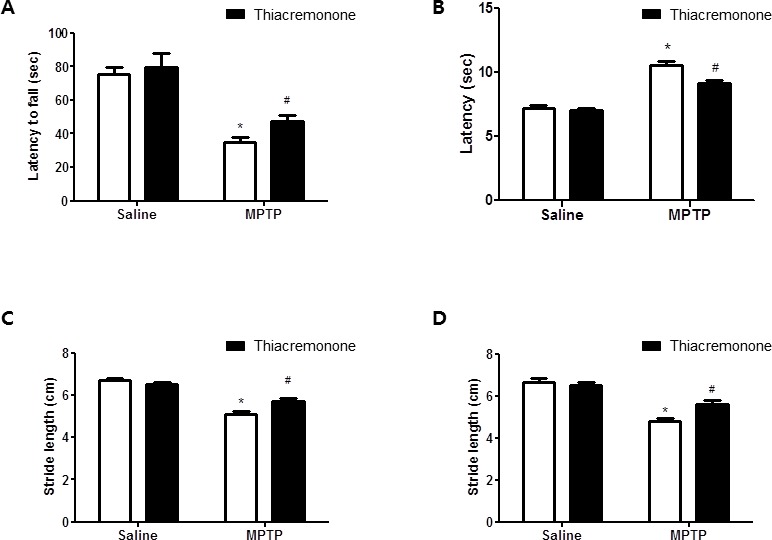
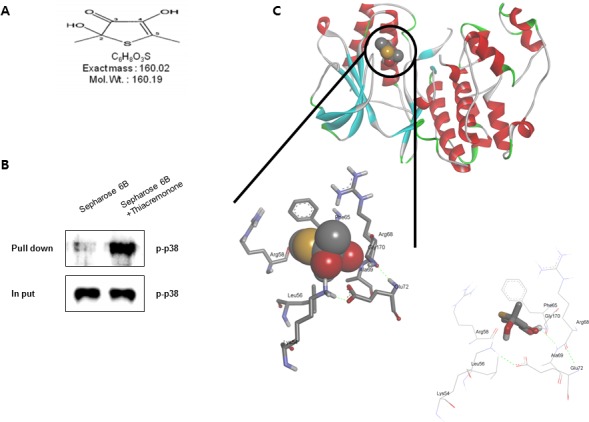
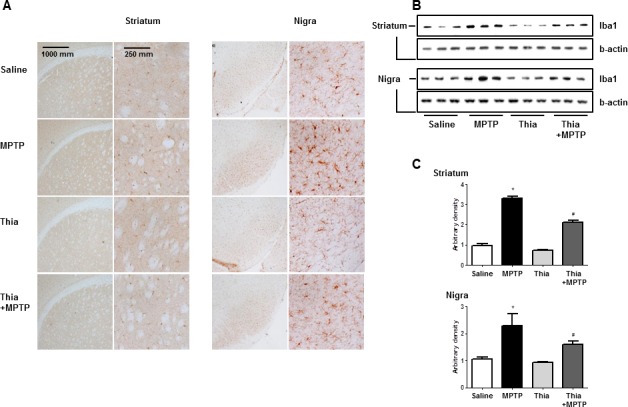
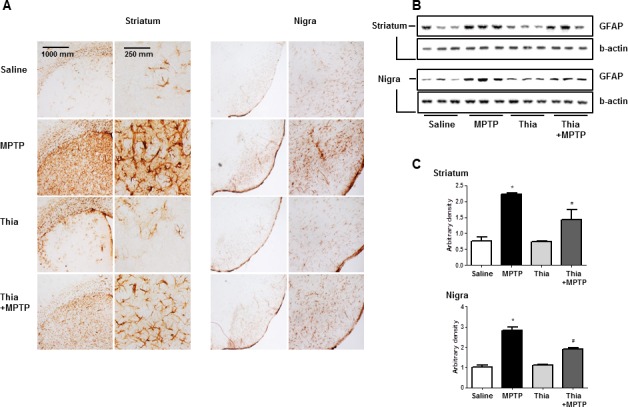
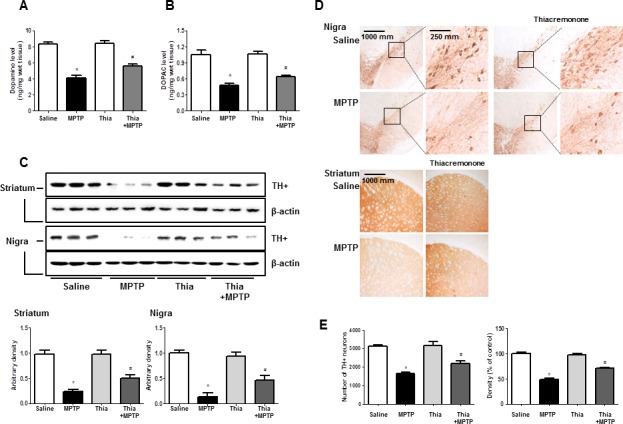
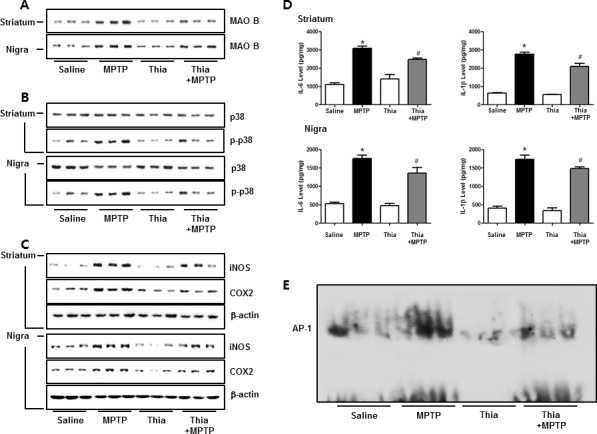
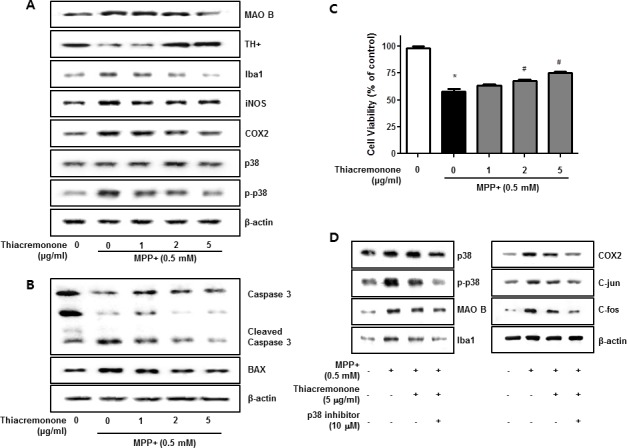
Neuroinflammation is implicated for dopaminergic neurodegeneration. Sulfur compounds extracted from garlic have been shown to have anti-inflammatory properties. Previously, we have investigated that thiacremonone, a sulfur compound isolated from garlic has anti-inflammatory effects on several inflammatory disease models. To investigate the protective effect of thiacremonone against 1-methyl-4-phenyl-1,2,3,6-tetrahydropyridine (MPTP)-induced behavioral impairment and dopaminergic neurodegeneration, 8 week old ICR mice were given thiacremonone (10 mg/kg) in drinking water for 1 month and received intraperitoneal injection of MPTP (15 mg/kg, four times with 2 h interval) during the last 7 days of treatment. Our data showed that thiacremonone decreased MPTP-induced behavioral impairments (Rotarod test, Pole test, and Gait test), dopamine depletion and microglia and astrocytes activations as well as neuroinflammation. Higher activation of p38 was found in the substantia nigra and striatum after MPTP injection, but p38 activation was reduced in thiacremonone treated group. In an in vitro study, thiacremonone (1, 2, and 5 μg/ml) effectively decreased MPP+ (0.5 mM)-induced glial activation, inflammatory mediators generation and dopaminergic neurodegeneration in cultured astrocytes and microglial BV-2 cells. Moreover, treatment of p38 MAPK inhibitor SB203580 (10 μM) further inhibited thiacremonone induced reduction of neurodegeneration and neuroinflammation. These results indicated that the anti-inflammatory compound, thiacremonone, inhibited neuroinflammation and dopaminergic neurodegeneration through inhibition of p38 activation.
神经炎症与多巴胺能神经元变性有关。从大蒜中提取的硫化合物已被证明具有抗炎特性。此前,我们已经研究发现,从大蒜中分离出的硫化合物硫代秋水仙酮对多种炎症疾病模型具有抗炎作用。为了研究硫代秋水仙酮对1-甲基-4-苯基-1,2,3,6-四氢吡啶(MPTP)诱导的行为障碍和多巴胺能神经元变性的保护作用,给8周龄的ICR小鼠在饮水中给予硫代秋水仙酮(10mg/kg),持续1个月,并在治疗的最后7天腹腔注射MPTP(15mg/kg,共4次,间隔2小时)。我们的数据表明,硫代秋水仙酮减轻了MPTP诱导的行为障碍(转棒试验、爬杆试验和步态试验)、多巴胺耗竭以及小胶质细胞和星形胶质细胞的激活以及神经炎症。MPTP注射后,黑质和纹状体中p38的激活程度更高,但硫代秋水仙酮治疗组中p38的激活程度降低。在一项体外研究中,硫代秋水仙酮(1、2和5μg/ml)有效地减少了1-甲基-4-苯基吡啶离子(MPP+,0.5mM)诱导的培养星形胶质细胞和小胶质细胞BV-2中的胶质细胞激活、炎症介质生成和多巴胺能神经元变性。此外,p38丝裂原活化蛋白激酶抑制剂SB203580(10μM)的处理进一步抑制了硫代秋水仙酮诱导的神经变性和神经炎症的减轻。这些结果表明,抗炎化合物硫代秋水仙酮通过抑制p38激活来抑制神经炎症和多巴胺能神经元变性。