Tian Yuejun, Ma Zhiming, Chen Zhaohui, Li Mingguo, Wu Zhiping, Hong Mei, Wang Hanzhang, Svatek Robert, Rodriguez Ronald, Wang Zhiping
Institute of Urology, Lanzhou University Second Hospital, Key Laboratory of Gansu Province for Urological Diseases, Clinical Center of Gansu Province for Nephro-urology, Lanzhou University, Lanzhou, China.
Department Gastroenterology, The Second Hospital of Lanzhou University, Lanzhou University, Lanzhou, China.
PLoS One. 2016 Jul 13;11(7):e0158891. doi: 10.1371/journal.pone.0158891. eCollection 2016.
Ki-67 is an established marker of cell proliferation, and the Ki-67 index correlates with the clinical course of several cancer types, including bladder cancer (BC). However, the clinicopathological and prognostic significance of Ki-67 in bladder cancer remains unclear. Therefore, we performed a systematic review and meta-analysis to clarify this relationship.
A comprehensive literature search for relevant studies published up to February 1, 2016, was performed using PubMed, Cochrane Library, Embase and ISI Web of Knowledge. The effects of Ki-67 expression on survival outcome in patients with BC and BC subtypes were evaluated. Furthermore, the relationship between Ki-67 expression and the clinicopathological features of BC were assessed.
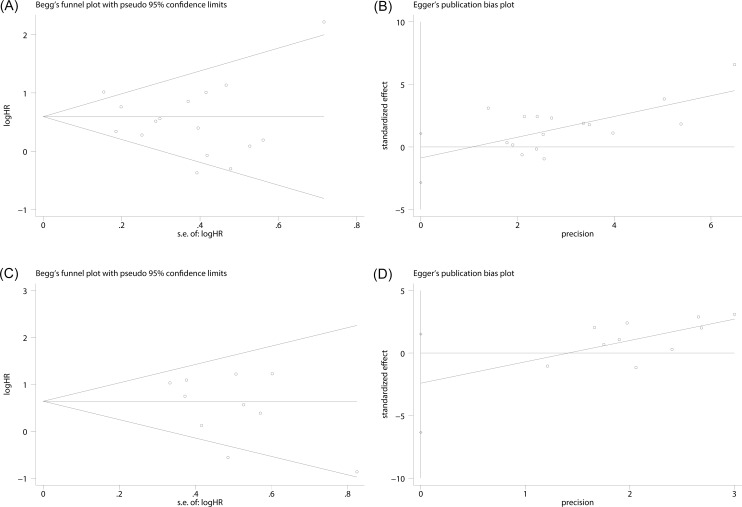
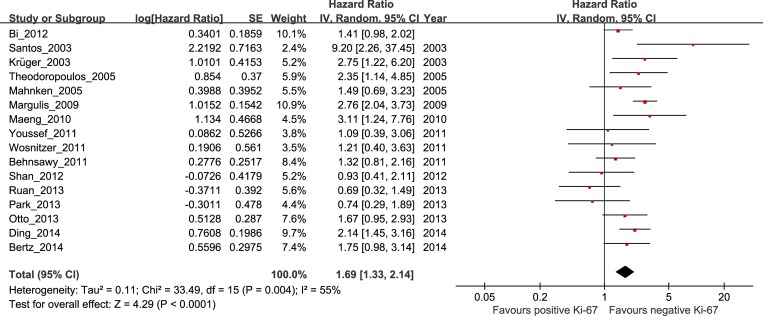
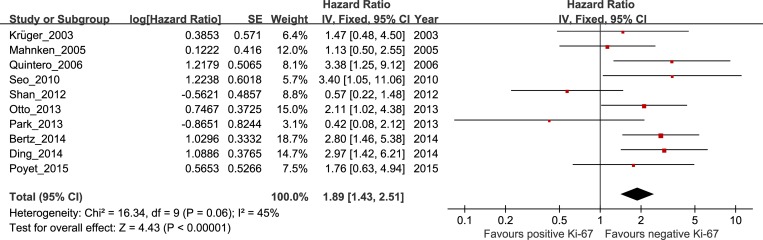
Thirty-one studies with 5147 bladder cancer patients were selected for evaluation. Ki-67 expression was significantly associated with shorter recurrence-free (HR 1.69, 95% CI: 1.33-2.14), progression-free (HR 1.89, 95% CI: 1.43-2.51), overall (HR 2.03, 95% CI: 1.31-3.16), and cancer-specific (HR 1.69, 95% CI: 1.47-1.95) survival. Moreover, whereas high expression was more common in high tumor stage, recurrence status, tumor size, there was no correlation between high Ki-67 expression and age, gender, smoking habits, and tumor number. Importantly, analysis of the different subgroups of BC suggested that significant correlations between high Ki-67 expression and survival outcome (recurrence-free/progression-free/overall/cancer-specific survival) are present only in European-American patients.
The present results indicate that over-expression of Ki-67 is distinctly correlated with poor patient survival. Ki-67 may serve as a valuable biomarker for prognosis in BC patients, particularly in non-Asian BC patients. The results suggest no significant association between Ki-67 expression and BC prognosis in Asian patients. Further efforts are needed to fully clarify this relationship.
Ki-67是一种公认的细胞增殖标志物,Ki-67指数与包括膀胱癌(BC)在内的多种癌症类型的临床病程相关。然而,Ki-67在膀胱癌中的临床病理及预后意义仍不明确。因此,我们进行了一项系统综述和荟萃分析以阐明这种关系。
使用PubMed、Cochrane图书馆、Embase和ISI科学网对截至2016年2月1日发表的相关研究进行全面文献检索。评估Ki-67表达对BC患者及BC亚型生存结局的影响。此外,评估Ki-67表达与BC临床病理特征之间的关系。
选取31项研究共5147例膀胱癌患者进行评估。Ki-67表达与无复发生存期缩短(HR 1.69,95%CI:1.33 - 2.14)、无进展生存期缩短(HR 1.89,95%CI:1.43 - 2.51)、总生存期缩短(HR 2.03,95%CI:1.31 - 3.16)及癌症特异性生存期缩短(HR 1.69,95%CI:1.47 - 1.95)显著相关。此外,虽然高表达在高肿瘤分期、复发状态、肿瘤大小中更常见,但Ki-67高表达与年龄、性别、吸烟习惯及肿瘤数量之间无相关性。重要的是,对BC不同亚组的分析表明,仅在欧美患者中,Ki-67高表达与生存结局(无复发生存期/无进展生存期/总生存期/癌症特异性生存期)之间存在显著相关性。
目前结果表明,Ki-67过表达与患者不良生存明显相关。Ki-67可能是BC患者预后的有价值生物标志物,尤其是在非亚洲BC患者中。结果表明,亚洲患者中Ki-67表达与BC预后无显著关联。需要进一步努力以充分阐明这种关系。