Feng Yan-Lei, Wicke Susann, Li Jian-Wu, Han Yu, Lin Choun-Sea, Li De-Zhu, Zhou Ting-Ting, Huang Wei-Chang, Huang Lu-Qi, Jin Xiao-Hua
State Key Laboratory of Systematic and Evolutionary Botany, Institute of Botany, Chinese Academy of Sciences, Beijing, China University of Chinese Academy of Sciences, Beijing, China.
Institute for Evolution and Biodiversity, University of Muenster, Germany.
Genome Biol Evol. 2016 Aug 3;8(7):2164-75. doi: 10.1093/gbe/evw144.
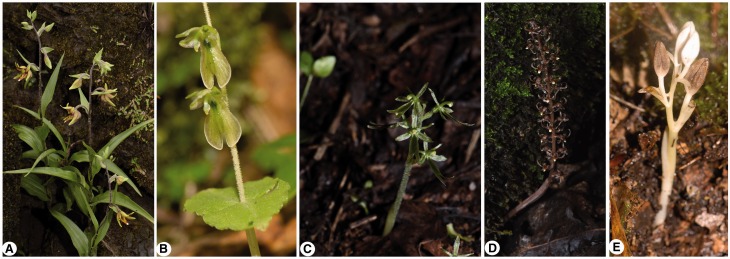
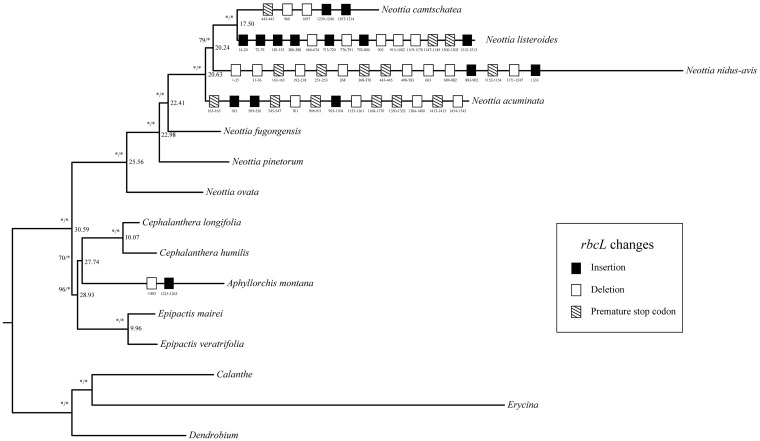
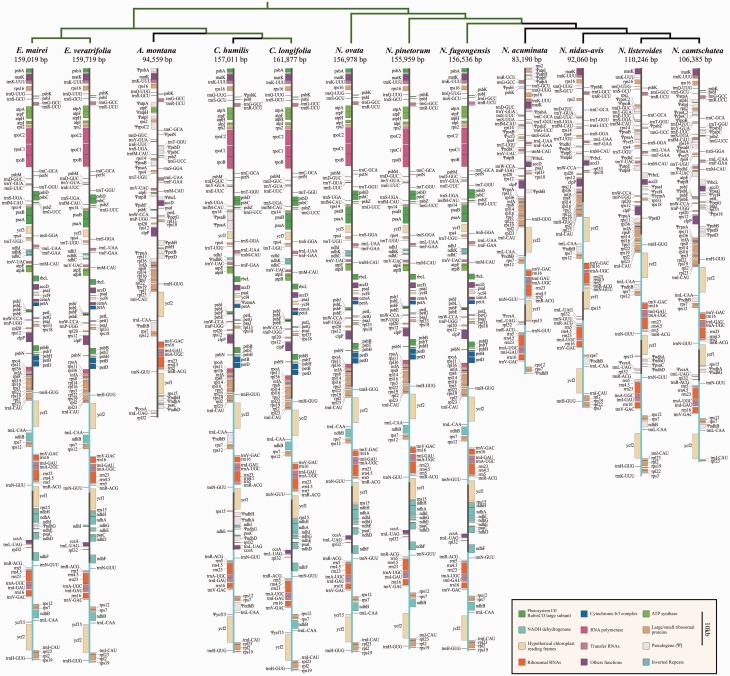
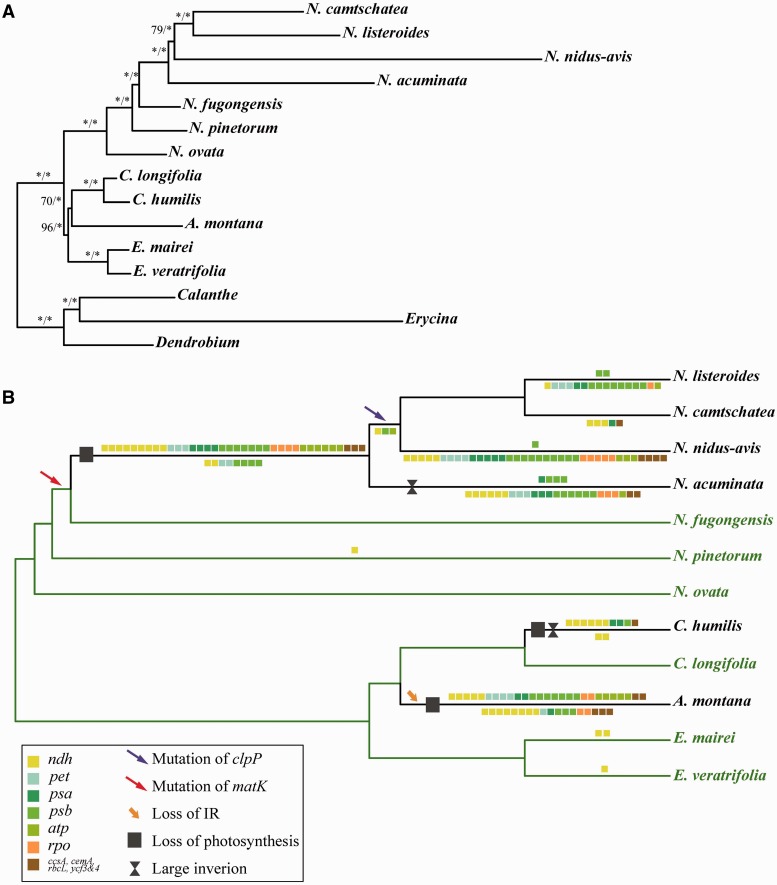
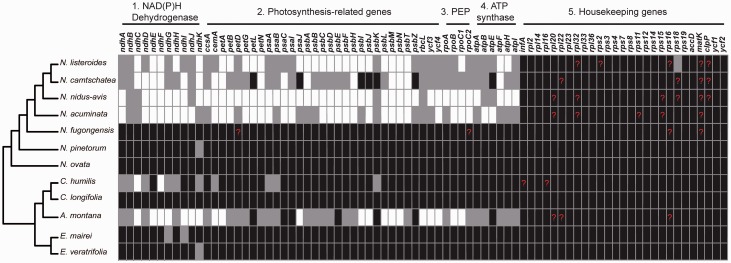
The plastid genome (plastome) of heterotrophic plants like mycoheterotrophs and parasites shows massive gene losses in consequence to the relaxation of functional constraints on photosynthesis. To understand the patterns of this convergent plastome reduction syndrome in heterotrophic plants, we studied 12 closely related orchids of three different lifeforms from the tribe Neottieae (Orchidaceae). We employ a comparative genomics approach to examine structural and selectional changes in plastomes within Neottieae. Both leafy and leafless heterotrophic species have functionally reduced plastid genome. Our analyses show that genes for the NAD(P)H dehydrogenase complex, the photosystems, and the RNA polymerase have been lost functionally multiple times independently. The physical reduction proceeds in a highly lineage-specific manner, accompanied by structural reconfigurations such as inversions or modifications of the large inverted repeats. Despite significant but minor selectional changes, all retained genes continue to evolve under purifying selection. All leafless Neottia species, including both visibly green and nongreen members, are fully mycoheterotrophic, likely evolved from leafy and partially mycoheterotrophic species. The plastomes of Neottieae span many stages of plastome degradation, including the longest plastome of a mycoheterotroph, providing invaluable insights into the mechanisms of plastome evolution along the transition from autotrophy to full mycoheterotrophy.
像菌根异养植物和寄生植物这样的异养植物的质体基因组(质体基因组)由于光合作用功能限制的放松而显示出大量基因丢失。为了了解这种异养植物中趋同质体基因组减少综合征的模式,我们研究了来自鸟巢兰族(兰科)三种不同生活型的12种近缘兰花。我们采用比较基因组学方法来研究鸟巢兰族质体基因组的结构和选择变化。有叶和无叶的异养物种在功能上都减少了质体基因组。我们的分析表明,NAD(P)H脱氢酶复合体、光系统和RNA聚合酶的基因在功能上已经多次独立丢失。物理上的减少以高度谱系特异性的方式进行,伴随着结构重排,如大的反向重复序列的倒位或修饰。尽管有显著但微小的选择变化,但所有保留的基因仍在纯化选择下继续进化。所有无叶的鸟巢兰属物种,包括明显绿色和非绿色的成员,都是完全菌根异养的,可能是从有叶和部分菌根异养的物种进化而来。鸟巢兰族的质体基因组跨越了质体基因组降解的许多阶段,包括菌根异养植物最长的质体基因组,为从自养到完全菌根异养转变过程中的质体基因组进化机制提供了宝贵的见解。