Ritschel Vibeke N, Seljeflot Ingebjørg, Arnesen Harald, Halvorsen Sigrun, Eritsland Jan, Fagerland Morten W, Andersen Geir Ø
Center for Clinical Heart Research, Oslo University Hospital, Ullevål, Oslo, Norway Center of Heart Failure Research, University of Oslo, Ullevål, Oslo, Norway Faculty of Medicine, University of Oslo, Ullevål, Oslo, Norway
Center for Clinical Heart Research, Oslo University Hospital, Ullevål, Oslo, Norway Department of Cardiology, Oslo University Hospital, Ullevål, Oslo, Norway Center of Heart Failure Research, University of Oslo, Ullevål, Oslo, Norway Faculty of Medicine, University of Oslo, Ullevål, Oslo, Norway.
J Am Heart Assoc. 2016 Jun 13;5(6):e003014. doi: 10.1161/JAHA.115.003014.
Reports on soluble interleukin-6 (IL-6) receptor (sIL-6R) and glycoprotein 130 (sgp130) in ST-elevation myocardial infarction (STEMI) are few and include a small number of patients. The aim of this study was to investigate the possible association between levels of these biomarkers in the acute phase of STEMI and future cardiovascular events.
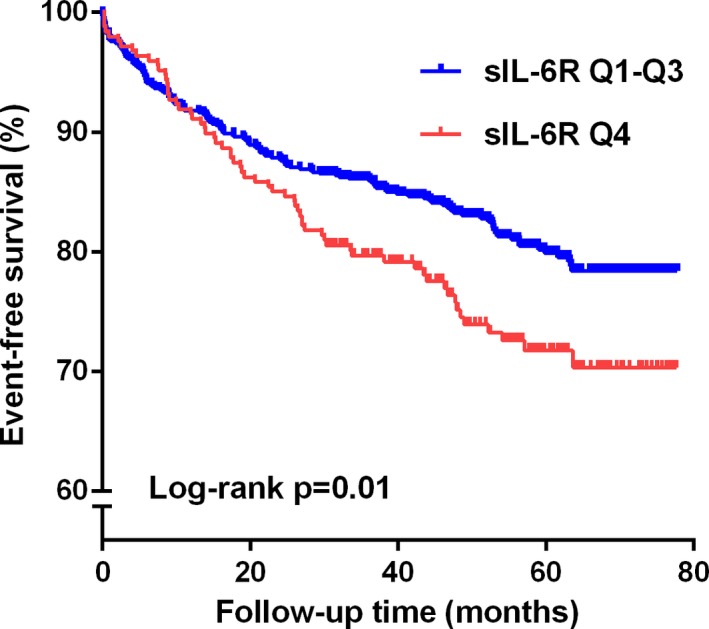
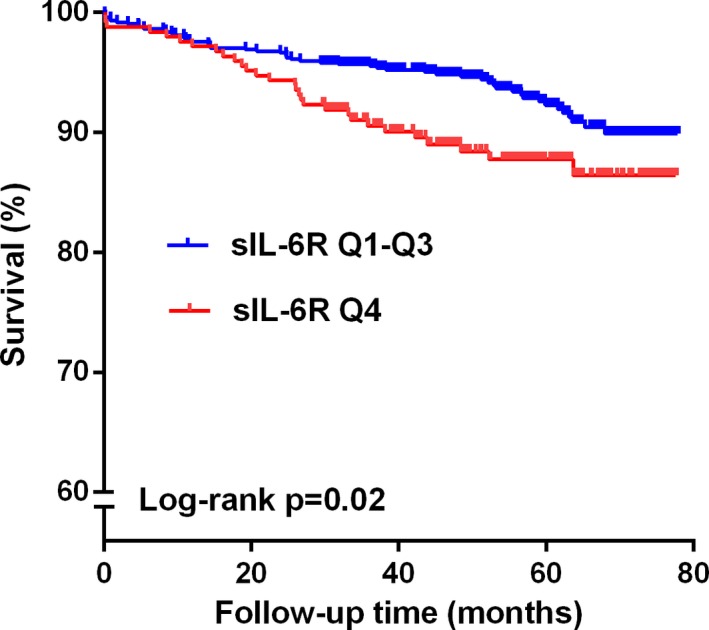
Circulating IL-6, sgp130, sIL-6R, and C-reactive protein (CRP) were measured in 989 STEMI patients during 2007-2011, and cardiovascular events were recorded during follow-up. The primary endpoint was composite of all-cause mortality, myocardial infarction, stroke, unscheduled revascularization, or rehospitalization for heart failure. Cox regression models were used to estimate hazard ratios (HRs) for cardiovascular events in relation to biomarker levels. Median levels of sIL-6R, sgp130, IL-6, and CRP measured 24 hours (median) after symptom onset were 39.2 ng/mL, 240 ng/mL, 18.8 pg/mL, and 13.7 mg/L, respectively. During a median follow-up time of 4.6 years, 200 patients (20.2%) experienced a primary endpoint, and 82 patients (8.3%) died. Patients with sIL-6R levels in the upper quartile (>47.7 ng/mL) had significantly higher risk of future adverse events (primary endpoint) and mortality compared to patients with lower levels (adjusted HR, 1.54 [1.08, 2.21]; P=0.02 and 1.81 [1.04, 3.18]; P=0.04, respectively). Neither IL-6 nor sgp130 levels were related to future events, but patients with CRP levels in the upper quartile (>31.5 mg/L) had higher risk of death.
High levels of sIL-6R were associated with future cardiovascular events and mortality in STEMI patients, suggesting an important role of the IL-6 signaling system.
关于可溶性白细胞介素-6(IL-6)受体(sIL-6R)和糖蛋白130(sgp130)在ST段抬高型心肌梗死(STEMI)中的报道较少,且纳入患者数量不多。本研究旨在探讨STEMI急性期这些生物标志物水平与未来心血管事件之间的可能关联。
在2007年至2011年期间,对989例STEMI患者测定了循环中的IL-6、sgp130、sIL-6R和C反应蛋白(CRP)水平,并在随访期间记录心血管事件。主要终点为全因死亡率、心肌梗死、中风、非计划血管重建或因心力衰竭再次住院的复合终点。采用Cox回归模型估计与生物标志物水平相关的心血管事件风险比(HRs)。症状发作后24小时(中位数)测得的sIL-6R、sgp130、IL-6和CRP的中位数水平分别为39.2 ng/mL、240 ng/mL、18.8 pg/mL和13.7 mg/L。在中位随访时间4.6年期间,200例患者(20.2%)发生主要终点事件,82例患者(8.3%)死亡。与sIL-6R水平较低的患者相比,处于上四分位数(>47.7 ng/mL)的患者未来发生不良事件(主要终点)和死亡的风险显著更高(校正后HR分别为1.54 [置信区间1.08, 2.21];P = 0.02和1.81 [置信区间1.04, 3.18];P = 0.04)。IL-6和sgp130水平均与未来事件无关,但CRP水平处于上四分位数(>31.5 mg/L)的患者死亡风险更高。
STEMI患者中高水平的sIL-6R与未来心血管事件和死亡率相关,提示IL-6信号系统具有重要作用。