Shimada Hiroyuki, Makizako Hyuma, Doi Takehiko, Tsutsumimoto Kota, Lee Sangyoon, Suzuki Takao
Department of Preventive Gerontology, Center for Gerontology and Social Science, National Center for Geriatrics and Gerontology, Obu, Japan.
National Center for Geriatrics and Gerontology, Obu, Japan.
PLoS One. 2016 Jul 14;11(7):e0158720. doi: 10.1371/journal.pone.0158720. eCollection 2016.
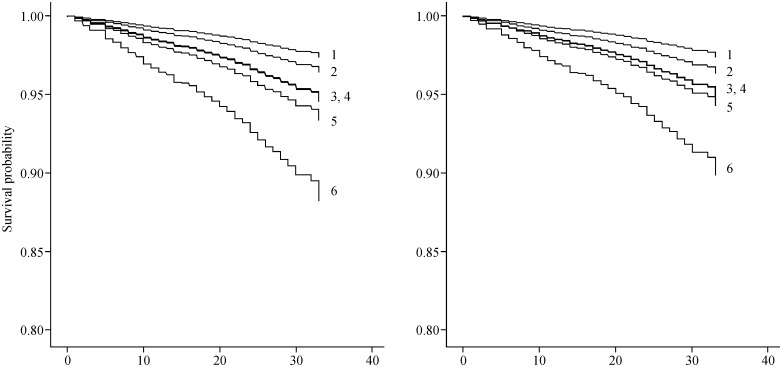
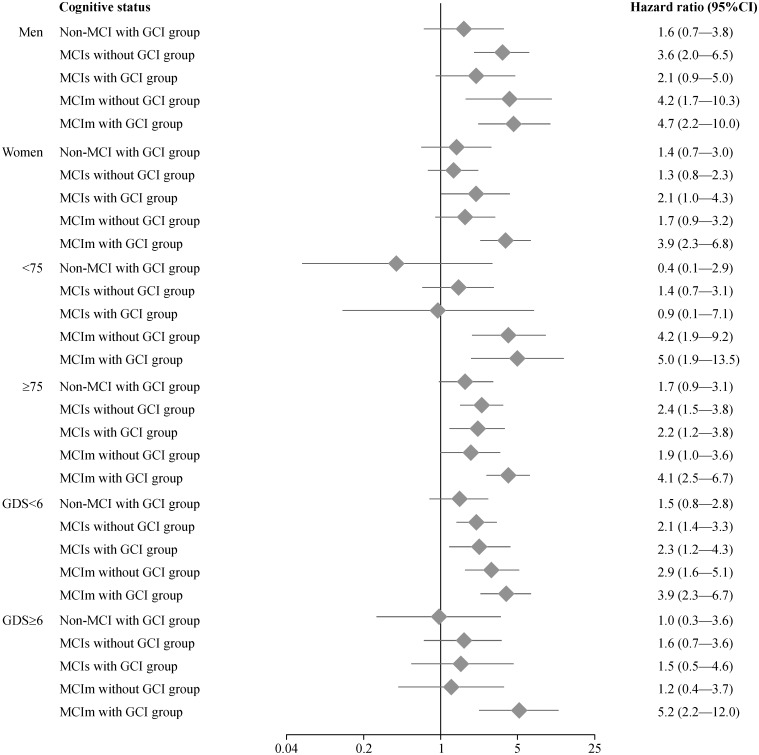
The prevalence of disability is increasing due to an expanding aging population and an increasing incidence of chronic health problems. Cognitive impairment may predict the development of disability in older adults. Therefore, we examined the association of mild cognitive impairment (MCI) and/or general cognitive impairment (GCI, defined as a Mini Mental State Examination [MMSE] score of 20-23) with the development of disability in a cohort of Japanese community-dwelling older adults. A total of 4290 participants (aged ≥65 years) enrolled in the Obu Study of Health Promotion for the Elderly were classified according to the presence and degree of cognitive impairment as follows: cognitively healthy, GCI, MCI single domain (MCIs), MCIs with GCI, MCI multiple domain (MCIm), and MCIm with GCI. MMSE scores, risk factors for dementia, and incidences of new disability were recorded. After an average of 29.5 months, 205 participants (4.8%) experienced a new onset of disability. All subtypes of cognitive impairment showed significant relationships with disability except for GCI alone. The following hazard ratios (HRs) were determined: MCIs (HR, 2.04; 95% CI, 1.39-3.00), MCIs with GCI (HR, 2.10; 95% CI, 1.21-3.62), MCIm (HR, 2.32; 95% CI, 1.39-3.85), and MCIm with GCI (HR, 4.23; 95% CI, 2.73-6.57). These results indicate that cognitive impairment may be related to an increased risk for the development of disability. Healthcare providers should implement global cognitive assessments to identify MCI and GCI and consider preventive interventions for disability, especially in older persons.
由于老龄人口不断增加以及慢性健康问题的发病率上升,残疾的患病率正在增加。认知障碍可能预示着老年人残疾的发展。因此,我们在一组日本社区居住的老年人中,研究了轻度认知障碍(MCI)和/或一般认知障碍(GCI,定义为简易精神状态检查表[MMSE]得分为20 - 23分)与残疾发展之间的关联。参加大府老年人健康促进研究的共有4290名参与者(年龄≥65岁),根据认知障碍的存在情况和程度进行如下分类:认知健康、GCI、单领域MCI(MCIs)、伴有GCI的MCIs、多领域MCI(MCIm)以及伴有GCI的MCIm。记录了MMSE得分、痴呆风险因素以及新残疾的发生率。平均29.5个月后,205名参与者(4.8%)出现了新的残疾。除了单独的GCI外,所有认知障碍亚型均与残疾表现出显著关系。确定了以下风险比(HRs):MCIs(HR,2.04;95%置信区间,1.39 - 3.00)、伴有GCI的MCIs(HR,2.10;95%置信区间,1.21 - 3.62)、MCIm(HR,2.32;95%置信区间,1.39 - 3.85)以及伴有GCI的MCIm(HR,4.23;95%置信区间,2.73 - 6.57)。这些结果表明,认知障碍可能与残疾发展风险增加有关。医疗保健提供者应进行全面的认知评估以识别MCI和GCI,并考虑针对残疾的预防干预措施,尤其是在老年人中。