Sahin Mustafa, Aydogdu Ibrahim, Akyildiz Serdar, Erdinc Munevver, Ozturk Kerem, Ogut Fatih
Department of Otolaryngology, Adnan Menderes University Medical School, Aydin, Turkey.
Department of Neurology, Ege University Medical School, Izmir, Turkey.
Clin Exp Otorhinolaryngol. 2017 Jun;10(2):193-202. doi: 10.21053/ceo.2016.00241. Epub 2016 Jul 2.
Bilateral vocal fold abductor paralysis (BVFAP) both deteriorates quality of life and may cause life-threatening respiratory problems. The aim of this study was to reduce respiratory symptoms in BVFAP patients using cricothyroid (CT) botulinum toxin (BTX) injection.
Before and 2 weeks and 4 months after bilateral BTX injection into the CT muscles under electromyography; alterations in respiratory, acoustic, aerodynamic and quality of life parameters were evaluated in BVFAP patients with respiratory distress. For the respiratory evaluation modified Borg scale and spirometry, for the voice and aerodynamic evaluations Voice Handicap Index-30 (VHI-30), GRBAS, acoustic analysis (sound pressure level, F0, jitter%, shimmer%, noise-to-harmonic ratio) and maximum phonation time and for the quality of life assessment Short Form-36 (SF-36) form were used.
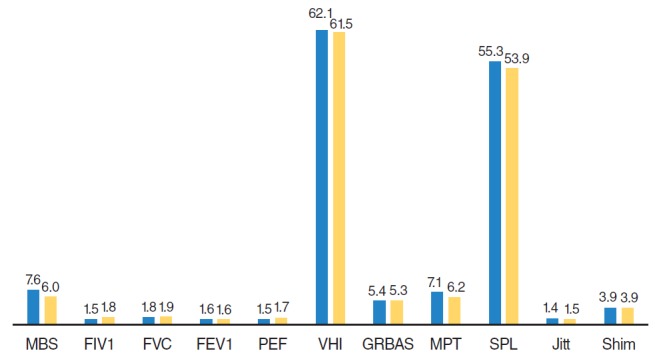
All patients were female with a mean age of 47±8.1 years. There was a mean time of 11.8±5.5 (minimum 2, maximum 23) months between BVFAP development and BTX injection. In all cases, other than one case with unknown aetiology, the cause of vocal fold paralysis was prior thyroid surgery. In total 18.6±3.1 units of BTX were applied to the CTs. In the preinjection period, and the 2nd week and 4th month after injection, the Borg dyspnea scale was 7.3/5.3/5.0, FIV1 (forced inspiratory volume in one second) was 1.7/1.7/1.8 L, peak expiratory flow (PEF) was 1.4/1.7/2.1 L/sec, maximum phonation time was 7.0/6.4/6.2 seconds and VHI-30 was 63.2/52.2/61.7 respectively. There was no significant alteration in acoustic analysis parameters. Many of the patients reported transient dysphagia within the first week. There were insignificant increases in SF-36 sub-scale values.
After BTX injection, improvements in the mean Borg score, PEF and FIV1 values and SF-36 sub-scale scores showed the restricted success of this approach. This modality may be kept in mind as a transient treatment option for patients refused persistent tracheotomy or ablative airway surgeries.
双侧声带外展麻痹(BVFAP)会降低生活质量,并可能导致危及生命的呼吸问题。本研究的目的是通过环甲肌(CT)注射肉毒杆菌毒素(BTX)来减轻BVFAP患者的呼吸症状。
在肌电图引导下对CT肌肉进行双侧BTX注射前、注射后2周和4个月;对有呼吸窘迫的BVFAP患者的呼吸、声学、空气动力学和生活质量参数的变化进行评估。呼吸评估采用改良的Borg量表和肺活量测定法,语音和空气动力学评估采用嗓音障碍指数-30(VHI-30)、GRBAS、声学分析(声压级、基频、抖动率、闪烁率、噪声谐波比)和最长发声时间,生活质量评估采用简明健康状况调查量表(SF-36)。
所有患者均为女性,平均年龄47±8.1岁。BVFAP发病与BTX注射之间的平均时间为11.8±5.5(最短2个月,最长23个月)。除1例病因不明外,所有病例声带麻痹的原因均为既往甲状腺手术。共向CT注射了18.6±3.1单位的BTX。注射前、注射后第2周和第4个月,Borg呼吸困难量表评分为7.3/5.3/5.0,一秒用力吸气量(FIV1)为1.7/1.7/1.8 L,呼气峰值流速(PEF)为1.4/1.7/2.1 L/秒,最长发声时间为7.0/6.4/6.2秒,VHI-30分别为63.2/52.2/61.7。声学分析参数无明显变化。许多患者在第一周内报告有短暂吞咽困难。SF-36子量表值有轻微增加。
BTX注射后,平均Borg评分、PEF和FIV1值以及SF-36子量表评分的改善表明该方法的成功有限。对于拒绝持续气管切开术或气道消融手术的患者,可将这种治疗方式作为一种临时治疗选择。