Xu Mei, Ren Zhenhua, Wang Xin, Comer Ashley, Frank Jacqueline A, Ke Zun-Ji, Huang Yi, Zhang Zhuo, Shi Xianglin, Wang Siying, Luo Jia
Department of Pharmacology and Nutritional Sciences, University of Kentucky College of Medicine, Lexington, KY, 40536, USA.
Pathophysiological Department, School of Basic Medicine, Anhui Medical University, Hefei, Anhui, 230032, China.
Mol Cancer. 2016 Jul 14;15(1):52. doi: 10.1186/s12943-016-0532-4.
Both epidemiological and experimental studies suggest that excessive alcohol exposure increases the risk for breast cancer and enhances metastasis/recurrence. We have previously demonstrated that alcohol enhanced the migration/invasion of breast cancer cells and cancer cells overexpressing ErbB2/HER2 were more sensitive to alcohol exposure. However, the underlying mechanisms remain unclear. This study was designed to investigate the mechanisms underlying alcohol-enhanced aggressiveness of breast cancer. Cancer stem cells (CSCs) play a critical role in cancer metastasis and recurrence.
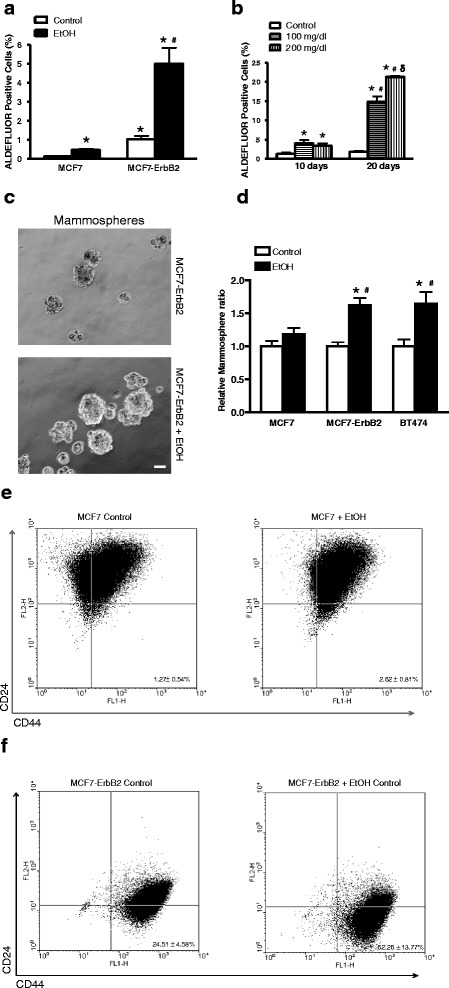
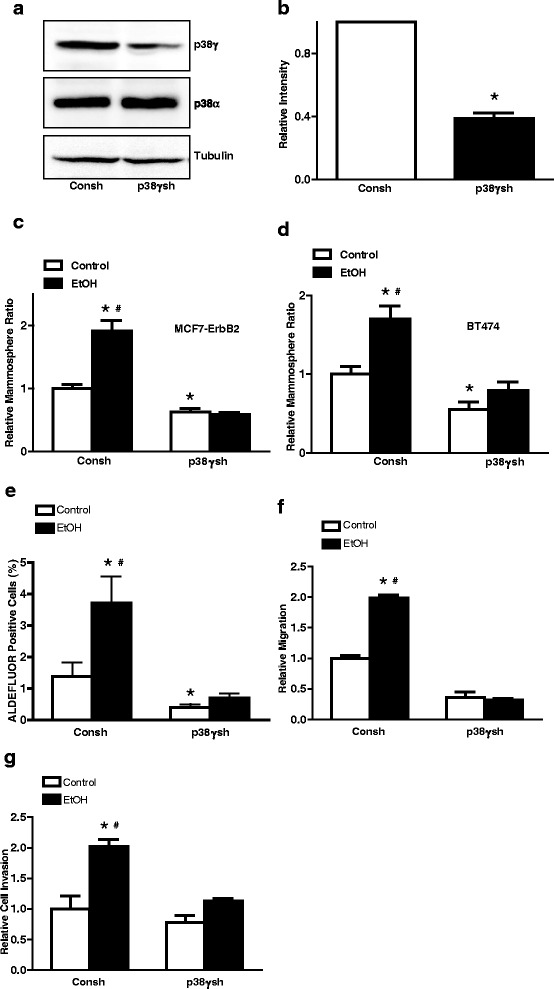
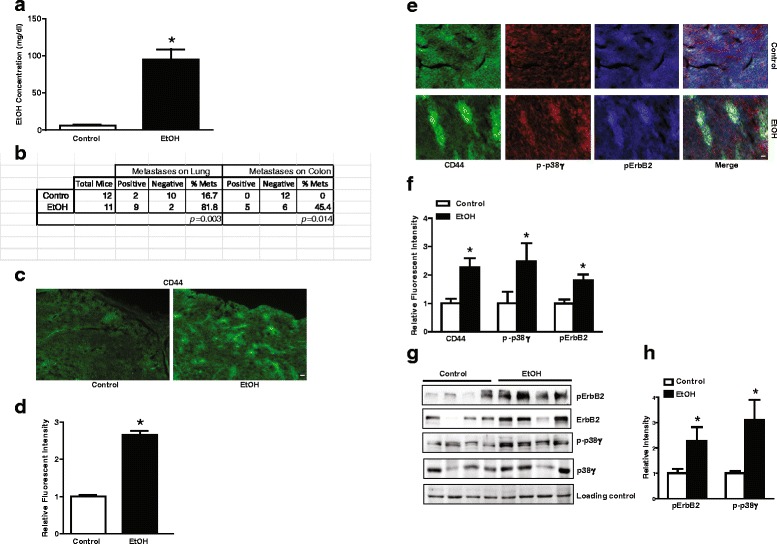
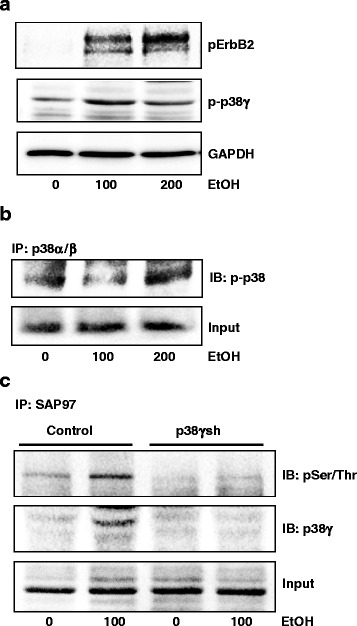
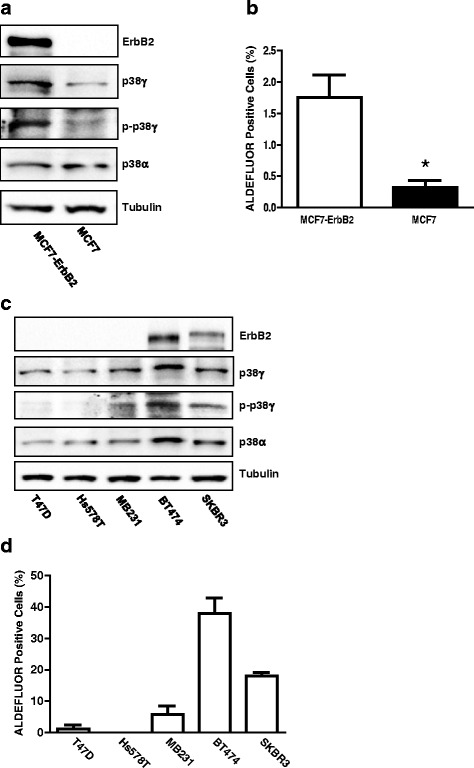
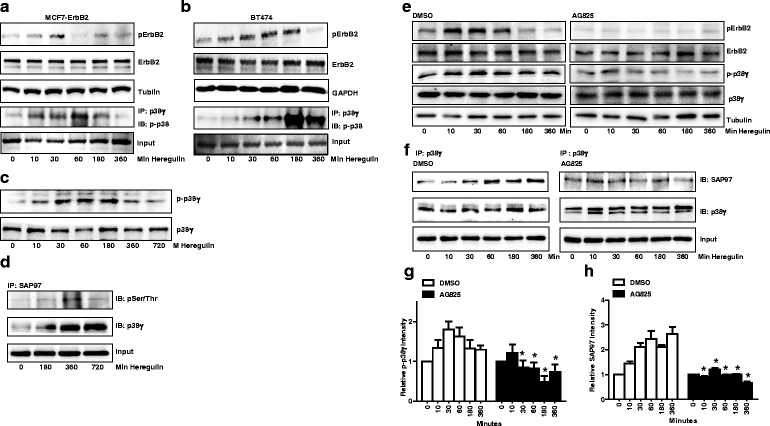
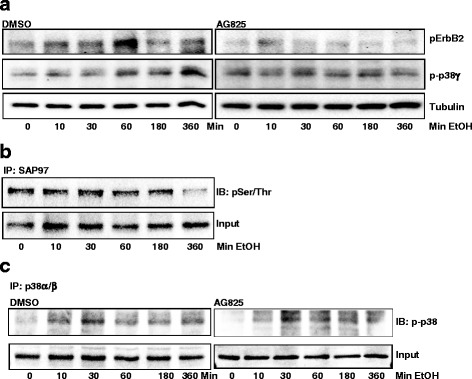
We evaluated the effect of chronic alcohol exposure on mammary tumor development/metastasis in MMTV-neu transgenic mice and investigated the cell signaling in response to alcohol exposure in breast cancer cells overexpressing ErbB2/HER2. RESULTS AND DISCUSSION: Chronic alcohol exposure increased breast cancer stem cell-like CSC population and enhanced the lung and colon metastasis in MMTV-neu transgenic mice. Alcohol exposure caused a drastic increase in CSC population and mammosphere formation in breast cancer cells overexpressing ErbB2/HER2. Alcohol exposure stimulated the phosphorylation of p38γ MAPK (p-p38γ) which was co-localized with phosphorylated ErbB2 and CSCs in the mammary tumor tissues. In vitro results confirmed that alcohol activated ErbB2/HER2 and selectively increased p-p38γ MAPK as well as the interaction between p38γ MAPK and its substrate, SAP97. However, alcohol did not affect the expression/phosphorylation of p38α/β MAPKs. In breast cancer cell lines, high expression of ErbB2 and p-p38γ MAPK was generally correlated with more CSC population. Blocking ErbB2 signaling abolished heregulin β1- and alcohol-stimulated p-p38γ MAPK and its association with SAP97. More importantly, p38γ MAPK siRNA significantly inhibited an alcohol-induced increase in CSC population, mammosphere formation and migration/invasion of breast cancer cells overexpressing ErbB2.
p38γ MAPK is downstream of ErbB2 and plays an important role in alcohol-enhanced aggressiveness of breast cancer. Therefore, in addition to ErbB2/HER2, p38γ MAPK may be a potential target for the treatment of alcohol-enhanced cancer aggressiveness.
流行病学和实验研究均表明,过量饮酒会增加患乳腺癌的风险,并促进转移/复发。我们之前已经证明,酒精会增强乳腺癌细胞的迁移/侵袭能力,且过表达ErbB2/HER2的癌细胞对酒精暴露更为敏感。然而,其潜在机制仍不清楚。本研究旨在探究酒精增强乳腺癌侵袭性的机制。癌症干细胞(CSCs)在癌症转移和复发中起着关键作用。
我们评估了慢性酒精暴露对MMTV-neu转基因小鼠乳腺肿瘤发生/转移的影响,并研究了过表达ErbB2/HER2的乳腺癌细胞对酒精暴露的细胞信号传导反应。结果与讨论:慢性酒精暴露增加了MMTV-neu转基因小鼠中乳腺癌干细胞样CSC群体,并增强了肺和结肠转移。酒精暴露导致过表达ErbB2/HER2的乳腺癌细胞中CSC群体和乳腺球形成急剧增加。酒精暴露刺激了p38γ丝裂原活化蛋白激酶(p-p38γ)的磷酸化,其在乳腺肿瘤组织中与磷酸化的ErbB2和CSCs共定位。体外实验结果证实,酒精激活了ErbB2/HER2,并选择性地增加了p-p38γ MAPK以及p38γ MAPK与其底物SAP97之间的相互作用。然而,酒精并未影响p38α/β丝裂原活化蛋白激酶的表达/磷酸化。在乳腺癌细胞系中,ErbB2和p-p38γ MAPK的高表达通常与更多的CSC群体相关。阻断ErbB2信号传导消除了这里调节蛋白β1和酒精刺激的p-p38γ MAPK及其与SAP97的关联。更重要的是,p38γ MAPK小干扰RNA显著抑制了酒精诱导的过表达ErbB2的乳腺癌细胞中CSC群体增加、乳腺球形成以及迁移/侵袭。
p38γ MAPK是ErbB