Larsen Kristian Traberg, Huang Tao, Larsen Lisbeth Runge, Olesen Line Grønholt, Andersen Lars Bo, Møller Niels Christian
Centre of Research in Childhood Health (RICH), Department of Sports Science and Clinical Biomechanics, University of Southern Denmark, Odense, Denmark.
Department of Physical Education, Shanghai Jiao Tong University, Shanghai, China.
BMC Pediatr. 2016 Jul 15;16:91. doi: 10.1186/s12887-016-0627-5.
Many weight-loss programs in children are performed without specific foci on training both physical fitness and motor skills. The aim of this study was to describe the effect of a one-year weight-loss program on children's motor skills and physical fitness.
Participants included 115 overweight fifth-grade children (12.0 years) randomized into either a Day-Camp Intervention Arm (DCIA), with a subsequent family-based support program or a low-intense Standard Intervention Arm (SIA). Physical fitness was assessed by vertical jump, hand grip strength, and a progressive cardio-respiratory fitness test. Motor skills were assessed by the Movement Assessment Battery for Children - second edition (M-ABC-2), age band 3.
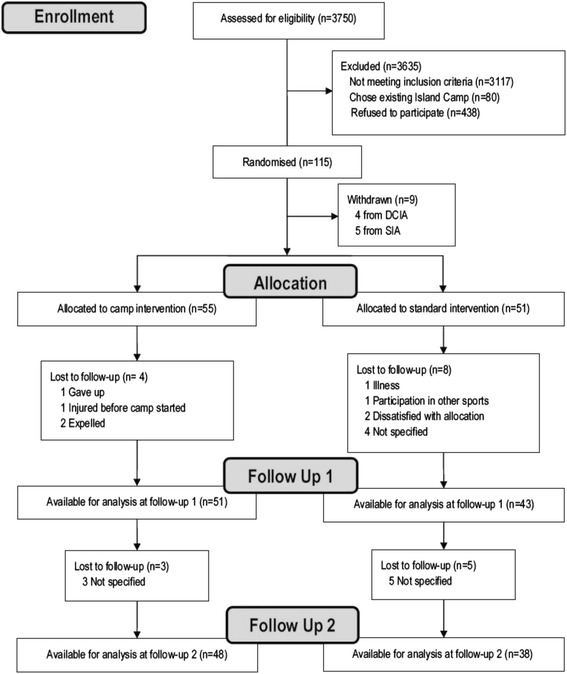
Loss to follow-up after 52 weeks was 19 % and 32 % in the DCIA and SIA, respectively. Balance skills were improved post-camp, but not after 52 weeks in children from the DCIA compared to the SIA. Contrary to the expected, children from the SIA improved aiming and catching skills relative to the DCIA children. Overall z-scores of the physical fitness components and cardio-respiratory fitness improved more in children from the DCIA compared to children from the SIA.
In conclusion, the day-camp intervention led to improvements in physical fitness but not in motor skills compared to the standard intervention. Including both motor skills and physical fitness could advantageously be considered in future immersive intervention programmes.
Clinicaltrials NCT01574352, March 26, 2012 (retrospectively registered).
许多儿童减肥项目并未特别注重体能和运动技能的训练。本研究旨在描述一项为期一年的减肥项目对儿童运动技能和体能的影响。
参与者包括115名超重的五年级儿童(12.0岁),他们被随机分为日间营地干预组(DCIA),后续有基于家庭的支持项目,或低强度标准干预组(SIA)。通过纵跳、握力和渐进性心肺适能测试来评估体能。通过儿童运动评估量表第二版(M-ABC-2)3岁年龄组来评估运动技能。
52周后,DCIA组和SIA组的失访率分别为19%和32%。与SIA组相比,DCIA组儿童在营地结束后平衡技能有所提高,但52周后没有。与预期相反,SIA组儿童相对于DCIA组儿童在瞄准和接球技能方面有所提高。与SIA组儿童相比,DCIA组儿童体能成分和心肺适能的总体z分数改善更多。
总之,与标准干预相比,日间营地干预导致体能改善,但运动技能没有改善。在未来的沉浸式干预项目中,可以考虑同时纳入运动技能和体能训练。
Clinicaltrials NCT01574352,2012年3月26日(追溯注册)。