
一款促进超重或肥胖成年人增加健康食品摄入量的严肃游戏:随机对照试验。
A Serious Game to Increase Healthy Food Consumption in Overweight or Obese Adults: Randomized Controlled Trial.
作者信息
Blackburne Tegan, Rodriguez Alexandra, Johnstone Stuart John
机构信息
Brain and Behaviour Research Institute, School of Psychology, University of Wollongong, Wollongong, Australia.
出版信息
JMIR Serious Games. 2016 Jul 13;4(2):e10. doi: 10.2196/games.5708.
BACKGROUND
Obesity is a growing global issue that is linked to cognitive and psychological deficits.
OBJECTIVE
This preliminary study investigated the efficacy of training to improve inhibitory control (IC), a process linked to overeating, on consumption and cognitive control factors.
METHODS
This study utilized a multisession mobile phone-based intervention to train IC in an overweight and obese population using a randomized waitlist-control design. A combination of self-assessment questionnaires and psychophysiological measures was used to assess the efficacy of the intervention in terms of improved general IC and modified food consumption after training. Attitudes toward food were also assessed to determine their mediating role in food choices. A total of 58 participants (47 female) completed 2 assessment sessions 3 weeks apart, with 2 weeks of intervention training for the training group during this time. The groups did not differ in baseline demographics including age, body mass index, and inhibitory control.
RESULTS
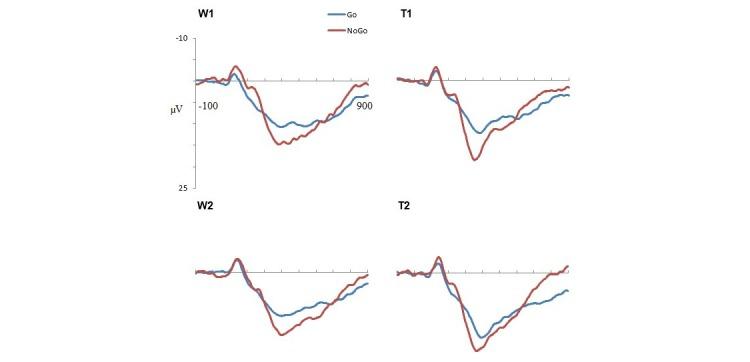
Inhibitory control ability improved across the training sessions, with increases in P3 amplitude implying increased cognitive control over responses. Inhibitory control training was associated with increased healthy and reduced unhealthy food consumption in a taste test and in the week following training, as measured by the Healthy Eating Quiz and the food consumption test. Cognitive restraint was enhanced after training for the training but not the waitlist condition in the Three-Factor Eating Questionnaire, implying that attempts to avoid unhealthy foods in the future will be easier for the training group participants.
CONCLUSIONS
Inhibitory control training delivered via a purpose-designed mobile phone app is easy to complete, is convenient, and can increase cognitive restraint and reduce unhealthy food consumption.
TRIAL REGISTRATION
Australian New Zealand Clinical Trials Registry ACTRN12616000263493; http://www.ANZCTR.org.au/ACTRN12616000263493.aspx (Archived by WebCite at http://www.webcitation.org/6ioHjGING).
背景
肥胖是一个日益严重的全球性问题,与认知和心理缺陷有关。
目的
这项初步研究调查了训练对改善抑制控制(IC)的效果,抑制控制是一个与暴饮暴食相关的过程,该训练针对消费和认知控制因素展开。
方法
本研究采用多阶段基于手机的干预措施,通过随机等待列表对照设计,对超重和肥胖人群进行抑制控制训练。使用自我评估问卷和心理生理测量相结合的方法,评估干预措施在训练后改善一般抑制控制和改变食物消费方面的效果。还评估了对食物的态度,以确定其在食物选择中的中介作用。共有58名参与者(47名女性)相隔3周完成了2次评估,在此期间,训练组进行了为期2周的干预训练。两组在包括年龄、体重指数和抑制控制在内的基线人口统计学特征上没有差异。
结果
在整个训练过程中,抑制控制能力得到改善,P3波幅增加意味着对反应的认知控制增强。在味觉测试和训练后的一周内,通过健康饮食问卷和食物消费测试测量发现,抑制控制训练与健康食物消费增加和不健康食物消费减少有关。在三因素饮食问卷中,训练组训练后认知克制增强,而等待列表组则没有,这意味着训练组参与者未来避免不健康食物会更容易。
结论
通过专门设计的手机应用程序进行的抑制控制训练易于完成,方便快捷,并且可以增强认知克制,减少不健康食物的消费。
试验注册
澳大利亚新西兰临床试验注册中心ACTRN12616000263493;http://www.ANZCTR.org.au/ACTRN12616000263493.aspx(由WebCite存档于http://www.webcitation.org/6ioHjGING)


 Zotero 插件