School of Korean Medicine, Pusan National University, Yangsan 626-870, Korea.
Department of Microbiology, Pusan National University, Busan 609-735, Korea.
Sci Rep. 2016 Jul 15;6:29956. doi: 10.1038/srep29956.
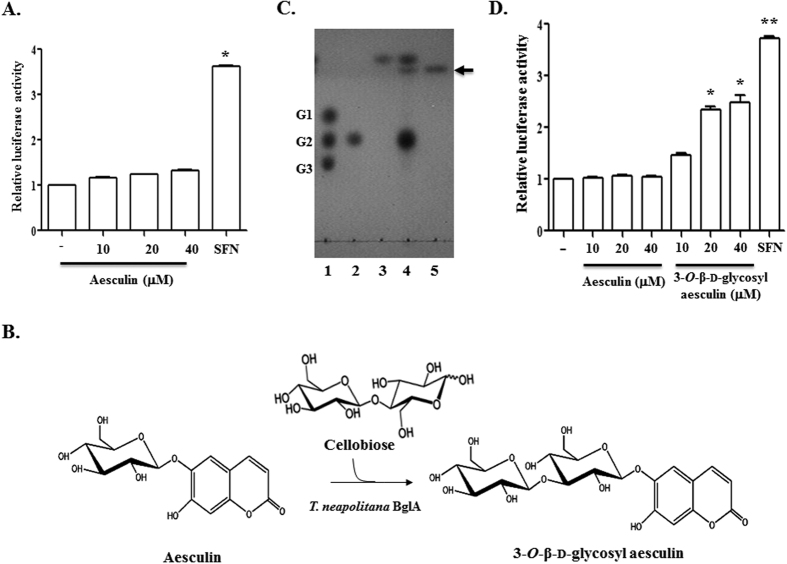
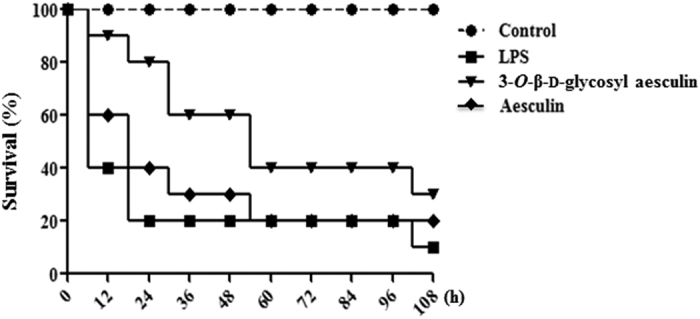
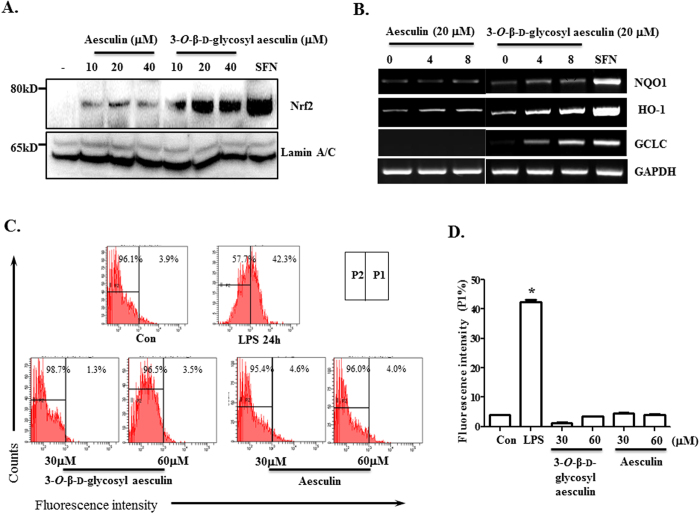
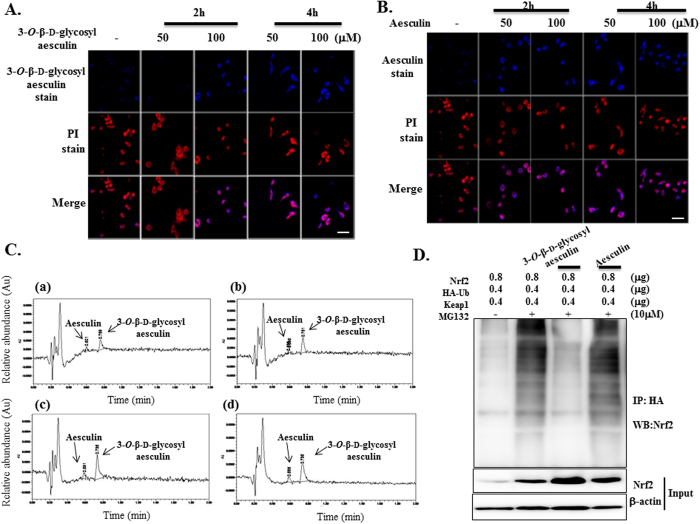
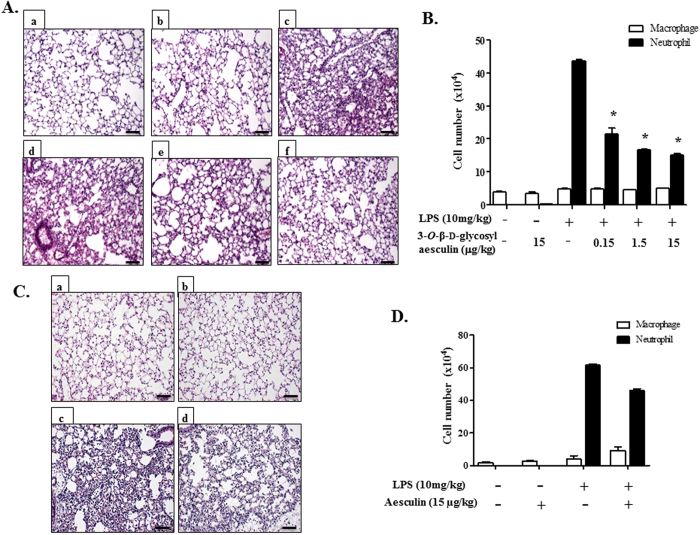
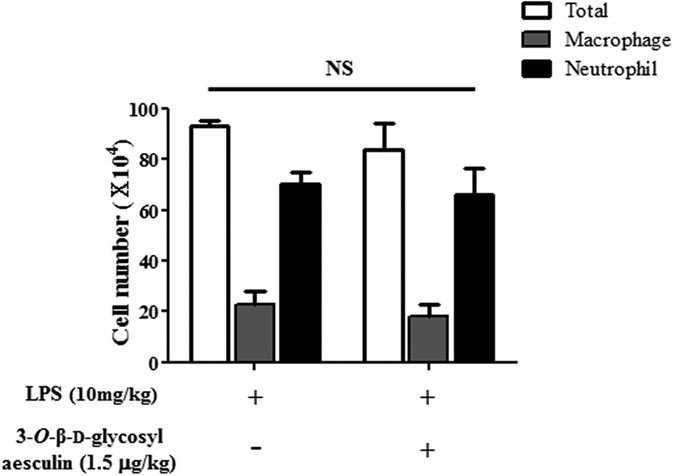
Since aesculin, 6,7-dihydroxycoumarin-6-O-β-glucopyranoside, suppresses inflammation, we asked whether its anti-inflammatory activity is associated with the activation of nuclear factor-E2-related factor 2 (Nrf2), a key anti-inflammatory factor. Our results, however, show that aesculin marginally activated Nrf2. Since glycosylation can enhance the function of a compound, we then asked whether adding a glucose makes aesculin activate Nrf2. Our results show that the glycosylated aesculin, 3-O-β-d-glycosyl aesculin, robustly activated Nrf2, inducing the expression of Nrf2-dependent genes, such as heme oxygenase-1, glutamate-cysteine ligase catalytic subunit, and NAD(P)H quinone oxidoreductase 1 in macrophages. Mechanistically, 3-O-β-d-glycosyl aesculin suppressed ubiquitination of Nrf2, retarding degradation of Nrf2. Unlike aesculin, 3-O-β-d-glycosyl aesculin significantly suppressed neutrophilic lung inflammation, a hallmark of acute lung injury (ALI), in mice, which was not recapitulated in Nrf2 knockout mice, suggesting that the anti-inflammatory function of the compound largely acts through Nrf2. In a mouse model of sepsis, a major cause of ALI, 3-O-β-d-glycosyl aesculin significantly enhanced the survival of mice, compared with aesculin. Together, these results show that glycosylation could confer the ability to activate Nrf2 on aesculin, enhancing the anti-inflammatory function of aesculin. These results suggest that glycosylation can be a way to improve or alter the function of aesculin.
由于七叶亭-6,7-二羟基香豆素-6-O-β-D-吡喃葡萄糖苷抑制炎症,我们询问其抗炎活性是否与核因子-E2 相关因子 2 (Nrf2) 的激活有关,Nrf2 是一种关键的抗炎因子。然而,我们的结果表明七叶亭苷仅轻度激活 Nrf2。由于糖基化可以增强化合物的功能,我们随后询问添加葡萄糖是否会使七叶亭苷激活 Nrf2。我们的结果表明,糖苷化的七叶亭苷 3-O-β-D-葡萄糖苷七叶亭苷可强烈激活 Nrf2,诱导 Nrf2 依赖性基因的表达,如巨噬细胞中的血红素加氧酶-1、谷氨酰胺半胱氨酸连接酶催化亚基和 NAD(P)H 醌氧化还原酶 1。从机制上讲,3-O-β-D-葡萄糖苷七叶亭苷抑制 Nrf2 的泛素化,从而延缓 Nrf2 的降解。与七叶亭苷不同,3-O-β-D-葡萄糖苷七叶亭苷显著抑制中性粒细胞性肺炎症,这是急性肺损伤 (ALI) 的标志,在 Nrf2 敲除小鼠中并未重现,表明该化合物的抗炎功能在很大程度上通过 Nrf2 发挥作用。在脓毒症(ALI 的主要病因)的小鼠模型中,与七叶亭苷相比,3-O-β-D-葡萄糖苷七叶亭苷显著提高了小鼠的存活率。总之,这些结果表明糖基化可以赋予七叶亭苷激活 Nrf2 的能力,增强七叶亭苷的抗炎功能。这些结果表明糖基化可以是改善或改变七叶亭苷功能的一种方式。